
Dreams under anesthesia will become less frightening for patients
The operating room is the last place where a person expects a good sleep. But a new study by American scientists has shown that doctors can gently nudge a patient’s brain toward dreaming during emergence from general anesthesia. And most surprisingly, almost all of these dreams turn out to be pleasant. For many people, it is the anesthesia rather than the surgery itself that causes the greatest fear. If we can learn to control what a person experiences during those minutes, the surgical experience could become noticeably less traumatic — without a single additional pill.
How Dreams Under Anesthesia Differ From Awareness During Surgery
First, it’s important to dispel the main fear. Dreams under anesthesia almost never transition into a state where a person becomes aware of what’s happening in the operating room during the procedure itself. Not a single patient in the study reported awareness of events during surgery.
This is about a different phenomenon. For most people, anesthesia feels like an instant — you close your eyes, and the operation is already over. But the brain doesn’t necessarily experience this lost time as complete emptiness. Some people go through dream-like states under anesthesia while remaining completely cut off from the outside world.
How the Five-Step Protocol for Controlling Dreams Under Anesthesia Works
Researchers tested a special methodology designed to increase the chances that a patient will see and remember a dream. It consists of five simple elements:
- before surgery, the patient is told they might have a dream and that they will be asked about it after waking up;
- toward the end of the operation, doctors use a special agent so the person emerges from anesthesia gradually;
- brain activity is monitored throughout using EEG;
- at the end of the operation, any stimulation is minimized for at least 10 minutes;
- the patient is asked about dreams as quickly as possible after waking up.
The idea is to let the brain gently surface from the depths of anesthesia rather than yanking it out abruptly. A similar principle of careful brain state management can be found in other experiments, such as when scientists attempt to control people’s dreams.
Why Operating Rooms Are Always Noisy
The most difficult part turned out to be neither the anesthesia nor the equipment. The hardest thing was ensuring 10 minutes of silence and calm before awakening. Doctors managed this in only 14% of cases.
The reason is that the operating room is a very noisy place. Patients are being moved, breathing tubes are checked, monitors beep continuously, and staff are already preparing for the next operation. Under such conditions, carving out ten quiet minutes is a luxury.
But when this period was successfully achieved, the effect was dramatic. Of 452 surveyed patients, 69% reported dreaming. And in a small group of 57 people who received all five steps of the protocol exactly as planned, dream recall rose to 93%.
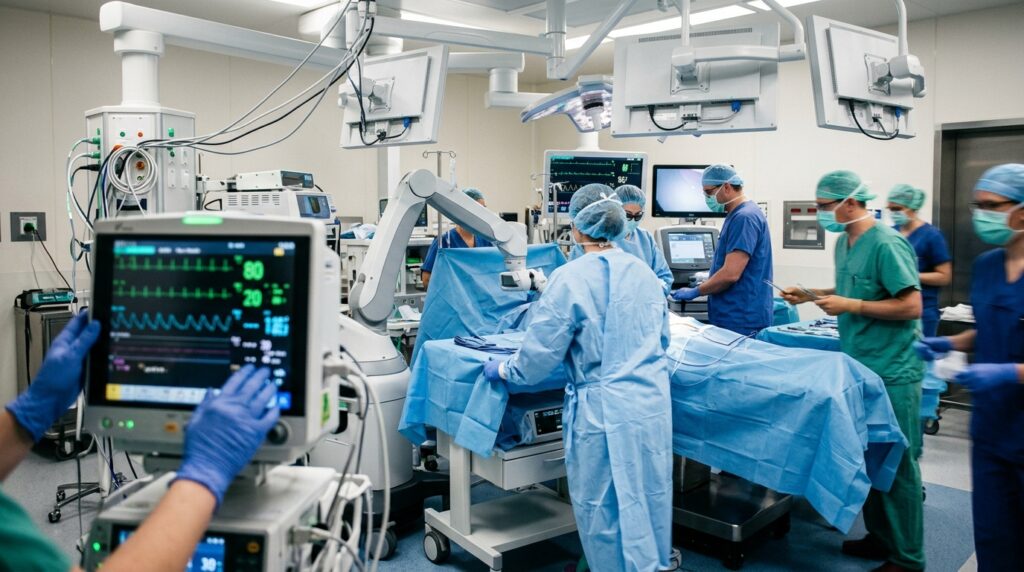
The operating room is a noisy and active place where it’s difficult to ensure complete silence
What the Dreams Under Anesthesia Were Like
These dreams were almost never related to the surgery. Most often they were mundane and everyday — about family, friends, work, or school. Surgery-related dreams did occur, but rarely.
Even more interesting was their emotional tone. Among patients who rated the mood of their dream, 86% described it as positive, and no one described a distressing, negative dream. Those who had dreams also rated the quality of their sleep under anesthesia higher than the others.
In the full group of 57 people, the picture was even more striking — 86% remembered a dream with content, and only 7% recalled no dream at all. In other words, structured calm truly works as a gentle switch toward dreaming.
Do Dreams Help Patients Recover Faster After Surgery
Here the authors honestly outline the limitations. In a subgroup of 106 female patients who underwent breast biopsy or tumor removal, those who dreamed did not recover faster. They did not use fewer painkillers or anti-nausea medications.

A pleasant dream improves the psychological experience but does not speed up physical recovery
In other words, a pleasant dream does not accelerate physical recovery. Its benefit is purely psychological. According to the researchers, previous reports indicated a reduction in symptoms of post-traumatic stress, depression, and anxiety after dreams under anesthesia. And the key ingredient may be something extremely simple — those very 10 minutes of silence during emergence from anesthesia.
It turns out that to improve the anesthesia experience, sometimes you need not to add interventions but, on the contrary, to remove the unnecessary ones. Let the brain calmly emerge from deep sleep without disturbing it with noise and unnecessary actions.
It’s worth remembering that this is still an early study, published in the journal Anesthesiology, and it primarily proves the connection between calm and pleasant dreams rather than a therapeutic effect. Perhaps the most frightening part of surgery for many people will become a little less scary thanks to a simple rule — a few minutes of silence before awakening. This is definitely a direction worth watching.