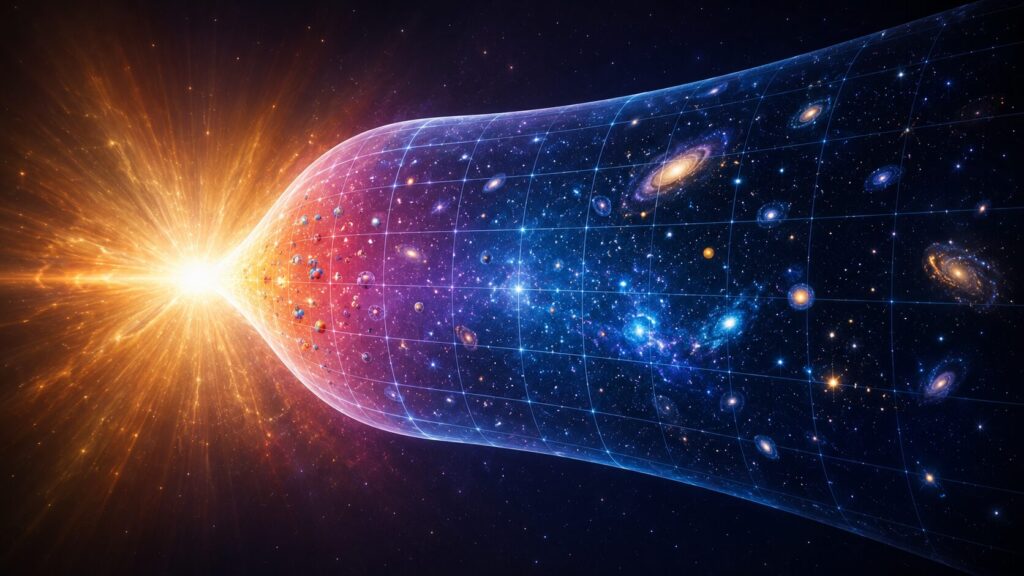
Humanity continues to uncover the strangest mysteries of the Universe
Humanity has long had a rough understanding of how our Universe was born. However, many nuances still remain hidden from scientists. It’s not just the limitations of Earth-based science that play a role, but also the peculiarities of the flow of time in space, which prevent us from learning the true origin story of many celestial bodies. Fortunately, the ALMA telescope has finally brought us closer to solving one of the oldest mysteries that had remained unsolved for 700 million years after the Big Bang.
Why Neutral Gas of the Early Universe Remained Invisible for So Long
Spoiler alert: ALMA did not discover aliens from other planets. It found neutral gas that formed the first stars, which may be older than our galaxy. But why is this so important?
For decades, scientists have been able to observe stars and hot ionized gas in distant galaxies, gradually reconstructing chapters of cosmic history. But one of the key components of galaxy evolution remained hidden — neutral gas, which serves as the direct fuel for star formation.
It is precisely from this reservoir that new stars are born, making it centrally important for understanding how the first galaxies assembled and evolved, including our own. The problem is that even such powerful observatories as James Webb and Hubble are unable to directly detect this neutral component.
Because of this, scientists had to rely on indirect indicators that can originate from multiple sources. This created uncertainty: it was unclear what conditions actually prevailed inside ancient galaxies. At enormous distances, the task only became more complicated — weak signals became increasingly harder to distinguish from background noise.
How ALMA Caught a Rare Oxygen Signal from the Cosmic Dawn Era
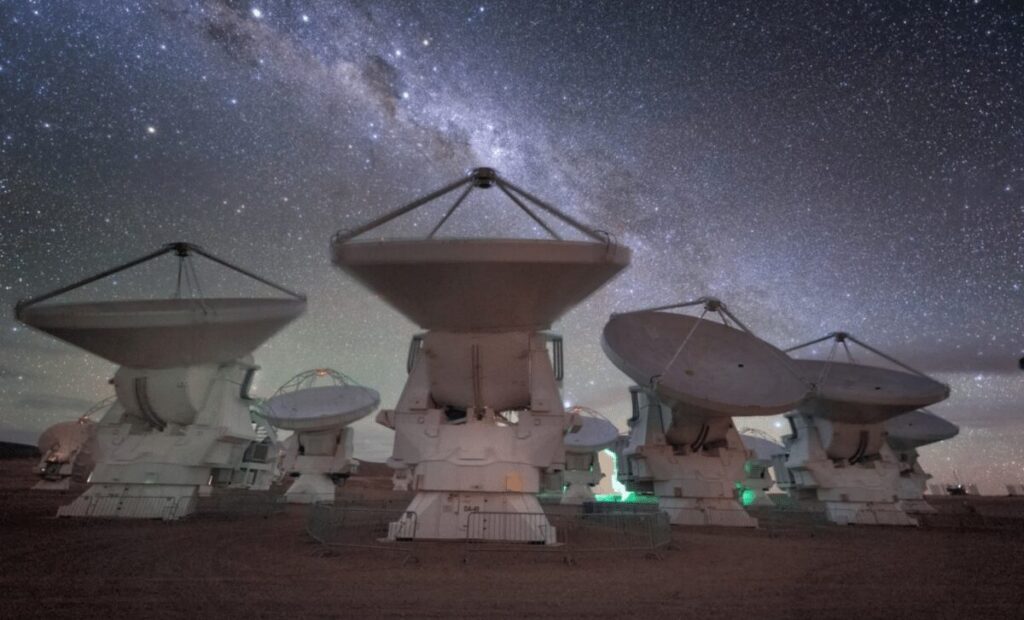
This is the ALMA telescope itself
An international team of researchers focused on four typical star-forming galaxies from an era when the Universe was less than a billion years old. Using the ALMA radio telescope in Chile, scientists managed to detect in all four galaxies the emission line [O I] at 145 micrometers — that is, the glow of neutral oxygen atoms.
This signal is considered one of the most direct indicators of neutral gas available to astronomers. Unlike the popular [C II] line, which can originate from both neutral and ionized regions, the oxygen signal provides a cleaner picture of the material actually involved in star birth.
To verify their conclusions, the researchers additionally studied the [N II] line at 205 micrometers, which traces only ionized gas. This signal turned out to be very weak — meaning that the main emission was indeed coming from neutral gas. Thus, the team for the first time confidently isolated and studied that very elusive fuel inside distant galaxies.
What the Combined Data from ALMA and James Webb Revealed
The study was published in the Astrophysical Journal, and in it, ALMA observations were combined with data from the James Webb telescope. This allowed scientists to study in finest detail the physical and chemical properties of gas inside ancient galaxies.
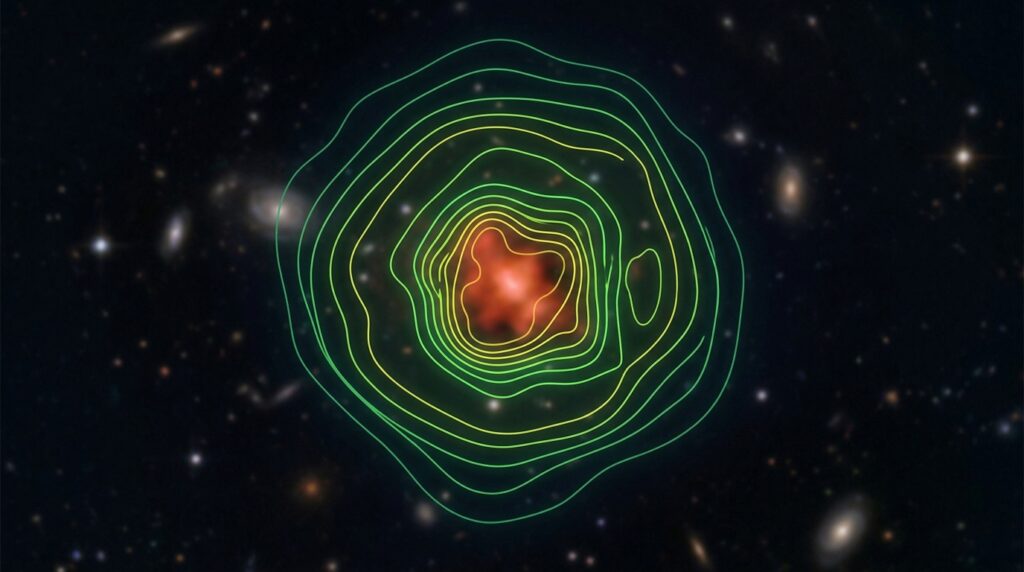
Galaxy A1689-zD1, which we see 700 million years after the Big Bang
The analysis showed that the neutral gas in these galaxies was extraordinarily dense — comparable in density to modern starburst galaxies, some of the most productive “star factories” in the Universe. At the same time, the surrounding radiation fields turned out to be less intense than is typical for starbursts.
This paints a portrait of early galaxies as compact, gas-rich systems capable of sustaining vigorous star formation under conditions markedly different from modern ones. By comparing oxygen and carbon signals, scientists were also able to more accurately interpret previously collected data on the [C II] line. It appears that many early galaxies contained large reserves of dense neutral gas — an ideal environment for rapid stellar growth.
The Most Distant Direct Detection of Neutral Gas in History
The significance of the discovery extends far beyond the four galaxies studied. By creating a direct method of searching for neutral gas at enormous distances, the researchers have opened a new way to study how galaxies formed during the earliest epochs of the Universe.
As Associate Professor Yoshinobu Fudamoto emphasized, this is the most distant direct detection of neutral gas in typical star-forming galaxies to date. Moreover, the new method allows a fresh look at the vast archives of already collected [C II] line observations and uses them as a probe for studying neutral gas in the early Universe.
Simply put, scientists have gained the ability to go back to old measurements and extract from them what previously drowned in uncertainty. One of the most widely used tools in observational astronomy has effectively become much more powerful.
Neutral Gas as Fuel for the First Stars
The implications of this work may shape future research on the early Universe for years to come. By proving the effectiveness of the [O I] line at 145 micrometers, scientists have paved a new path to studying one of the most elusive components of young galaxies.
As Dr. Akio K. Inoue noted, this work makes the oxygen line a working tool for studying hidden gas and opens a new window into the “fuel” of star formation. Further sky surveys should significantly expand the sample — for now, we are talking about just four galaxies.
By combining data from ALMA, James Webb, and future observatories, astronomers hope to compile a complete chronology of how galaxies accumulated gas, gave birth to stars, and transformed into the giant structures we see today. Each new detection brings us closer to answering the fundamental question: how did the first galaxies emerge from the aftermath of the Big Bang and eventually give rise to systems like our Milky Way.