Pigeons bob their heads when walking not because they’re cool — there’s a more important reason
When walking, pigeons don’t actually nod their heads — they hold them as still as possible for as long as they can, then thrust them forward in a quick jerk. From the side, it does look like funny nodding, but behind it lies an elegant solution to the problem of vision during constant walking.
Pigeons Don’t Actually Nod When Walking
If you film a walking pigeon in slow motion, the picture stops looking like rhythmic bobbing. The bird makes two distinct movements that we mistakenly merge into one. First, the pigeon’s head freezes in the air while the body continues moving forward beneath it. Then the head catches up with the body in a sharp jerk and freezes again in a new position.
It turns out that the pigeon’s head moves not smoothly but in jumps: a long pause of stillness, then a quick thrust forward, then another pause. These pauses and jerks alternate with each step, which is why at normal speed it seems to us that the bird is continuously nodding. This was explained by the authors at The Guardian.
Why Pigeons Hold Their Head Still When Walking
The main reason is image stabilization on the retina. The eye can only distinguish details well when the image in front of it isn’t blurred. If the head moves smoothly together with the body, the surrounding world “drifts,” and the brain has a harder time picking out something useful from this flow. For example, it becomes difficult to spot food on the ground, approaching danger, or nearby companions.
By freezing, the pigeon essentially takes a clear photograph of the world. While the head is stationary, the image on the retina stays in place, and the bird has time to examine everything around it. The sharp thrust of the head forward takes very little time — the brain simply ignores this blurred interval for a moment, just as we don’t notice the blur when we quickly shift our gaze from one object to another.
Why Humans Don’t Need Gaze Stabilization When Walking
Humans have their own mechanism for image stabilization, and it works differently. When we walk or turn our heads, our eyes automatically move in the opposite direction, compensating for the movement. This happens thanks to the connection between the inner ear and eye muscles, and we don’t even notice it.
A pigeon’s eyes are located on the sides of its head and can hardly rotate as freely as ours. That’s why it’s easier for the bird to stabilize not the eye inside the head, but the entire head relative to the surrounding world. Hence the strategy of keeping the head still for as long as possible and then quickly repositioning it to a new location.
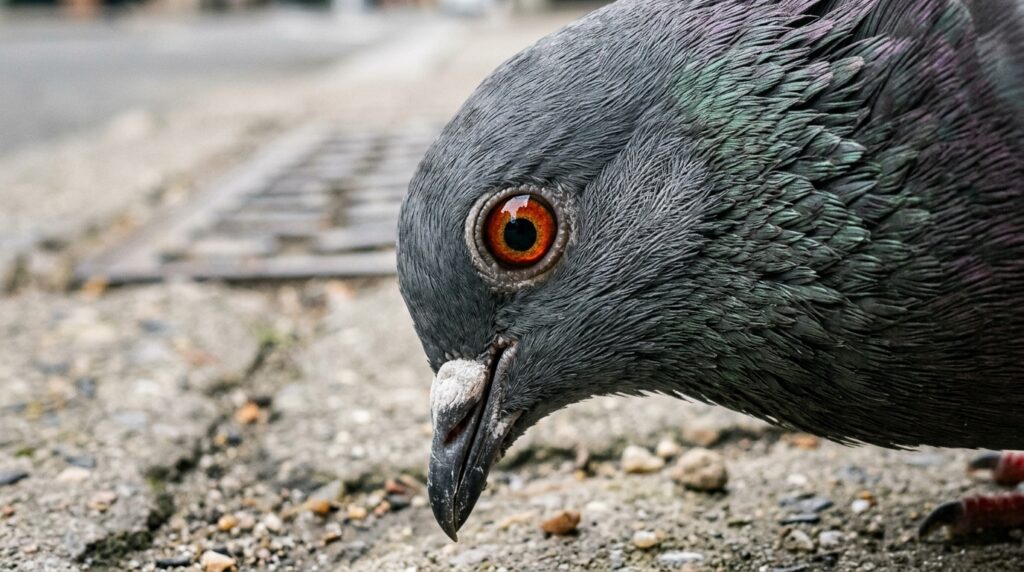
A pigeon’s eyes look sideways and barely rotate, so the bird stabilizes its entire head
How Scientists Studied Pigeon Head-Bobbing
To understand that it was specifically about vision rather than walking itself, researchers placed pigeons on a treadmill. If the bird walked in place but the surrounding scene didn’t move, the bobbing almost disappeared. As soon as the world around started moving again, the head movement returned.
This is the key explanation: the pigeon moves its head not in rhythm with its steps, but in response to changes in the image before its eyes. The head works not as part of the gait, but as a vision tool that the bird tries to keep as stable as possible.
Why Not All Birds Bob Their Heads When Walking
The characteristic head-bobbing while walking is found mainly in birds that spend a lot of time moving on the ground and searching for food underfoot. These funny movements can be observed in pigeons, chickens, herons, and some others. It’s important for them to constantly scan the surface around them while not missing any danger.
Birds that spend most of their time in flight or perched on branches need this mechanism less, because they have other ways of keeping their gaze steady. So the pigeon’s funny walk is a working solution to the problem of clear vision for a creature that spends almost its entire life walking on the ground and looking down.
Next time you’re watching pigeons in a square, pay attention: the head freezes, then a jerk, then freezes again. It’s not a nervous tic or a dance — it’s a way of seeing the world sharply while the entire body is in motion. A small but beautiful piece of vision engineering, hidden inside an ordinary city bird.