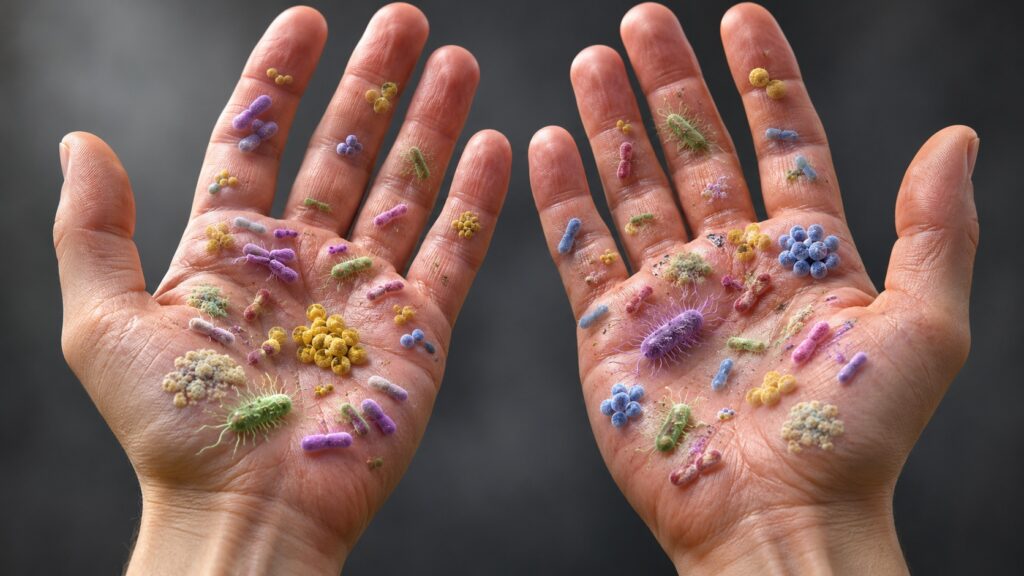
Bacteria on human hands
Door handles, transit handrails, elevator buttons and toilet seats seem like the obvious germ hotspots, but one object we use far more often gets much less attention: the smartphone. Researchers at the University of Arizona compared bacteria counts on phones and toilet seats and found roughly ten times more bacteria on the phones. The main reasons are simple: people handle their phones constantly and rarely clean them. That said, the figure measures how many bacteria are present, not how harmful they are, and it does not show how often phones actually make people sick.
What you need to know
- University of Arizona measurements found about ten times more bacteria on phones than on toilet seats; the figure is often attributed to the University of Michigan, which cites it.
- The comparison counts bacteria, not their danger: toilet seats are cleaned regularly, while microbes on phones can build up for weeks.
- According to the same data, the average person checks their phone 47 times a day, exchanging microbes between hands and screen each time.
- Bacteria found on phones include skin species (staphylococci, streptococci) and gut species (E. coli, enterococci), but their presence does not mean someone will get sick.
Where the “ten times dirtier” figure comes from
The unpleasant statistic is frequently credited to the University of Michigan. The university does cite it, but the measurements themselves were made by scientists at the University of Arizona. They compared the number of bacteria on phones with the number on toilet seats, and phones came out ahead by a factor of about ten.
One important caveat: the study counted bacteria, not how dangerous they are. Because the toilet seat is widely seen as the dirtiest spot in the home, it tends to be cleaned regularly. Almost nobody cleans their phone, so microbes can build up on it for weeks.
The second factor is frequency of contact. By the same data, the average person checks their phone 47 times a day, and each time, hands and screen trade whatever each has picked up.
Your phone travels to the bathroom and back
A smartphone behaves a bit like shoes or clothing: it goes everywhere with us, through places with very different levels of cleanliness. In the morning it may sit on the kitchen table, during the day on a café table, and in the evening on a seat on public transport. Many people also take it into the bathroom.
Caitlin Mangan, a laboratory head at Gillson Science, says, as reported by Popular Science, that people touch their phones constantly but do not wipe them down or wash their hands in between. Emily Martin, an epidemiologist at the University of Michigan, explains the same point with an everyday comparison: taking your phone into the bathroom and carrying it back out is almost the same as using the bathroom and not washing your hands.
The result is a closed loop. You wash your hands, then immediately pick up a phone that still carries microbes from everywhere it has been that day, and your clean hands are contaminated again within seconds.
Why a subway handrail may be cleaner than your phone
Surprisingly, a handrail in a subway car may well be cleaner than your phone. According to Mangan, what matters is how often a surface is cleaned, not how many people touch it.
She gives an example: an office door handle is touched by relatively few people each day, so it may be cleaned rarely and microbes have time to accumulate. A handrail that is properly cleaned every day, by contrast, will pass fewer bacteria to you. By this logic, the phone loses to everything: it is touched constantly and cleaned almost never.

A man disinfecting handrails
What bacteria are found on phone screens
Two types of bacteria have been found on phones. The first live on human skin, such as staphylococci and streptococci. The second come from the gut, for example E. coli and enterococci. In other words, screens carry traces of both hands and toilets.
These bacteria are capable of causing skin infections, strep throat, and intestinal upsets with nausea, vomiting, and diarrhea. But “capable” is the key word. The mere presence of bacteria on a surface does not mean you will fall ill: many microbes on phones are harmless, and a healthy person’s immune system deals with many others. The research shows that smartphones carry a lot of bacteria; it did not measure how often a phone is actually the cause of illness.
This is a matter of reasonable habits rather than a reason to panic: what matters is regular behavior, not a single instance.
Simple hygiene habits for your smartphone
It is impossible to eliminate bacteria from a phone entirely, and there is no need to. These steps are recommended to reduce them:
- avoid using your phone in the bathroom;
- don’t put it down on surfaces likely to be heavily contaminated with microbes;
- don’t press the screen against your cheek and lips during calls;
- when possible, wipe the phone with alcohol-based paper wipes and clean gaps and ports with cotton swabs.
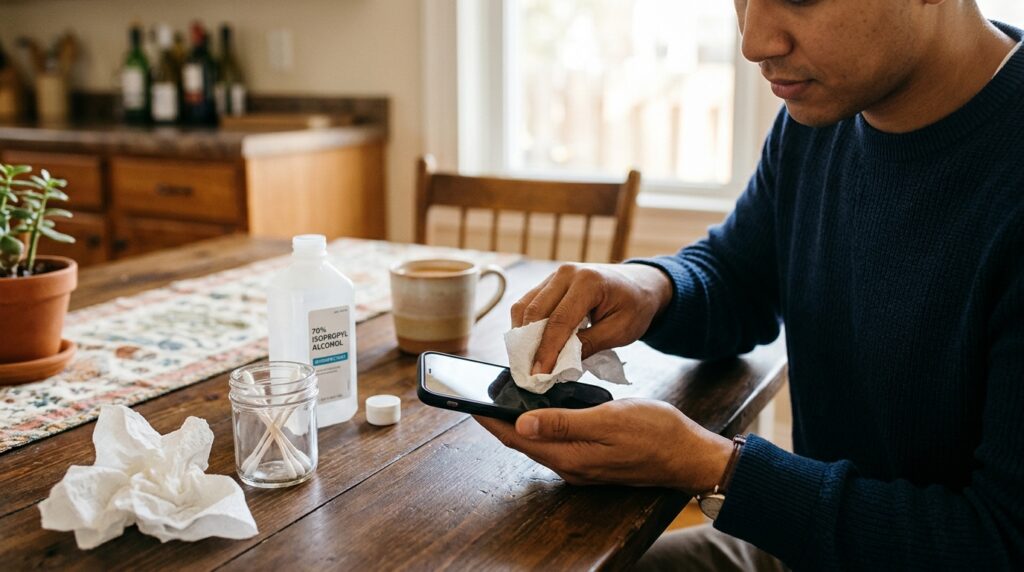
A man wiping a smartphone with a paper napkin at a kitchen table
One rule works better than any wipe: wash your hands often and thoroughly. A clean phone in dirty hands quickly becomes dirty again, while clean hands at least won’t add new microbes to the screen.