
Photo of a man with psychopathic traits
Appearance cannot reveal whether someone is a psychopath. People with pronounced psychopathic traits often seem ordinary and can even be likable, which has been linked to features of how their brains work. What can be noticed are repeated patterns of behavior. Psychologists highlight several such signs, and five are especially telling: a lack of real guilt, charm used for manipulation, understanding others’ pain without feeling compassion, habitual lying, and reckless rule-breaking. None of them is proof on its own, and none should be used to diagnose friends or colleagues.
What you need to know
- Psychopathy is not a separate diagnosis in the DSM-5-TR; the closest diagnosis, antisocial personality disorder, is not the same thing, because far from everyone with it has psychopathic traits.
- A 2011 study comparing 20 prisoners with psychopathy and 20 without found weaker connectivity between the amygdala and the ventromedial prefrontal cortex in the first group, but most such research has been done on prisoners and the findings are not conclusive.
- Specialists assess psychopathic traits with the PCL-R, a tool developed by psychologist Robert Hare that considers emotions, relationships, and past behavior as well as actions.
- A fixed stare, rare blinking, or a strange smile are not reliable signs, and psychopathic traits do not mean a person will commit a crime.
A charming colleague, not a movie maniac
Films usually portray the psychopath as a cruel killer with a wild stare. Real life looks different. Such a person may have a good job and many friends, be interesting to talk to, and seem very caring. The coldness, habitual deception, and indifference to other people’s feelings behind that charm are not immediately visible.
Psychopathy is not considered a mental illness in which a person loses touch with reality. A psychopath fully understands what they are doing and where it will lead. The term describes a combination of character traits: a weak sense of guilt, little sympathy for others, a habit of using people, and disregard for rules. The American handbook of psychiatric diagnoses, the DSM-5-TR, contains no separate diagnosis of “psychopathy.” It does include antisocial personality disorder, which is close to it, but the two are different: far from everyone with that disorder has psychopathic traits.
Emotional brain regions work together less effectively
Brain scans suggest that people with psychopathic traits do have something in common. In a 2011 study, scientists compared the brains of 20 prisoners with psychopathy and 20 prisoners without it. The first group showed weaker connectivity between the amygdala and the ventromedial prefrontal cortex. Put simply, the region that reacts to fear and other strong emotions and the region in the front of the brain that helps us take those emotions into account when making decisions “communicate” with each other less well.
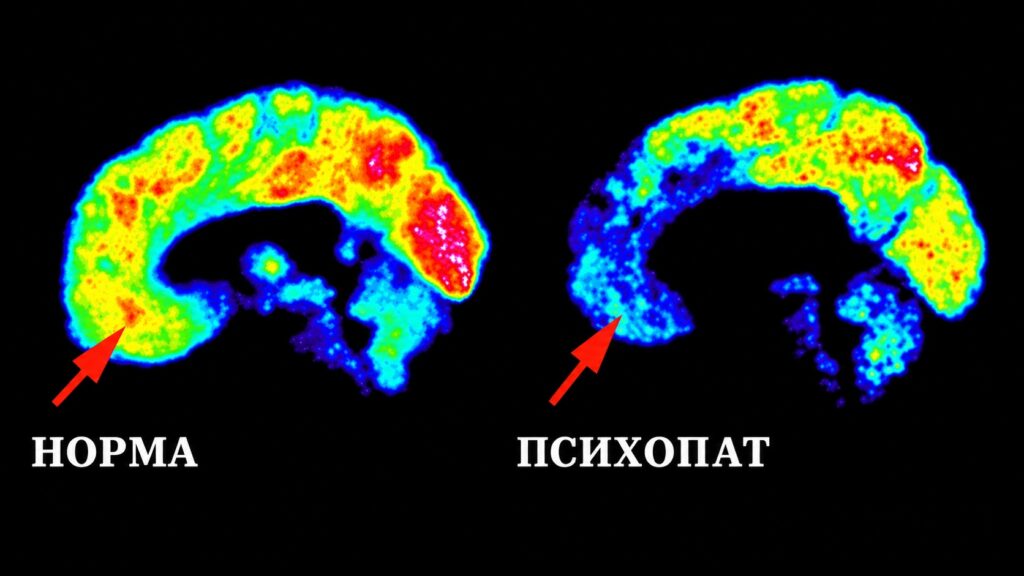
Brain scans of an ordinary person and a psychopath
Scientists believe that this weak connection makes a person less able to feel what others are going through. Another study involved 167 young men. Those in whom this connection responded more weakly to frightened faces at age 20 showed more pronounced psychopathic traits by age 22.
The picture is not final, however. Most of this research has been carried out on prisoners, and one large review even questioned the popular idea that the amygdala is “underactive” in psychopaths. And since nobody can put an acquaintance in a brain scanner, in everyday life the only thing left to observe is behavior.
How specialists assess psychopathic traits
Specialists evaluate psychopathic traits using the PCL-R, a method created by psychologist Robert Hare. It considers not only a person’s actions but also their emotions, their relationships with others, and how they have behaved in the past. The five signs below are among those most often mentioned in such assessments.
1. No genuine guilt
Many people who deceive a friend or humiliate someone in public later feel ashamed, worry about it, or try to make amends. In people with pronounced psychopathic traits, this reaction is much weaker. Such a person may deceive a close friend and keep socializing with them calmly, and when the deception comes to light, explain that the friend was to blame for being so trusting.
The point is not that the person never apologizes but that they do not genuinely feel sorry. They will say “sorry” easily if it helps them avoid trouble or win back trust. A single incident means nothing, though: pride, fear, or upbringing prevent many people from admitting mistakes. The warning sign is persistent indifference to the harm a person causes others.
2. Charm used for gain and manipulation
Many people with psychopathic traits are not rude at all. They make acquaintances easily, carry themselves confidently, and give compliments, so that by the second day it feels as though you have known each other for years. The new acquaintance asks about your life, offers support, and says pleasant things, then starts asking for money, favors, or introductions. Once they get what they want, their interest in you disappears.
For such people, relationships serve gain rather than closeness. Scientists call this superficial charm and a tendency to manipulate. Charisma on its own says nothing, however: most sociable people have nothing to do with psychopathy. The worrying sign is charm combined with a habit of using others again and again.

A man and a woman talking at a cafe table
3. Sees other people’s pain but does not sympathize
Empathy, the ability to understand another person’s feelings and share them, works unusually in people with psychopathic traits. They do understand: they see that someone is upset, notice tears, and can guess the reason. But they feel almost no compassion, and another person’s grief does not make them want to help. Moreover, they recognize that someone who is afraid or ashamed is easier to manipulate.

A man in a jacket gestures at a cafe table across from a woman
In practice, this can look like mocking topics that are painful for others, ignoring the suffering of loved ones, or continuing to cause harm while fully understanding the consequences. But coldness can have other causes too. A person may seem unfeeling because of stress, depression, or simply their way of communicating.
4. Lies constantly, sometimes for no obvious reason
Almost everyone lies occasionally, for example saying “I’m heading out now” while still lying on the couch. But with pronounced psychopathic traits, lying becomes a habitual way of communicating. Such a person might tell one acquaintance that they run a large company, another that they served in the intelligence services, and a third that they have influential relatives. Sometimes the motive is money or respect; sometimes there is no visible benefit at all.
The warning sign is a combination of frequent lying, confident behavior, and complete calm after being exposed. If caught in a contradiction, such a person will invent a new version or claim that you misunderstood. Chronic lying also occurs in people without psychopathy, and it has many possible causes. It is also worth knowing that a liar’s gaze and gestures rarely give them away.
5. Breaks rules without thinking about the consequences
Another sign is impulsiveness, irresponsibility, and disregard for other people’s safety. Such a person may drive dangerously, get into fights, spend other people’s money, borrow without paying back, and break promises. They understand that they are creating problems, but their own desires matter more to them. They usually blame others for their failures and repeat the same patterns again and again.
Importantly, not everyone with these traits behaves this way. Some people with psychopathic traits act in a calculated manner, planning every step in advance and maintaining the appearance of a respectable life for years. Rule-breaking is therefore a common sign but not a necessary one.
The eyes and smile do not give a psychopath away
Online articles often claim that a psychopath can be recognized by a fixed stare, rare blinking, or an odd smile. There is no reliable way to identify psychopathy by appearance. It is also untrue that such people inevitably become criminals: psychopathic traits can be associated with antisocial behavior, but they do not mean a person will ever break the law.
What to do instead of diagnosing
Rather than diagnosing acquaintances with internet tests, it is better to honestly assess whether it is safe to interact with the person. A cold gaze, an absence of tears, or strong charm prove nothing on their own. Persistent lying, manipulation, and indifference to other people’s suffering, however, are a serious reason for caution, even if the person does not have psychopathy at all.
Finally, psychopathic traits do not depend solely on how a person was born. Researchers are also studying how habits, including spending many hours on a phone, affect brain function.