A lizard squirts blood from its eyes at a predator
North America’s horned lizards have an unusual last line of defense. When camouflage fails, they squirt streams of foul-tasting blood from their eyes at predators such as coyotes and dogs. The tactic costs them a lot of blood: in one experiment, a lizard confronted by a dog lost 6.8% of its body mass after a defensive squirt. Researchers suspect the blood’s bad taste may come from the venomous ants the lizards eat, but that link remains a hypothesis. Meanwhile, horned lizards are struggling in parts of Texas, where habitat loss and invasive fire ants threaten them.
What you need to know
- Blood-squirting is a backup defense. Horned lizards rely first on staying still and blending into their surroundings.
- A 2024 study found that feeding the lizards harvester ants sharply raised the level of one substance in their blood. Researchers suggest this substance may make the blood distasteful.
- The blood deters coyotes, dogs and other mammals, but not roadrunners, birds of prey or snakes.
- Horned lizards have disappeared from eastern Texas. Researchers working with Texas zoos release nearly 1,000 young lizards into the wild each year.
Science recognizes more than 7,000 species of lizards, and many have striking abilities. Horned lizards, which live in the deserts of North America, are among the more remarkable examples.
Camouflage comes first
Horned lizards, also called horned toads, are small, measuring 7.5 to 15 centimeters long. Their backs are hard, sand-colored and covered in sharp spines. They live in dry deserts and prairies from Mexico to southern Canada. Their predators include coyotes, snakes that swallow prey whole, and roadrunners.
Dean Williams is a biology professor at Texas Christian University who studies these lizards in central Texas. He describes the blood squirt as a backup escape plan. The lizard’s primary defense is camouflage: it stays almost motionless and blends in with the rocks around it.
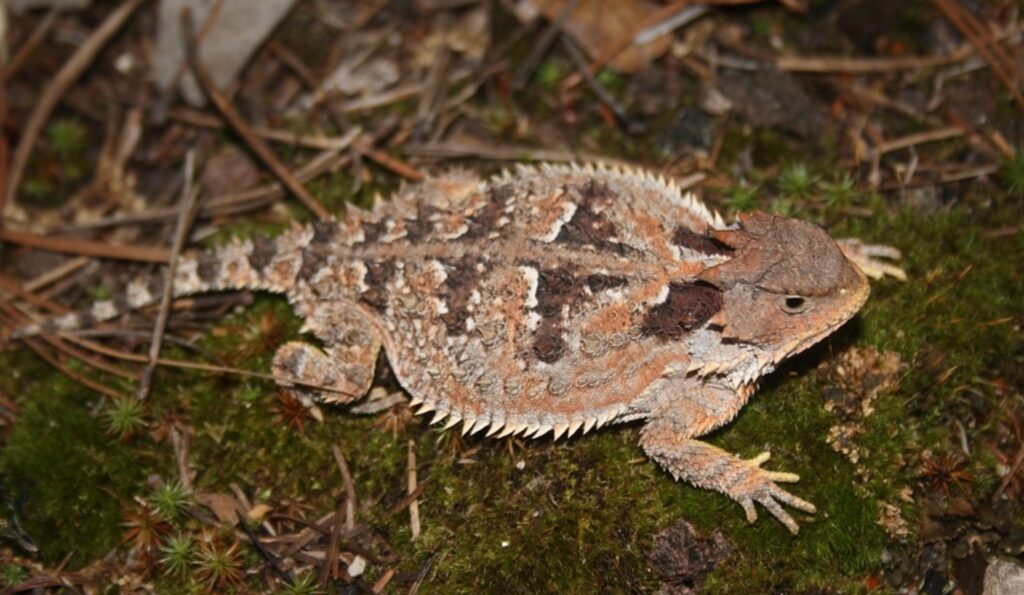
A camouflaged horned lizard. Image source: wikimedia.org
The camouflage is highly effective. Scientists fit the lizards with radio transmitters that pinpoint their location to an area roughly the size of a desk. Even so, finding an animal in the undergrowth can sometimes take 15 minutes of searching.
Ant venom may make the blood taste bad
If camouflage fails, the blood comes into play. Its unpleasant taste appears to be linked to the lizards’ diet. Horned lizards feed mainly on large harvester ants, which defend themselves with venom that acts on the nervous system. In mammals, a sting causes intense, long-lasting burning pain.
The venom has little effect on the lizards, which eat the ants in large numbers. In a 2024 study, scientists fed horned lizards harvester ants and observed a sharp rise in the level of one substance in their blood. The researchers suggest this substance may be derived from the ant venom and may be what makes the blood distasteful. For now, this is a hypothesis, not an established fact.
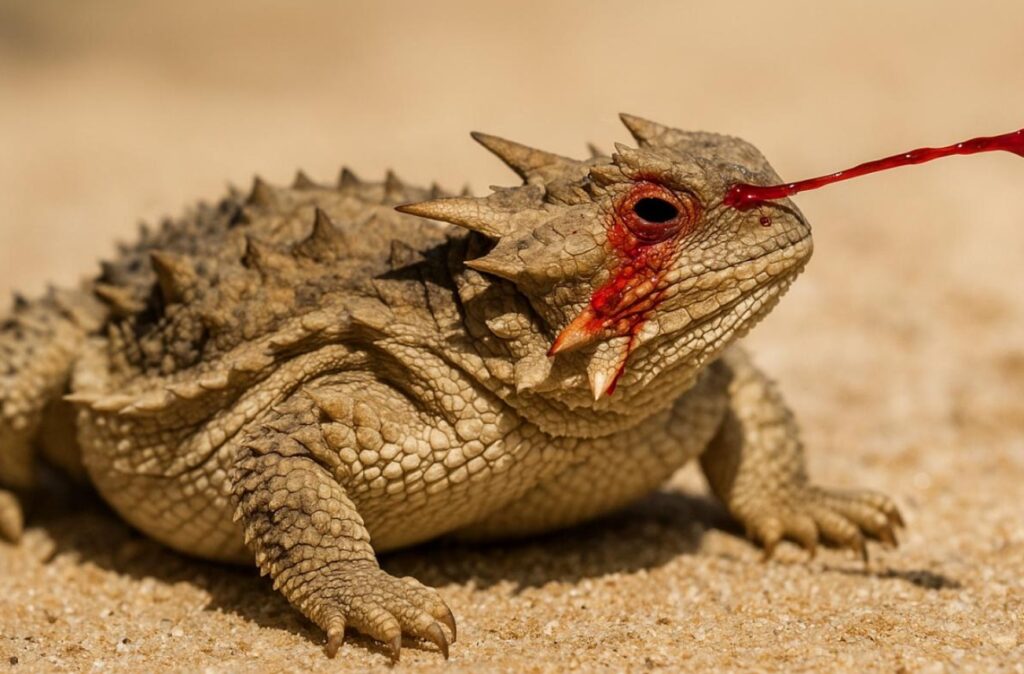
A lizard squirting blood. Image source: livescience.com
How the blood squirt works
Bad-tasting blood would be of little use if a predator only discovered the taste after biting off the lizard’s head. What matters is that the lizard can release the blood in advance and at a distance.
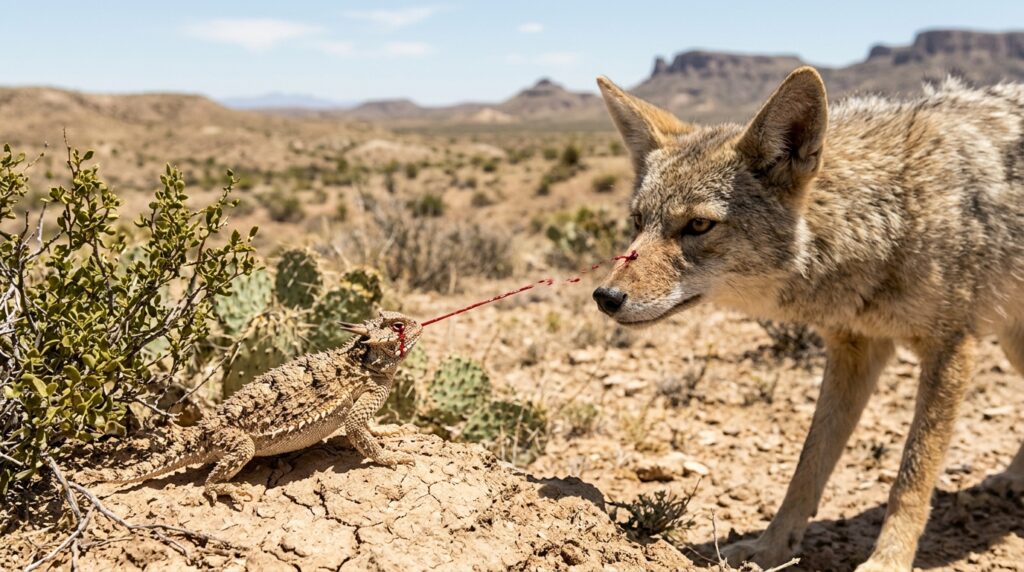
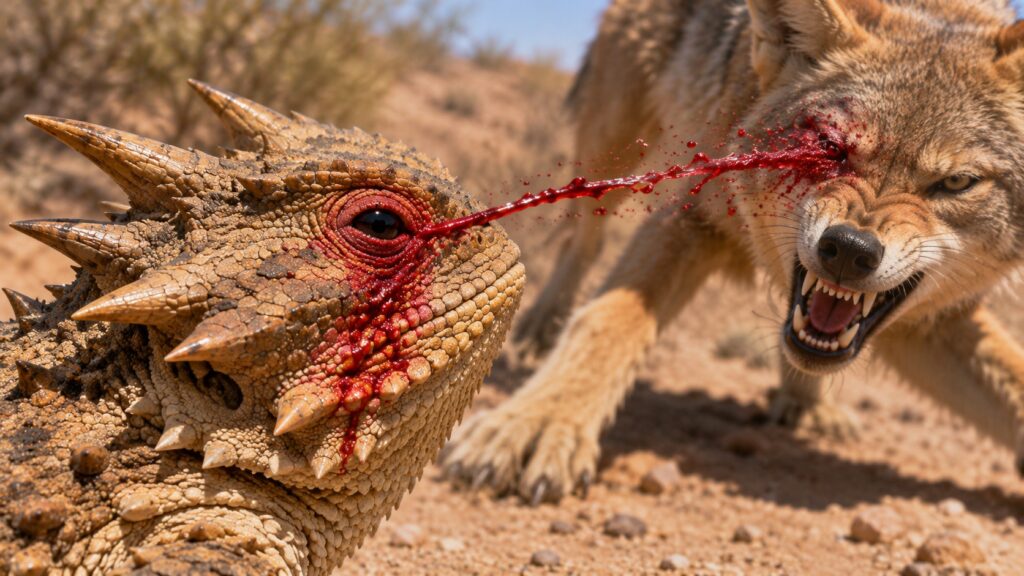
A lizard squirts blood at a coyote
According to Williams, the lizard raises the pressure in the blood vessels around the sinuses in its head. At a certain point, the vessels rupture and blood shoots out in thin streams. Coyotes, dogs and other mammals react with obvious disgust and often back off.
The squirt appears to do the lizard little harm, even though it loses a considerable amount of blood. In one experiment, a lizard confronted by a dog lost 6.8% of its body mass after squirting. Photographs of the lizards mid-defense show that this is not a drop but a full stream.
Different tactics against birds and snakes
The blood does not work on every predator. It does not stop roadrunners or birds of prey. If a bird grabs a horned lizard in its beak, the lizard jabs it with the sharp horns on the back of its head.
Snakes are not put off by the taste of the blood either, so horned lizards behave differently depending on which snake is hunting them:
- Rattlesnakes are ambush predators that wait for long periods in the shade, so the lizard simply runs away from them.
- Fast racer snakes could easily catch a fleeing lizard. Instead of running, the lizard presses its flat body to the ground and presents its spiny back, which is hard to swallow.
In Texas, the lizards are vanishing along with the brush
Despite these defenses, horned lizards are in trouble in Texas. They have already disappeared from the eastern part of the state. Williams links the decline to industrial land development and says the lizards are highly sensitive to changes in their habitat.
In small towns, the lizards can coexist with people as long as brush remains nearby. Where the brush has been cleared, Williams says, the lizards have simply disappeared.
The reason is that horned lizards are cold-blooded. They have no internal heating or cooling and regulate their body temperature through behavior, such as moving into the shade. Under the scorching Texas sun, without shade from vegetation, they cannot keep their body temperature within safe limits.
Fire ants and the release of nearly 1,000 hatchlings a year
The second major threat is, once again, ants, but a different kind. Fire ants arrived in the United States from elsewhere. They raid horned lizard nests, eating the eggs and sometimes attacking and killing the young.
To support the population, Williams and Texas zoos release nearly 1,000 young horned lizards into the wild each year. The hatchlings fit in the palm of a hand. Each one is transported in its own plastic container and released into desert scrub.
To help the young lizards survive, Williams’ graduate student Kira Gangbin is developing a poison intended to target fire ants specifically. It is not yet known how well it will work.