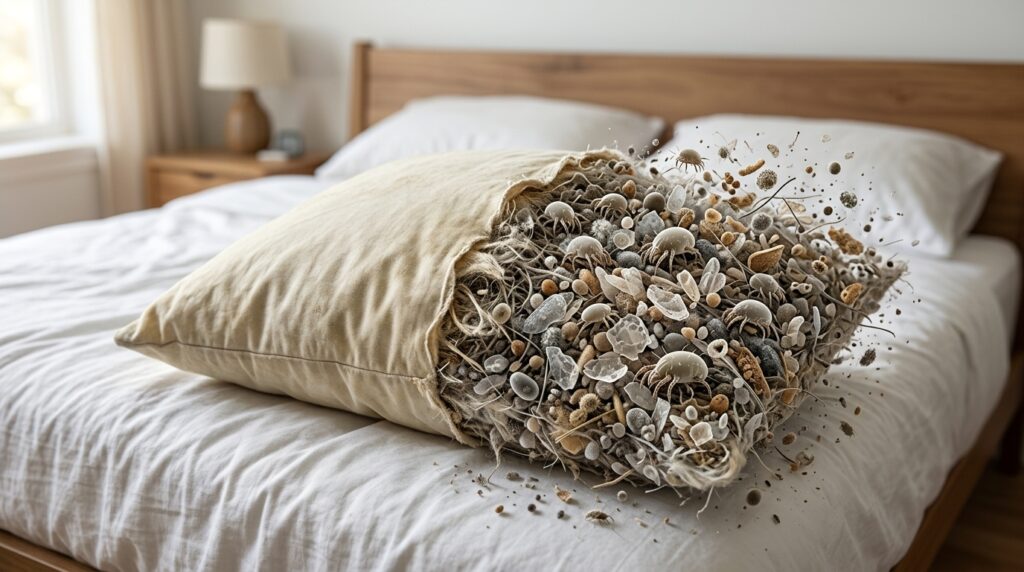
What’s inside your pillow is something you definitely won’t like
You’ve probably come across the popular internet scare story claiming that after a couple of years, a pillow doubles in weight due to accumulated dead mites and their waste. The actual composition of old pillow filling can indeed be surprising, but the frightening numbers from the internet are far from the truth. Let’s figure out what actually gets inside your bedding and why weight is the last criterion you should be paying attention to. Yellow stains on a pillow are much more telling.
The Myth About Mites in Pillows
Various claims circulate online. Some sources claim that after two years, mites make up 10% of a pillow’s weight, while others raise the bar to a third. The problem is that there are no real studies behind these bold claims.
Scientists have not conducted multi-year experiments where a new pillow would be weighed before and after use, carefully separating dust from down. Therefore, the myth about the mass of dead mites cannot be considered a proven fact. Moreover, the weight of an item changes unpredictably over time.
On one hand, moisture, dust, and oil do indeed get inside. On the other hand, pillow filling is constantly being compressed and breaking down, and during washing, dirt is rinsed out and individual fibers fall away. Depending on air humidity, the same pillow will weigh differently in the morning versus the evening.
What Makes a Pillow Dirty
Even if you take a shower before bed and don’t wake up drenched in sweat, your body continuously releases moisture. Saliva, wet hair, and nighttime sweating cause moisture to penetrate deep inside. If the bedding doesn’t have time to dry out, the filling fibers begin to stick together, and a musty smell develops inside the pillow.
The second unavoidable factor is sebum and cosmetic residue. Sebaceous glands work around the clock, protecting our skin. At night, this secretion remains on the pillowcase and gradually seeps deeper. It’s precisely because of the mixture of sebum and sweat that old pillows turn yellow, become sticky inside, and start collecting household dust much faster. If you’re curious about what happens to your face during long hours of sleep on a dirty pillowcase, it’s worth remembering the constant contact of skin with these accumulations.
Additionally, a person sheds approximately one gram of dead skin flakes daily. A significant portion of them settles right in the headboard area of the bed, turning into a nutrient medium for microorganisms.
Why Dust Mites Live in Pillows
Household dust doesn’t consist only of our cells. It contains a mix of outdoor dirt, plant pollen, pet hair, clothing fibers, and fungal spores. And dust mites — microscopic relatives of spiders — thrive perfectly in this rich mixture.
A warm and moist bed suits them perfectly. At the same time, dust mites don’t bite humans at all and don’t transmit infectious diseases. They don’t live deep in the center of the pillow but prefer to stay closer to the surface: in seams, folds, and dust beneath the pillowcase.
The main problem lies in their waste products. It is specifically the enzymes in mite excrement that are a powerful allergen. Microscopic particles easily become airborne when you fluff a pillow or simply toss and turn in your sleep, landing directly on the mucous membranes of your nose.
Bacteria and Mold in Pillows
Bacteria surround us everywhere, and those that end up on bedding from our bodies usually pose no threat to a healthy person. However, moisture and an abundance of organic matter change the rules of the game.
An ordinary mixture of sweat and skin cells serves as excellent nutrition for microbes. A damp, rarely dried pillow supports their colonies much better than a dry one. The same applies to fungi: their spores constantly float in the air, but they only start multiplying in a favorable, moist environment.
In old feather and synthetic products, scientists have sometimes found up to 17 different species of fungi. For people with strong immune systems, this isn’t a death sentence, but mold spores can trigger allergies and asthma attacks in sensitive individuals.
If the filling doesn’t dry out, fungi can start multiplying inside
Signs That It’s Time to Replace Your Pillow Immediately
Assessing the wear of your sleeping surface by weight is pointless. It’s much more reliable to focus on the physical properties of the filling and how you feel. If you’ve started frequently noticing that your nose is congested or your eyes are watering in the morning, that’s a serious reason to check your bedding.
Experts recommend paying attention to the following warning signs:
- a persistent musty smell even after washing;
- the appearance of yellow, brown, or greenish mold spots;
- a feeling of dampness inside;
- filling that has clumped into dense lumps;
- regular neck pain in the morning.
A simple elasticity test: fold the pillow in half for thirty seconds and release it. If it straightens out too slowly or remains bent altogether, the material has completely lost its ability to support your head.
Simple Ways to Protect Your Bed from Dirt
There is no single expiration date for pillows. Cheap polyester filling can give out within a year, while quality latex or memory foam can last many years if properly maintained.
To keep your pillow fresh for as long as possible, it’s enough to follow a few basic habits:
- Change your pillowcase at least once a week;
- Use an additional protective zippered cover — it will absorb most of the sweat and sebum;
- Don’t cover your bed with a thick bedspread immediately after waking up. Let the bedding breathe and dry out for at least an hour;
- Keep humidity in the bedroom at 30–50% to deprive mites of comfortable conditions;
- Wash the product strictly according to the instructions on the label and make sure to dry it completely.
In the end, an old pillow does indeed collect a rather unpleasant company of microbes and dust inside. However, it certainly doesn’t turn into a disgusting little sack of mites. The main reason to buy a new pillow should not be frightening myths, but loss of shape, unpleasant odor, and your personal sense of comfort.