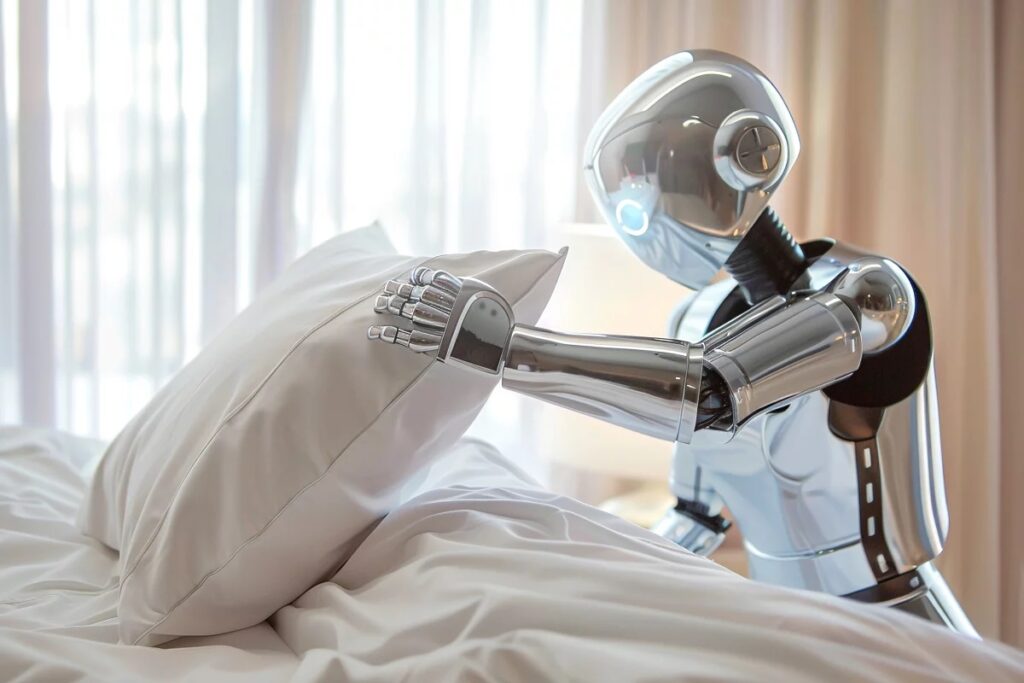
The world’s first fully robotic hotel will open in 2027
Pudu Robotics, together with Shenzhen CTID, is building the world’s first hotel where all work is done by robots — from greeting guests at the reception to cleaning rooms and delivering coffee. Robots have appeared in hotels before: they carried luggage and cleaned rooms, but here they want to entrust them with absolutely everything. A trial launch is planned for the end of 2026, and the hotel will be fully operational in 2027. This is how you know the future has arrived. Where is the hotel located, what will actually happen there, and why does this matter not just for fans of unusual travel?
Where the robotic hotel is located
The hotel will be situated in a very unusual place — on the Western Artificial Island, which will connect an ambitious bridge and tunnel known as the Shenzhen-Zhongshan (ShenZhong) link in Guangdong Province in southern China. This is one of the most complex sea crossings in the world: bridges, tunnels, underwater interchanges, and man-made islands assembled into a single engineering structure.
The location was chosen deliberately. Streams of tourists and business guests from around the world pass through this crossing, and the island itself becomes a kind of showcase for new technologies. The logic is simple: if you’re going to showcase a hotel of the future, do it where millions of people will definitely see it. The hotel was given the name Artificial West Island.
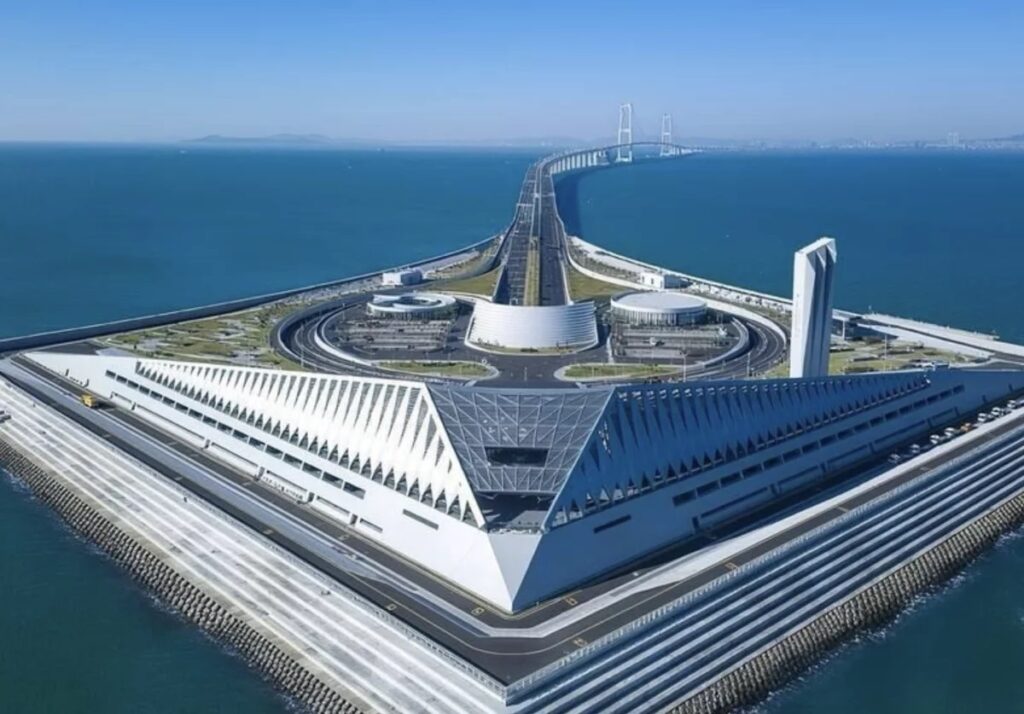
Artificial West Island.
Who and how will serve the guests
The main highlight of the project is that robots will take over absolutely all service scenarios, not just a couple of functions for show. Typical “smart hotels” install one robot vacuum and call it innovation. The idea here is different — a unified connected system where machines work together at all stages.
Here’s what the robots will do:
- greet guests and handle check-in
- deliver luggage (one of the robots can pull up to 300 kg and rides the elevator on its own)
- take orders and deliver food and drinks directly to the room
- clean premises and maintain floor cleanliness
- brew and serve coffee, communicating through voice and lighting
All of this was already demonstrated live at the contract signing ceremony. The barista robot BellaBot Pro poured freshly brewed coffee, KettyBot Pro delivered snacks while also displaying event information on its screen, and cleaning machines found trash and tidied up in real time. A separate robot, D5, even put on an interactive show — so guests could see that robots can not only work but also entertain.
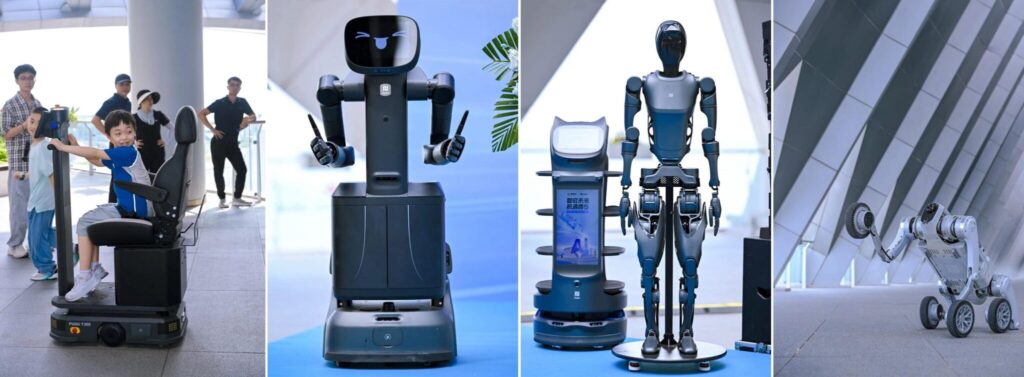
Several models that will be installed at the Artificial West Island hotel were presented at the showcase in Shenzhen
Why the robotic hotel is more than just a set of gadgets
The most interesting part is hidden not in the hardware, but in the “brains.” All hotel robots run on a shared artificial intelligence platform — a single AI manages machines that differ in form and function. The developers call this approach “one brain — many bodies.”
What this means in practice: the robot at the reception understands gestures and knows how to behave in social situations, the courier robot calculates the optimal route on its own, and the cleaner adapts to changing conditions — and all of this runs on one shared “intelligence.” Interestingly, the foundation is built on technologies from self-driving cars, adapted for indoor use.
The approach to robot autonomy is developing rapidly — recently, for example, a robot was created that can change its own batteries to work around the clock without human intervention.
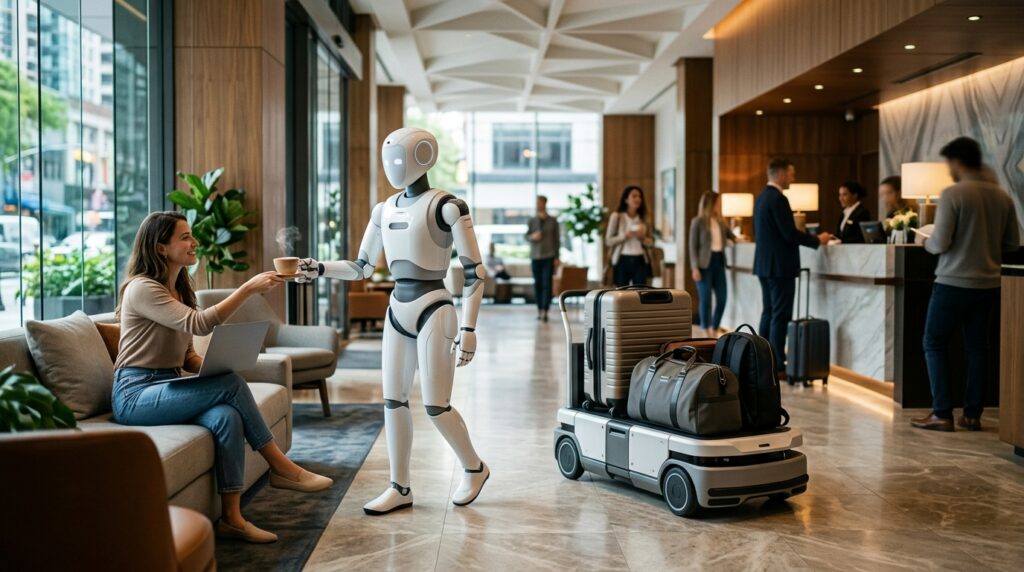
Different hotel robots are managed by a single artificial intelligence system
When it opens and how much it will cost
The hotel will be built in stages, with a target completion by 2030. But you won’t have to wait that long: the trial launch begins at the end of 2026, when some rooms and robotic services will open for the first guests. Everything will be fully operational by 2027.
As for prices: the company has not yet announced the cost of staying. The official announcement includes timelines, location, and a list of robots, but no specific rates. Given its positioning as a premium hotel and the uniqueness of the location, it’s unlikely to be cheap.
What the robotic hotel changes for ordinary travelers
If the project succeeds, it will become the first place in the world where you can spend an entire hotel day without encountering a single human employee. For some, this is an introvert’s dream, while others still fear robots and see them as a troubling signal of where the service industry is heading.
It’s important to understand: this is not a one-off experiment, but an attempt to create a scalable model. Pudu Robotics already has over 130,000 robots operating in 85 countries — in restaurants, stores, and hospitals. The hotel is a way to bring everything together in one place and demonstrate that autonomous service can work from start to finish. The robotic hotel is stress-testing the very idea — how far can you go in automating everyday things.
Should we expect such hotels to appear everywhere? It’s too early to say. But the end of 2026 will reveal the main question — whether people are ready to entrust their entire vacation to machines and whether they’ll enjoy it.
Whether such hotels will appear everywhere — it’s too early to say. But by the end of 2026, it will become clear whether people are ready to fully entrust their rest to machines.