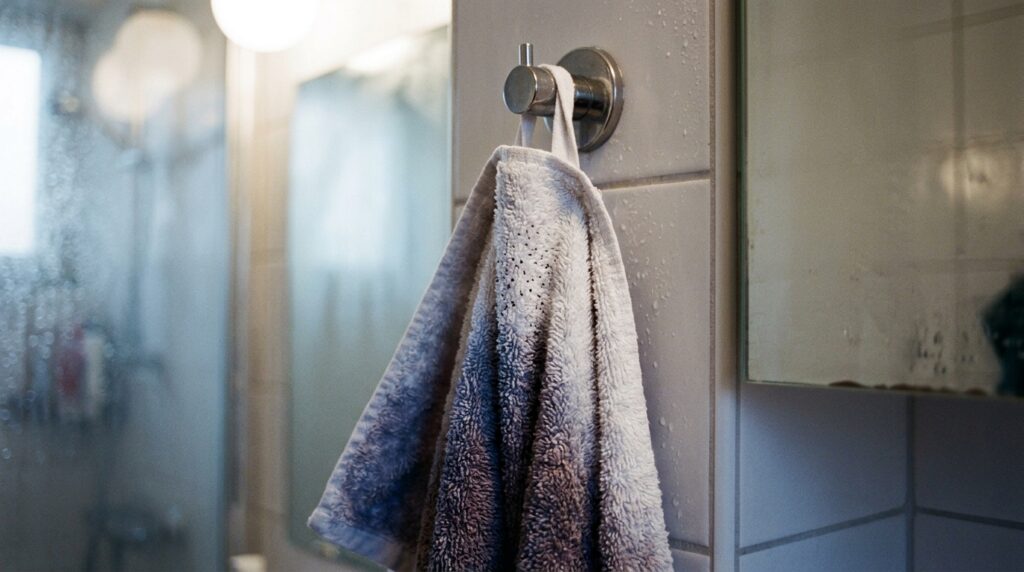
If your towel stinks, you’re washing and storing it wrong
Recently I stepped out of the shower clean, grabbed a freshly washed towel, started drying off, and caught a whiff of a damp rag. At first, I thought I just hadn’t washed myself well enough, but then I realized it wasn’t about me at all. As usual in such situations, I dug around online and found out that a towel stinks after a shower for a completely different reason. This is an important topic because we press a towel against our face and body every day. And we need to know how to keep it clean and fresh.
Why a Wet Towel Smells Bad
A dry towel may smell perfectly fine, but the moment you wet it against your clean body, a musty odor appears. That means the smell isn’t coming from you. It was already living in the fabric and simply waiting for water.
A shower doesn’t sterilize a person. Even after thorough washing, your skin retains its normal microflora, and that’s normal, not a sign of being dirty. When you towel off, moisture, dead skin cells, sebum, and microbes transfer onto the towel.
So the towel regularly receives water, organic matter, and warmth. For bacteria, that’s practically a resort. And here’s where it gets interesting. Why does everything come alive specifically from water?
The Main Cause of Bad Towel Odor
While the towel is dry, microbes have nothing to work with and go dormant without moisture. But as soon as the fabric gets wet, bacteria reactivate, and the already accumulated smelly substances become noticeable again. Water literally switches the smell on.
This mustiness has a specific culprit. According to PubMed, studies on unpleasant laundry odor specifically single out the bacterium Moraxella osloensis. It produces a substance with the long name 4-methyl-3-hexenoic acid, and it’s precisely what gives that sour sweat and wet dirty rag smell. The scientific paper directly describes the odor as similar to a wet, dirty, dusty rag, and the bacterium itself tolerates drying well and revives again when moistened.
That’s why there’s the frustrating effect where a towel has been washed and dried, smells normal, but after the very first wetting it reeks of dampness again. It’s not magic and not bad washing per se, but residual microbial life in the fibers. The bacteria survived drying and were simply waiting for water.
But for them to be so comfortable, one more thing is needed — constant dampness. And that’s where the bathroom itself comes into play.
Why Bathrooms Have So Many Microbes and Mold
After a shower, the bathroom stays warm and humid, and moisture is the key factor for mold and microbial growth. That’s why humidity control is the main way to fight mold: if wet items are dried within 24–48 hours, mold in most cases simply doesn’t have time to grow. It’s also recommended to keep room humidity below 60%, ideally 30–50%, and to turn on an exhaust fan or open a window during a shower.
The logic with towels is the same. If it hangs in a clump on a hook, lies on the washing machine, on the floor, or in a hamper, it stays damp for a long time. And the longer the dampness, the higher the chance of catching that wet rag smell.
Thick bath towels deserve a separate mention. A towel starts to stink faster than clothing because it’s denser, absorbs more water, and takes longer to dry. Fluffy towels with dense pile feel great on the skin, but precisely because of their density they dry more slowly. In other words, the more luxurious the towel, the more carefully you need to look after it. You’d think you just need to wash the towel more often. But sometimes washing actually makes things worse.
Mistakes That Make Your Towel Smell Even Worse
The first surprise: the source of the smell may not be the towel but the washing machine itself. Inside it there’s a rubber gasket, a detergent drawer, a filter, and hoses — places with standing water. Biofilms form there, meaning colonies of bacteria and fungi.
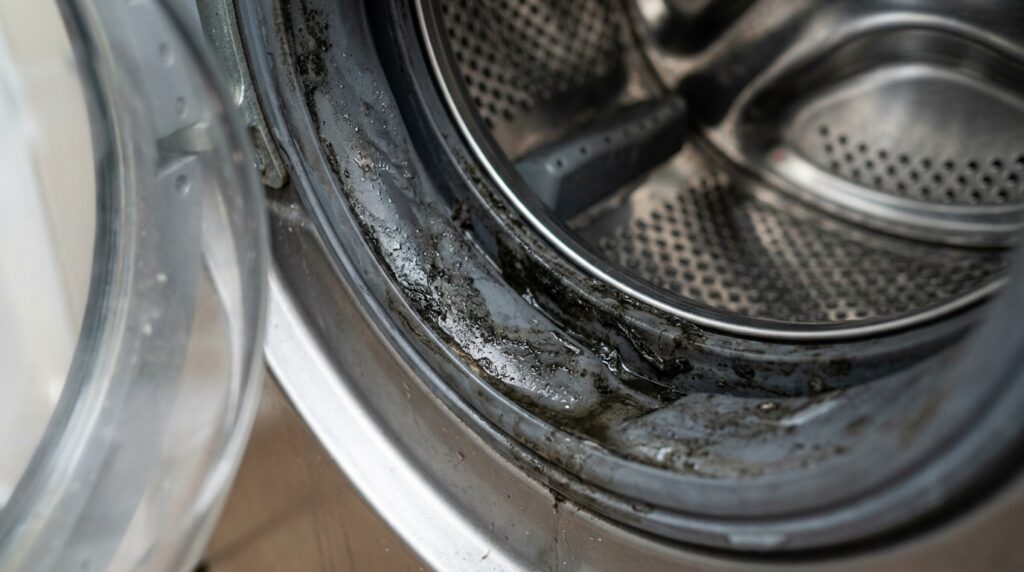
The rubber gasket of the machine is a common spot for biofilm buildup
A review in the scientific journal MDPI explains that washing machines create excellent conditions for microbes due to moisture and nutrients, and biofilms form precisely in hard-to-reach damp places: in the drawer, gasket, filter, and on plastic parts. From there, bacteria and smelly compounds can transfer back onto clean laundry. So it happens that towels come out of the machine clean, but the microbial base is already sitting inside, and the smell returns when wet.
The second surprise is related to detergent. If you use too much powder or gel, it rinses out poorly and leaves a sticky layer in the fibers that retains sebum, moisture, and odors. Excess detergent leaves residue on fibers, and fabric softener coats the fabric and reduces absorbency. Over time, this traps moisture, oils, and bacteria.
The most common mistakes that make your towel stink:
- The towel doesn’t dry completely between uses;
- The same towel is used for too long, and dead skin, sebum, and microbes accumulate on it;
- It hangs in a clump on a hook instead of a wide towel bar;
- Too much detergent or fabric softener is used in the wash;
- Washing on too gentle or cold a cycle doesn’t remove grease and microbes;
- A dirty washing machine contaminates even clean laundry;
- The towel was put away in a closet while still damp, and the smell became locked in the enclosed space;
- The bathroom is poorly ventilated, and the high humidity helps microbes thrive.
How to Keep Your Towel From Stinking
The first and most important thing is quick and complete drying. After a shower, spread your towel out to its full width: on a towel bar, drying rack, door, or heated towel rail. The larger the surface area exposed to air, the faster the moisture evaporates. A wet towel shouldn’t be tossed into a hamper in a ball — dry it first, then throw it in the wash.
The second thing is ventilation. It’s best to turn on a fan or open a window during a shower to reduce humidity in the bathroom. This works both against towel odor and against mold on the walls.
Here’s how to properly wash towels:
- Don’t use too much detergent — use the amount specified on the package or slightly less if your machine rinses poorly;
- Skip fabric softener for towels: it reduces absorbency and slows drying;
- Periodically wash on a hotter setting if the care label allows it. Temperatures of 50 degrees Celsius and above in household washing significantly reduce the number of bacteria;
- Regularly clean your machine: wipe the door gasket, rinse the detergent drawer, check the filter, and run a drum cleaning cycle.
- After washing, leave the door and drawer slightly open so water doesn’t sit inside.
If the towel already smells right after getting wet, a regular wash may not be enough. Wash your towels separately without overstuffing the drum, on a hot cycle without fabric softener, add an extra rinse, and dry them completely. At the same time, clean your machine — otherwise the smell will come back.
Important safety note. If you use bleach, vinegar, or specialty cleaners, do not mix household chemicals with each other.
How Often to Wash a Towel and When to Throw It Away
There’s no single universal rule, but there are clear guidelines. Experts recommend hanging bath towels to dry between uses and washing them after 3–5 regular uses. There’s also the advice to wash or change your towel at least once a week, and more often if it doesn’t have time to dry, if you have skin issues, or if it already smells. If you shower every day, it’s safer to aim for 3–4 uses rather than stretching it until it already stinks.
Sometimes a towel is beyond saving. If it’s old, consistently smells after getting wet, has become stiff, and absorbs poorly, oils, detergent residue, and microbes have most likely become firmly embedded in the fibers. You can repurpose it for cleaning, and get a new one for your body. You should be especially careful with your face, because dirty towels can trigger outbreaks of skin conditions and transfer bacteria and fungi. So if you have acne, eczema, or irritation, it’s better not to bring a smelly towel anywhere near your face.
In the end, it turns out that a smelly towel is a signal that the fabric is staying damp for too long. Eliminate the dampness, dry your towel completely, ventilate your bathroom, don’t go overboard with detergent, and keep your washing machine clean — and the wet rag problem will practically solve itself.