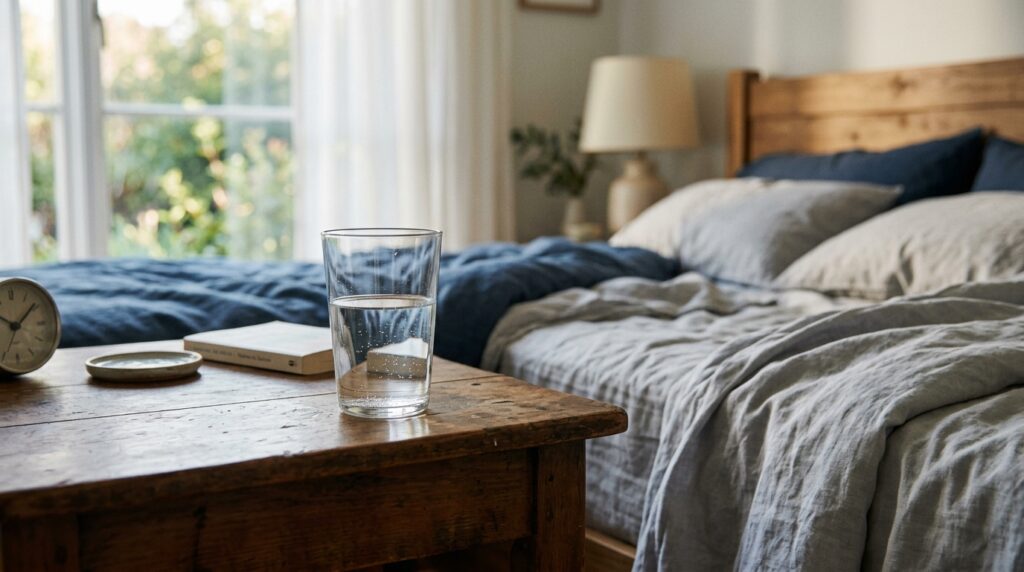
Many people leave water on their nightstand overnight without thinking about how safe it is
Many of us place a glass on the nightstand in the evening to quench our thirst right after waking up. After all, they say that water in the morning is beneficial, especially with lemon. Yesterday’s water itself doesn’t spoil or become toxic, as molecules simply don’t sour the way food does. However, over several hours the liquid comes into contact with the surrounding environment, and it’s this invisible process that determines how safe your morning sip will be.
Why Water Tastes Bad in the Morning
The morning sip often disappoints: the liquid seems flat, or as people say, stale. This makes us think that dangerous processes have started inside, as if something has gone bad. In reality, the unpleasant taste of water is caused by the dissolution of carbon dioxide from the room air. This was explained by the authors of Wired.com.
In contact with oxygen, water absorbs a small amount of carbon dioxide, forming weak carbonic acid. Because of this, the pH level of the water drops slightly. Additionally, the liquid warms up to room temperature, causing previously dissolved gases and some chlorine to evaporate. Experts note that this stale taste only indicates contact with air and not sudden spoilage.
If the glass was clean and the room didn’t have pet hair floating around or thick dust settling, a healthy adult can safely drink such water. But from a laboratory standpoint, it can no longer be called perfectly clean.
Are There Bacteria in a Water Bottle?
It seems logical that water in a bottle is protected from dust and air, and therefore completely safe. This is true only if you poured it into a clean container and closed it with a lid. The situation changes dramatically if you’ve already been drinking directly from the neck of the bottle.
Millions of bacteria live in our oral cavity. When lips contact the bottle, some microorganisms inevitably get inside. Studies show that warmth dramatically accelerates bacterial growth in already opened containers. In one experiment, scientists left a partially drunk bottled water at a temperature of 37 degrees Celsius. Within 48 hours, the number of bacteria grew from fewer than one colony per milliliter to a staggering 38,000 colonies.
Of course, in a typical bedroom the temperature is noticeably lower, and with cool storage, microbial growth is minimal. However, the principle remains the same. If you drank from the bottle after dinner and left it in a warm room, by morning the number of bacteria in the bottle will have noticeably increased.
Chlorine in Tap Water and the Vulnerability of Boiled Water
The quality of water left out since the evening largely depends on the source. If the water comes from the tap and is officially recognized as potable, it contains chlorine or chloramine. These are the chemical elements that protect tap water from microbial contamination while it sits in your closed carafe on the table. But as the glass sits open, this protection gradually evaporates.
Many people prefer to boil water, considering this method the most reliable disinfection. Heat treatment does indeed kill most microorganisms. The problem is that after cooling, the liquid loses its protective barrier. Boiled water should be stored in closed containers to avoid recontamination from the air.
So a night in a closed kettle poses no threat. But an open mug of boiled water is an excellent target for dust particles and microbes.
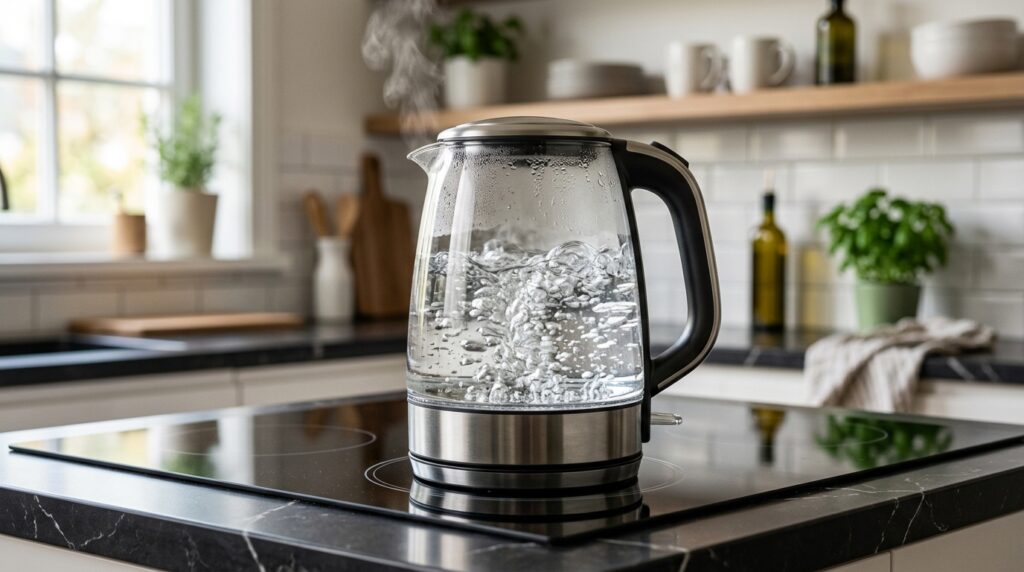
Boiling kills bacteria, but after cooling the water becomes vulnerable again
Why You Shouldn’t Store Water Bottles in the Sun
A regular plastic bottle with a cap is perfectly suitable for storage at room temperature. Food-grade plastic undergoes strict quality control and does not release dangerous substances under normal conditions. However, this material has its own hidden enemy — high temperature.
Scientific reviews on plastic bottles have found a direct link between heating and the release of chemical substances from the bottle walls. It was discovered that prolonged exposure to heat increases the migration of antimony from the plastic walls directly into the liquid. Russia’s Rospotrebnadzor also recommends storing such bottles in dark places at temperatures no higher than 20 degrees Celsius, away from radiators.
Therefore, the main threat lies not in the plastic itself but in violating storage conditions. Leaving a bottle on a windowsill in summer or in a scorching car is a bad idea. However, a night on a dark table won’t harm your health in any way.
When You Should Not Drink Yesterday’s Water
Even if you follow basic hygiene rules, there are situations when it’s better to simply pour the morning’s leftover water down the drain and get a fresh glass.
You should replace the water in the following cases:
- The glass stood open all night next to pets, food, or an open window where dust blows in;
- You sipped from the container while eating, introducing bacteria from your mouth;
- The bottle spent time near a hot radiator or under direct sunlight;
- The liquid sat on the table not just one night but for several days in a row;
- You noticed the color changed, cloudiness appeared, or a film formed on the surface;
- The morning portion is intended for a child, an elderly person, or someone with a weakened immune system.
It turns out that understanding how water interacts with its environment eliminates unnecessary fears. Water doesn’t turn into poison overnight, and all real threats come down to dust, saliva, and heat. A closed lid or carafe solves most problems, so taking care of your health simply comes down to choosing clean dishes for overnight storage.