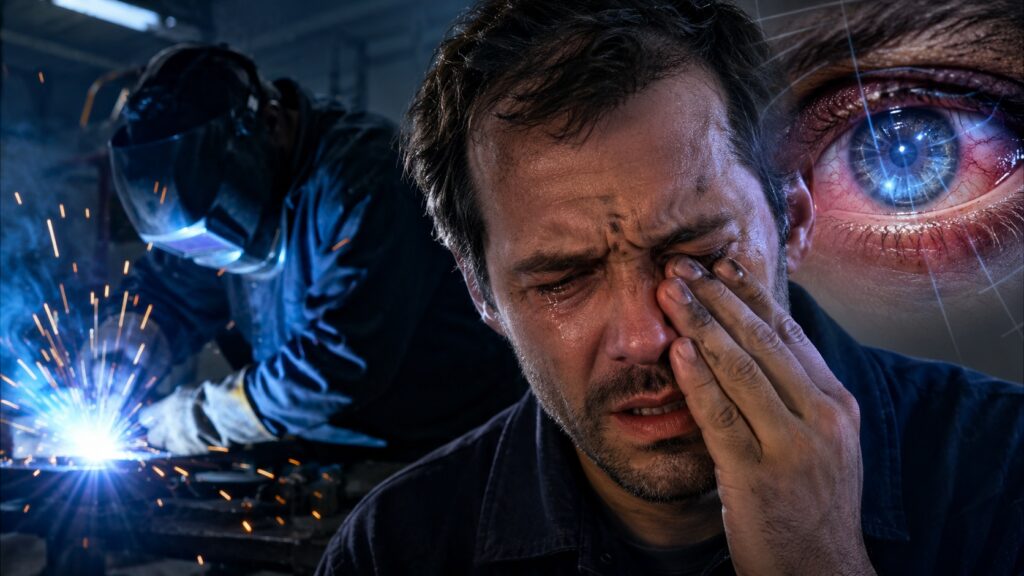
Looking at welding can cost you your sight, and this is no joke
Welders have an expression “catching a bunny” — that’s what they call a corneal burn from the welding arc. The danger isn’t in the bright light, but in the ultraviolet radiation, which is tens of times more powerful than sunlight. And the insidious part is that at the moment of the flash, a person feels nothing. Pain and stinging in the eyes appear several hours later, when the burn has already occurred. What are the risks and how can you protect your eyes?
What Does “Catching a Bunny” From Welding Mean
Catching a bunny is welder slang, and it has nothing to do with playing with a sunlight reflection on a wall. In professional jargon, this refers to an ultraviolet burn of the eyes from the welding arc. The medical name for this condition is ophthalmia or electroophthalmia.
The point is that the bright light from a welding torch contains an ultraviolet component in its spectrum — invisible radiation that damages the eye. Essentially, it’s a sunburn, only not of the skin but of the delicate surface of the eye. And you can get it in literally a few seconds of a careless glance.
Why You Shouldn’t Look at Welding
The main treachery of welding light is that ultraviolet is not felt at the moment of exposure. You’re looking at a beautiful bright arc, your eyes don’t hurt, nothing burns — but the damage is already happening. A sunburn on the skin behaves exactly the same way. While you’re sunbathing, everything seems fine, but redness and pain only come in the evening.
That’s precisely why looking at welding without additional protection is not allowed. Not only the person welding is at risk, but anyone nearby who decides to take a quick peek.
How Ultraviolet From Welding Damages Eyes
Ultraviolet from welding primarily strikes the cornea — the transparent front membrane of the eye through which we see the world. The radiation damages its surface cells, and over time microscopic erosions appear on the cornea, it becomes cloudy, and in severe cases, deeper tissues of the eye are also affected. And no amount of carrots with vitamins will help restore vision.
In terms of mechanism, this is a burn very similar to a sunburn, only concentrated on a tiny area. That’s why the body’s reaction is delayed: cells need time to realize they’re damaged and send a pain signal. This pause is the most insidious part of the whole story.
First Symptoms of Eye Burns After Welding
Like a skin UV burn, an eye burn may initially produce no symptoms at all. Problems begin several hours later, usually in the evening or at night after work.
Symptoms of corneal burns:
- eye pain;
- sensation of “sand in the eyes”;
- stinging in the eyes;
- redness of visible parts of the eye;
- severe tearing;
- light sensitivity.
A combination of these signs several hours after welding is an almost certain sign of an ultraviolet burn. Particularly characteristic is the feeling as if sand has been poured under the eyelids, making you want to rub your eyes — but rubbing them is exactly what you must not do.
Degrees of Eye Burns: From Mild to Vision Loss
Doctors distinguish four degrees of severity of such burns, and the difference between them is enormous — from mild discomfort to a threat to vision.
- First degree — redness of the eyeball, tearing, and slight clouding of the cornea;
- Second degree — corneal erosions and blisters on the skin appear, easily removable films form on the conjunctiva, the cornea noticeably clouds;
- Third degree — the cornea becomes opaque, like frosted glass, necrotic changes begin on the skin;
- Fourth degree — severe clouding of the cornea and tissue death of the eye and conjunctiva.
With first and second degree burns, treatment at home is possible, but even then it’s better to see an eye doctor after first aid. With severe burns, however, medical help must be sought immediately, because in very severe cases complete vision loss is possible.
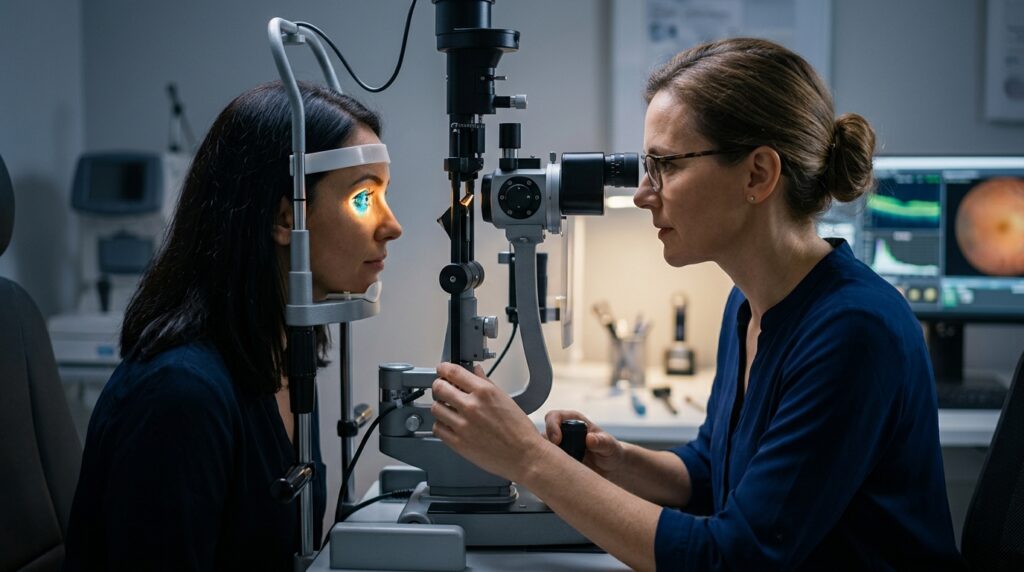
The degree of eye burn can only be accurately determined by a doctor during examination
First Aid for Eye Pain After Welding
If pain appears after welding, you should act calmly and in order:
- Rinse eyes with cold clean water;
- Apply eye drops;
- Place cold compresses on the eyes to ease the condition;
- Take a painkiller if the pain is bothersome;
- Protect your eyes from bright light until fully recovered.
These measures relieve the acute symptoms but do not treat a deep burn. If the pain is severe, that’s a signal not to play hero but to go to the doctor.
What Not to Do After an Eye Burn
The main mistake is rubbing your eyes, no matter how badly you want to. When you have a sensation of sand in your eyes, the corneal surface is already damaged, and rubbing adds new micro-injuries and introduces infection. Light is the second enemy of a damaged eye, because bright lighting intensifies the pain and slows recovery, so it’s worth dimming the lights indoors and wearing dark glasses outside.
You should also not self-medicate with severe pain, hoping it will go away on its own. A mild burn does indeed pass in a couple of days, but distinguishing it from a severe one without a doctor is difficult.
When You Need to See an Ophthalmologist
You should urgently see an ophthalmologist if the pain is severe and doesn’t subside after first aid. An immediate doctor’s visit is also required for clear signs of a severe eye burn: pronounced clouding, sharp deterioration of vision, and severe light sensitivity.
A simple guideline is this: mild burning and tearing that quickly subside can be waited out at home, carefully helping your eyes with drops and darkness. But anything beyond mild discomfort is a reason not to delay and see a specialist, because the cost of a mistake here is your ability to see.
How to Protect Your Eyes During Welding Work
The good news is that eyes during welding can be protected. Personal protective equipment exists for this purpose, blocking dangerous radiation:
- welding mask
- safety glasses
- protective shields
So if someone nearby is welding, don’t look at the arc without protection, even for a moment. Vision doesn’t recover as easily as a tan on the skin, and protecting your eyes is much easier than having to treat a burn afterward.
So behind the playful “catching a bunny” lies a very serious injury. Understanding that ultraviolet from welding works like an invisible sunburn helps you not underestimate the danger and treat a welding mask as a real and very important form of eye protection.