
Holding in a sneeze can land you in the hospital
Many people, when they feel a sneeze coming on, pinch their nose and close their mouth to avoid making noise or spraying saliva. They do it automatically, without thinking. Yet sneezing is a reflex expulsion of air at speeds of about 50–120 meters per second. And we can sneeze from just about anything, even simply seeing bright sunlight. If you block the exit for this airflow, it goes back inside. I’ll explain what that leads to below.
What Happens to the Body During a Normal Sneeze
A sneeze is always a powerful release of energy. Dr. Qin Liu, a researcher at Washington University in St. Louis, compares sneezing to a shotgun blast because the body abruptly expels built-up pressure outward. This is reported on the Popular Science website.
During a normal sneeze, all that energy bursts out through the nose and mouth and dissipates into the air. That’s exactly how the system is designed — like an open pressure-relief valve that always has a free exit.
Sneezing is designed as an open pressure-relief system; problems begin when that exit path is suddenly blocked, — the scientist explained.
What Happens When You Sneeze With Your Mouth Closed
The moment you pinch your nose with your fingers and clench your lips during a sneeze, the pressure has no exit at all. The same force reverses back inside the body, into tissues and structures that were never designed to handle such a load. And if the pressure is strong enough, something gives way.
According to the researcher, this trapped pressure can spread into the nasopharynx, sinuses, and Eustachian tubes — the very channels that make your ears pop on an airplane. In rare cases, it penetrates deeper, into the tissues of the neck or chest.
It’s important to understand that these organs simply end up in the path of a force that has nowhere to go. None of these parts of our body were made to absorb such an impact — they just happen to be caught in its way.
What Injuries Can a Sneeze Cause
When the force exceeds the mechanical limit of a specific tissue, damage begins. The list of possible consequences sounds more serious than you might expect from a sneeze:
- Ruptured eardrum and middle-ear barotrauma, when the ear absorbs pressure it wasn’t prepared for;
- Damage to the tissues lining the throat;
- Air entering under the skin of the neck, causing noticeable swelling;
- Air penetrating the chest cavity between the lungs.
For most people, occasionally holding in a sneeze won’t end in a hospital visit. Such severe cases are rare. But the very fact that such an everyday action can in principle damage the ears, throat, and even tissues in the chest shows what enormous force our body generates.
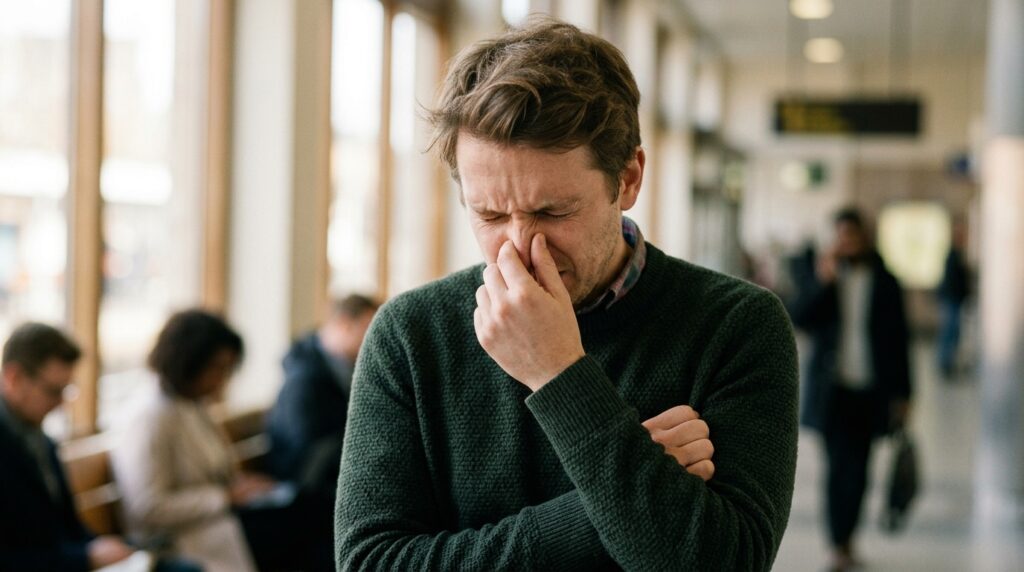
Trying to hold in a sneeze redirects pressure back inside the body
How to Properly Hold Back a Sneeze
The experts’ main takeaway is simple: holding in a sneeze is not a good idea. But what if a sneeze creeps up at an inconvenient moment — in the middle of a job interview or during an important presentation?
Experts recommend the following:
- Whenever possible, just let yourself sneeze, covering your nose and mouth with a tissue or sneezing into the crook of your elbow;
- If you can’t sneeze fully, never block both exits completely;
- Leave at least a little air through your mouth — this helps partially release the pressure and reduce the strain.
It turns out that behind the most ordinary sneeze lies serious physics, and the best strategy is also the simplest: when in doubt — let the sneeze out. That way you protect your ears, throat, and don’t force your body to absorb an impact it could easily send into the air.