
Why dermatologists warn about the danger of sun exposure for neck skin
There is a famous medical photograph that is more convincing than any lecture about sun damage. The photo below shows the face and neck of a 92-year-old woman who applied sunscreen to her face for decades but not to her neck. The difference in skin condition turned out to be so striking that it is still shown as a visual argument in favor of UV protection.
What the Photo of a 92-Year-Old Woman’s Face and Neck Revealed
The image was first published in 2011 in the Journal of the European Academy of Dermatology and Venereology, and was later revisited in a 2021 commentary. The woman used a moisturizer with UV protection only on her face for more than 40 years, leaving her neck without it. The result was a very noticeable difference in the amount of visible skin damage.
The facial skin in the photo looks noticeably smoother and more even, while the neck skin is deeply furrowed with wrinkles and clearly more “aged.” Yet this is the same person, the same age, and the same genetics. The only significant difference between these areas was the presence or absence of sun protection.
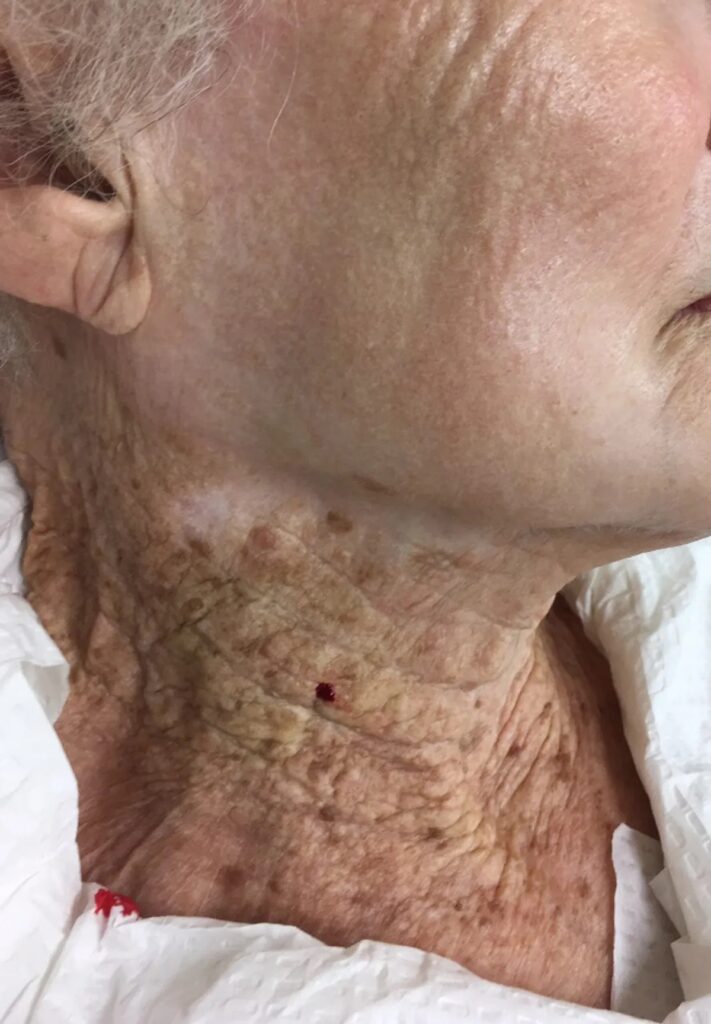
Cheek and neck of a 92-year-old woman who used UV-protective moisturizers on her face for over 40 years but not on her neck.
This is precisely why the photo became so illustrative: it eliminates all the usual disclaimers like “it’s just genetics” or “age takes its toll.” Here, both genetics and age are the same — yet the result is different.
How Photoaging from the Sun Differs from Natural Aging
Doctors distinguish two types of skin aging. The first is chronological aging, meaning when the skin looks old simply because a person has lived many years. This is a natural process that happens to everyone and everywhere, including areas of the body covered by clothing.
The second type is photoaging caused by solar radiation. Ultraviolet rays can penetrate through skin layers and damage cells. Over time, this damage accumulates, and the skin on exposed areas ages noticeably faster.
In this regard, skin is almost unique: it is an organ that directly interacts with the environment, including solar ultraviolet radiation. Therefore, areas that are most often left exposed — the face, neck, arms, and hands — usually look older than skin on the torso covered by clothing.
The photo of the 92-year-old woman is essentially a visual illustration of photoaging in its purest form. This is especially important for those who spend a lot of time behind the wheel of a car: side windows do not always block UVA rays.
How Ultraviolet Radiation Damages Skin Cells and DNA
The main culprit behind premature wrinkles and skin aging is ultraviolet radiation from the sun. But the problem goes beyond aesthetics. UV rays damage DNA in skin cells, and this damage can accumulate year after year.
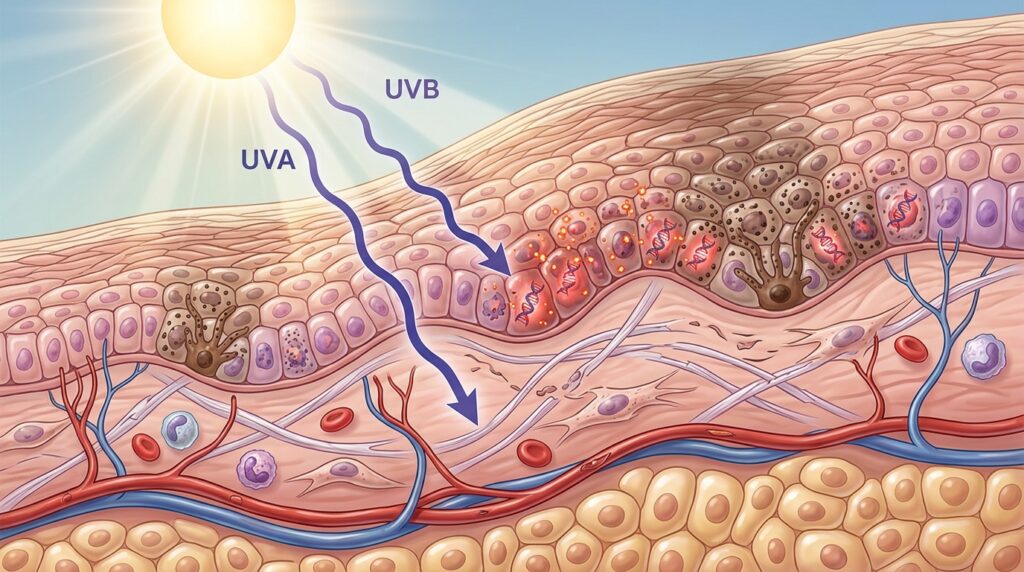
Ultraviolet radiation penetrates the skin and damages cells at a deep level
The more accumulated DNA damage there is, the higher the probability of genetic mutations. And it is precisely mutations that can trigger the development of certain types of cancer — including dangerous melanoma. Therefore, when it comes to the sun, aging and cancer risk go hand in hand — they are often driven by the same mechanism of cellular damage.
In other words, wrinkled neck skin in this case is not just a cosmetic issue. It is a visible trace of the very process that increases health risks.
Why Anti-Aging Prevention Is Linked to Reducing Skin Cancer Risk
The author of the 2021 commentary, skin cancer research specialist Dr. Christian Posch, draws attention to an interesting connection: there is significant overlap between signs of aging and cancer risk, so by fighting the manifestations of aging, one can simultaneously reduce the risk of disease.
Posch thinks broader than just one cream. He writes about “healthy longevity” — the time a person lives without disease — and notes that influencing the biological mechanisms of aging also affects the preconditions for cancer development. According to him, many hallmarks of cancer and hallmarks of aging largely overlap.
This certainly won’t completely eliminate cancer risk. It’s not about magical protection, but about a reasonable preventive measure. Reduce the probability — yes, eliminate it — no. And you certainly shouldn’t count on “safe” tanning in a solarium: for the skin, it’s still the same source of ultraviolet radiation.
Should You Apply Sunscreen to Your Neck?
The useful takeaway from this story: sun protection should extend not only to the face but also below the chin line. The neck, like the face, is constantly exposed to the sun, but it’s easy to forget about.
To slow down aging of exposed skin areas, it’s enough to keep a few things in mind:
- apply sunscreen not only to the face but also to the neck, ears, arms, and hands
- don’t skip protection on cloudy days: clouds don’t completely block ultraviolet radiation
- remember that damage accumulates over years, so consistency matters more than one-time efforts
Of course, a single medical photograph is a visual illustration, not a large-scale clinical study involving thousands of people. But it aligns well with what dermatologists have long known about the harm of ultraviolet radiation. And in this sense, the story of the 92-year-old woman is valuable precisely because of its obviousness: it shows a difference that is usually impossible to see, because we don’t carry a “control area” of unprotected skin next to a protected one.