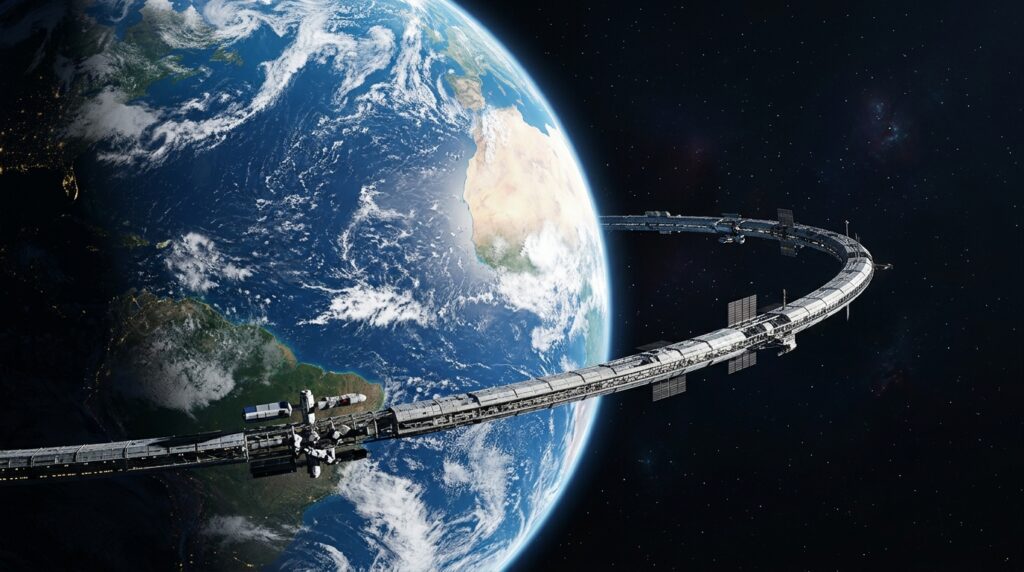
Building a bridge around the Earth is impossible, and it’s not about money or building materials
Recently I caught myself thinking a strange thought: why hasn’t humanity, which already builds bridges hundreds of kilometers long, ever built a bridge across the entire Earth? I dug into the topic and quickly realized that it’s not about money or concrete at all. The idea contradicts several laws of physics at once, and as soon as you scratch the surface, all the romance falls apart. It turned out that the phrase a bridge across the entire Earth can be understood in three different ways, and each one is impossible in its own way. Let’s go through all three, without formulas or overly technical terms.
A Ring Bridge Around the Earth
The first option is the most beautiful one. Imagine a giant ring that encircles the planet along the equator and hovers above it or stands on columns. At first glance, everything seems logical — since the Earth pulls the ring equally in all directions, it should hang stably, like perfectly balanced scales.
But this is exactly where the trap lies. Such a structure is in a state of unstable equilibrium — it’s like balancing a pencil on its sharp tip. As long as it stands perfectly upright, everything is fine, but the slightest breeze and it falls.
According to discussions on the AskPhysics forum, where physicists analyzed this problem, the issue is that if the ring shifts by even a centimeter — due to the Moon’s gravitational pull, a meteorite impact, or even wind — the symmetry breaks. The section of the ring that ends up closer to Earth starts being pulled more strongly, since gravitational force increases with proximity. And the more that section is pulled in, the closer it gets, and the stronger the pull becomes.
The attraction increases in a runaway cascade, and the entire ring ultimately crashes into the planet’s surface at tremendous speed. No ideal symmetry can save it — it’s simply too fragile.
A Bridge Across the Atlantic Ocean
The second option is more down-to-earth — a regular bridge from one continent to another, for example across the Atlantic from America to Europe. Here, there’s no room for cosmic aesthetics, but equally insurmountable, very earthly problems arise.
The first is the movement of the Earth’s crust. The planet’s crust isn’t a single piece of rock but a set of plates that slowly drift. The Mid-Atlantic Ridge spreads at approximately 2.5 centimeters per year, and over decades, this adds up to tens of centimeters. Geological forces would simply tear any rigid bridge in half, and clever expansion joints wouldn’t help here.
The second problem is depth. The average depth of the oceans is about 3.7–4 kilometers, and humanity doesn’t yet know how to build support pillars that tall. As a comparison, the tallest bridge in the world, the Millau Viaduct in France, stands on pillars 340 meters high.
Maybe make the bridge float? That won’t work either, because it would be destroyed by ocean currents like the Gulf Stream and storms. Lateral winds and waves over thousands of kilometers would create such bending loads that the metal would fatigue and the structure would collapse. According to an analysis by engineers on the Worldbuilding Stack Exchange platform, it’s precisely the combination of currents, tectonics, and loads that makes a transatlantic bridge pure fantasy.
A Passage Through the Middle of the Planet
The third option is the most literal and the most insane. What if we take “through the Earth” to mean a tunnel through the center of the planet, from one hemisphere to the other? Here we run up against not engineering limitations, but fundamental material limits.
The main problem is heat. At the center of the Earth, temperatures reach 5,000–6,000 degrees Celsius — comparable to the temperature of the Sun’s surface. Any known material, including refractory tungsten and the strongest alloys, would instantly turn to liquid or even vaporize under such conditions.
The second problem is pressure. Deep inside the planet, it’s measured in millions of atmospheres. No hollow tube or support could withstand the weight of the mantle pressing down from above — the tunnel would be instantly crushed and flooded with molten magma. Simply put, building a road through the core is like trying to construct a tunnel inside a blast furnace.
Why It’s Impossible to Build a Bridge Across the Earth
The most curious thing about this whole story is that the main obstacle turned out to be neither finances nor a shortage of building materials — though the planet’s resources truly wouldn’t be enough for such a project. The problem runs deeper, and the idea clashes with three laws of nature at once: universal gravitation, tectonic plate movement, and the thermodynamics of the Earth’s core.
The Earth is simply too alive for such endeavors. It rotates, its crust drifts, its core churns, and gravity mercilessly pulls any asymmetric structure downward. Encasing such a planet in a single rigid structure is like gluing a stiff frame onto a balloon that keeps inflating and deflating.
However, engineers make up for it with more modest tasks and sometimes come up with unexpected solutions, like a circular bridge in Uruguay. So reflections about a bridge around the Earth will remain a beautiful fantasy. But they’ve helped us better understand just how delicate and precise the forces are that keep our planet in balance.