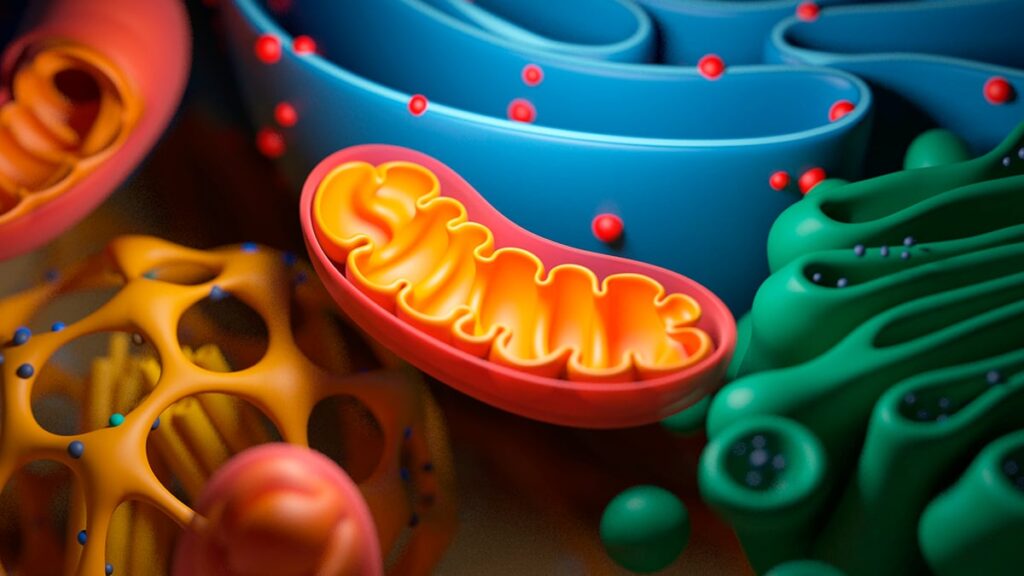
The secret to cell youth lies in the mitochondria we studied in school
German scientists have discovered why our cells lose energy over time and become vulnerable to disease. It turned out that the cause of cellular aging lies in a deficiency of just one molecular building block that can be replenished. This discovery overturns our understanding of age-related changes and offers hope for creating accessible methods of extending healthy life.
What Mitochondria Are For
To understand the physiological process of aging, you need to look inside an individual cell and examine its organelles. The key role here is played by mitochondria, traditionally called the cell’s power stations. However, they are not simply isolated batteries floating in cytoplasm.
In a healthy organism, mitochondria form a complex, constantly changing infrastructure. They merge into long flexible chains and split apart again to deliver resources where they are needed most in a timely manner. Mitochondria provide cells with the energy necessary for growth, division, and repair of damaged areas.
For a long time, biology was dominated by the theory that the cellular engine breaks down due to a gradual accumulation of genetic mutations. If the main problem were only in DNA, rejuvenation would require extremely complex gene modifications. But new research from the German Fritz Lipmann Institute has proven that the root of the problem may lie in a simple shortage of fats needed for membrane construction.
Why Mitochondrial Membranes Lose Flexibility With Age
The protective shell of any mitochondrion is made of lipids, among which phosphatidylcholine performs the most important function. It is this fat-like substance that is responsible for keeping the membrane soft, elastic, and able to freely change its shape during organelle fusion.
Biologists discovered that phosphatidylcholine levels decline with age because the aging body produces fewer and fewer proteins needed to synthesize this lipid. Without sufficient fats, mitochondria lose their ability to unite into networks. They become small, fragmented, and rigid.
Scientists compared this destructive process to the deterioration of a finely branched energy system of an entire city. Wires fray, connections break, and although energy production inside the mitochondria continues, it becomes extremely inefficient. Resources can no longer be flexibly distributed throughout the cell, leading to its gradual exhaustion.
How Nutrition Affects Aging
To test whether this process could be reversed, researchers conducted a series of experiments on laboratory nematode worms. These microscopic creatures have short lifespans, but their cellular aging mechanisms are in many ways identical to human ones, making them an ideal model for biologists.
The results were astonishing. When old worms showing signs of aging had phosphatidylcholine added to their diet, their mitochondria recovered. In just a few days, cellular structures returned to a flexible, youthful state, and the energy network began functioning smoothly again. It turned out that simply providing the cell with building material was enough for it to repair its own membranes.
Of course, the human body works in a much more complex way. However, analysis of human tissue samples confirmed exactly the same pattern. High levels of membrane lipids in elderly people directly correlated with fast walking speed and good memory — the main markers of healthy aging. At the same time, patients with obesity or diabetes showed an acute cellular deficiency of these substances.
The Unexpected Reason Behind Women’s Fatigue
Upon detailed examination of medical data, scientists discovered another extremely important detail regarding the differences between men and women. It turned out that in men, phosphatidylcholine levels in cells drop very slowly and evenly throughout life.
Women, however, face a sharp decline in this marker between the ages of 40 and 50. This period coincides with the onset of menopause, when a massive hormonal and metabolic restructuring of the entire body takes place.
It is this sudden chemical imbalance that causes severe fatigue and chronic energy decline that middle-aged women so often complain about. Against the backdrop of declining energy, the nervous system also becomes more vulnerable.
Prospects for Treating Age-Related Diseases by Halting Cell Aging
Fragmented and dysfunctional mitochondria are not just the cause of age-related wrinkles or decreased physical endurance. Their weakening triggers a chain of cellular disruptions that ultimately lead to severe chronic diagnoses.
Among the main consequences of cellular energy starvation, doctors highlight:
- Diabetes and other serious metabolic disorders;
- Cancer, developing against the backdrop of cellular stress;
- Neurodegenerative diseases, including Parkinson’s disease;
- Age-related muscle mass loss.
The research proves a crucial principle: age-related cellular changes can be reversed or at least significantly slowed down.
Ultimately, it turns out that aging is not irreversible genetic wear and tear. Often it is a deficiency of a specific molecular resource that can be compensated for. Now scientists must determine exactly how phosphatidylcholine molecules integrate into human membranes and what dosages of dietary supplements are needed to achieve a reliable therapeutic effect. But it is already clear that taking care of mitochondrial health is becoming the key to an active life free from chronic fatigue.