
We get used to the constant smells at home, but as soon as something new appears, we immediately pick up on that scent.
Every home has its own smell. It’s just that the residents are usually the last to find out about it. All it takes is returning from vacation or inviting someone who hasn’t visited in a while — and your familiar apartment suddenly smells of furniture, food, laundry detergent, a cat, or something else that’s hard to put a name to. Similarly, people may not notice their own body odor, even though others detect it effortlessly. There’s nothing wrong with the nose or sense of smell: the brain deliberately removes the constant background from our attention, otherwise every familiar scent would accompany us all day without a break.
The Nose Stops Reacting to a Constant Smell
When we enter an unfamiliar apartment, the smell appears almost instantly. After a few minutes it becomes weaker, and then it seems to dissolve. Although the molecules haven’t gone anywhere: they’re still floating through the air and landing on olfactory receptors.
This effect is called olfactory adaptation. With continuous exposure to the same smell, sensitivity to it decreases. Some of the changes occur at the receptor level, but the brain is especially quick at dampening a constant signal. In a scientific review, this process is described as a combination of sensory adaptation and habituation.
The logic behind this filter is quite practical. The smell of a sofa, a wooden wardrobe, or your favorite cream usually doesn’t require an urgent response. But smoke, spoiled food, or someone else’s perfume just appeared — those are better noticed. That’s why the sense of smell is good at detecting changes in odor but quickly loses interest in a stable background.
What Makes Up the Smell of an Apartment
The “smell of home” is rarely created by just one thing. Usually it’s a complex mixture of dozens or hundreds of volatile compounds. They’re emitted by furniture, paint, books, carpets, household chemicals, cooked food, houseplants, pets, and the residents themselves.
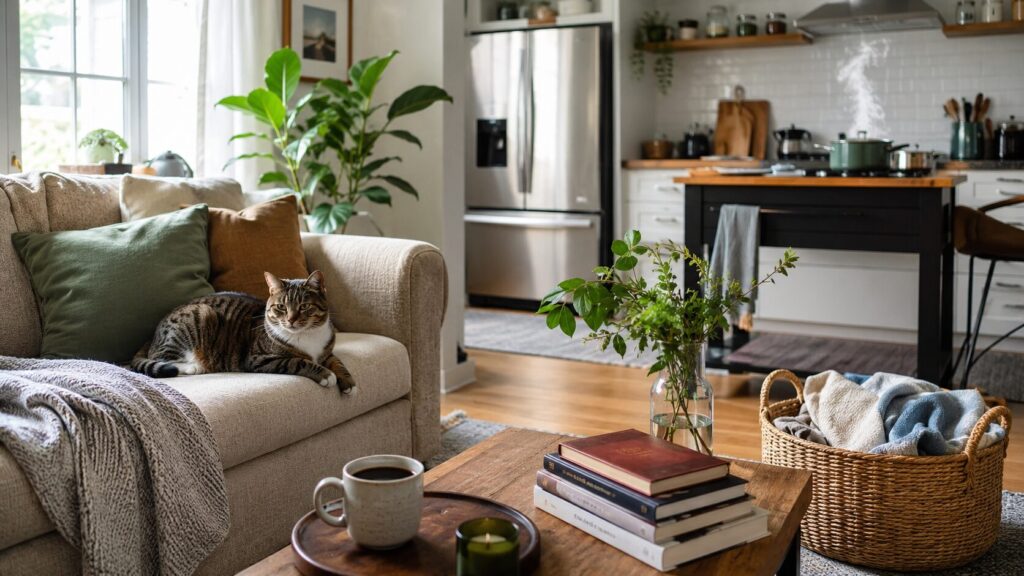
Sources of home smell can vary: a sofa, books, a cup of coffee, a kitchen, a houseplant, and a cat in one realistic interior.
Soft surfaces are especially good at retaining smells. Curtains, sofa cushions, mattresses, and clothing work almost like a sponge: they absorb molecules and then gradually release them back into the air. That’s why an apartment can still smell of dinner the next morning, even if the kitchen was cleaned long ago.
Over time, the brain stops breaking this mixture into individual components and perceives it as a single familiar background. For the resident it’s simply “doesn’t smell like anything,” while for a guest it’s a quite noticeable blend of wood, coffee, dog, and fabric softener. Interestingly, a single scent can become permanently linked to a specific place or period of life: that’s exactly why smells can instantly trigger memories.
After a Trip, Your Own Home Smells Different
Sometimes you can catch the true smell of your apartment right at the doorstep. This happens after a vacation, staying overnight somewhere else, or even just a long walk. During the time away, the olfactory system has had a chance to partially restore its sensitivity to the home background.
That’s why in the first seconds after returning, you can suddenly notice the smell of old furniture, a cat’s litter box, dampness in the hallway, or spices that usually seem completely undetectable. But the window is narrow: after just a few breaths, the brain recognizes the familiar environment again and starts dampening the signal.

A person with a travel bag opens the door to their apartment and stops at the threshold, as if smelling their home for the first time.
Moreover, habituation is quite selective. You can stop noticing the apartment’s smell but immediately detect burnt toast or a new air freshener. The olfactory system doesn’t “shut off” entirely — it removes a specific repeating background so that it’s easier to recognize something new in its place.
Why Guests Immediately Notice What We Can’t Smell
A guest doesn’t have your olfactory “settings.” For them, the apartment’s smell is new, so their brain doesn’t treat it as background and processes it much more attentively. Hence the familiar situation: the host is sure the home doesn’t smell like anything, while the person who just walked in immediately detects fish from dinner, a scented candle, or a dog.
Personal experience also influences perception. One person is quicker to notice cigarette smoke, another — dampness, a third — cat food. Smells associated with unpleasant experiences or danger usually attract more attention. Meanwhile, familiar and emotionally neutral ones fade into the background faster.
There’s also a reverse effect. A smell that seems cozy and almost dear to the host can seem heavy to a guest. The sense of smell doesn’t measure air like a laboratory instrument: the assessment depends on memory, expectations, and attitude toward the source of the smell. That’s why the phrase “it smells like home here” can be both a compliment and a very polite form of observation.

A guest enters an apartment and reacts to the smell, while the host nearby doesn’t notice anything unusual.
Home Smells You Shouldn’t Get Used To
The ability to tune out familiar background is convenient, but sometimes it works against us. A damp smell may indicate constant moisture and hidden mold. A sewage smell may point to a dried-out trap, a leaky connection, or a ventilation problem. A burning smell from an outlet, extension cord, or appliance requires immediate inspection.
Mold is especially insidious. It can grow behind furniture, under wallpaper, or inside damp structures while residents get used to the musty air. At the same time, mold in an apartment is linked not only to smell: its spores can worsen allergies and asthma symptoms. Therefore, it’s recommended to eliminate not the scent but the source of moisture, maintaining relative humidity at approximately 30–50%.
You can’t rely on smell when using gas appliances either. Odorants are deliberately added to household gas to make leaks easier to detect, but carbon monoxide has neither color nor odor. It is recommended to install CO detectors near sleeping areas and regularly check that they’re working. The absence of smell doesn’t mean safety.
How to Find Out What Your Home Actually Smells Like
The simplest method is to go outside for fresh air for at least a few minutes, then come back and take your time. The first breaths in the hallway will provide more information than trying to sniff around after being home all day. This exact technique is recommended when investigating indoor air quality problems.
It’s helpful to separately check places where smells linger the longest: textiles, the shoe cabinet, the trash can, the refrigerator, the drain, the area near the washing machine, and upholstered furniture. Even more honest feedback comes from someone who visits you rarely. Though it’s better to ask directly — out of politeness, guests usually don’t announce the smell of a cat’s litter box at the door.
If an unpleasant smell returns after airing out, masking it with an air freshener is pointless. You need to find the source: moisture, a dirty filter, spoiled food, a drain, an exhaust fan, or fabric that has long absorbed everything. The nose quickly gets used to a home, but that doesn’t mean the air is truly clean and pleasant-smelling. Sometimes all it takes is stepping out briefly, coming back — and the apartment will tell you itself what it’s living with.