The Voyager probes crossed the heliopause — the boundary where the solar wind gives way to interstellar plasma — more than a decade ago. Headlines at the time declared they had “left the Solar System.” But that framing is misleading. The Solar System defined by the Sun’s gravitational reach extends vastly farther than the bubble of solar wind, and by that measure the Voyagers have barely begun their journey out. Understanding why requires grasping that our star’s domain has not one edge but several, separated by staggering distances.
What you need to know
- Voyager 1 crossed the heliopause in 2012 at roughly 122 AU (about 18 billion km from Earth), but the Sun’s gravitational boundary — the outer Oort Cloud — may extend to 50,000–120,000 AU, nearly two light-years away.
- The Oort Cloud has never been directly imaged; its existence is inferred mathematically from the trajectories of long-period comets.
- At their current distance of roughly 150 AU, the Voyagers would need tens of thousands of years to escape the Sun’s gravitational influence entirely.
Pluto’s orbit is nowhere near the edge
School diagrams often place Pluto at the outermost fringe of the Solar System, suggesting empty space beyond. In reality, beyond Neptune’s orbit at about 30 AU lies the Kuiper Belt — a vast region filled with icy bodies, dwarf planets, and comet nuclei stretching to roughly 100 AU. Pluto is simply one of many objects in this cold zone, not a boundary marker.
For reference, one astronomical unit (AU) equals the average Earth–Sun distance: approximately 150 million kilometers.
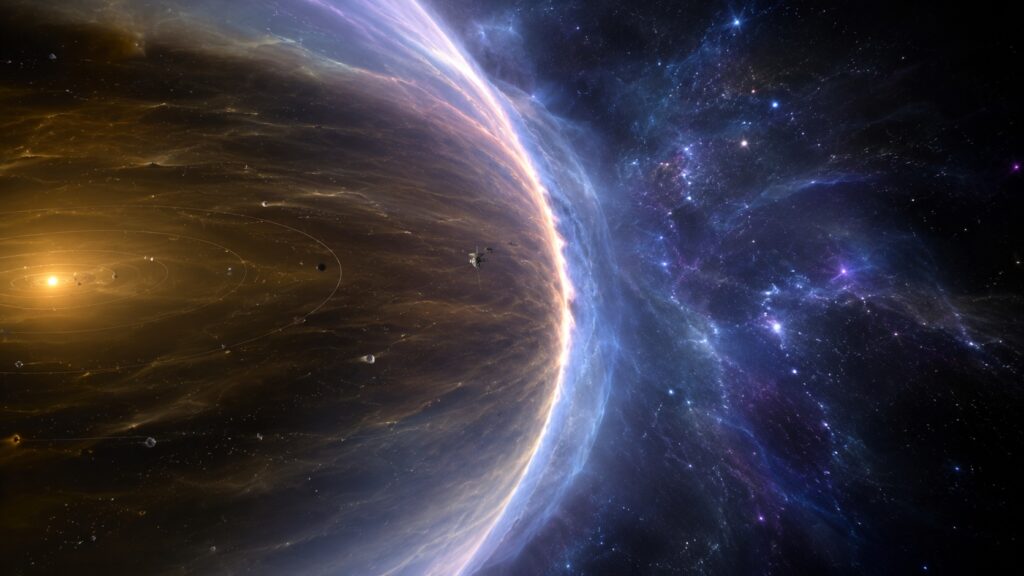
The boundary of the Solar System is so far away it is almost impossible to comprehend.
Where the solar wind fades: the heliopause
The Sun continuously ejects a stream of charged particles — electrons and protons — known as the solar wind. Traveling at hundreds of kilometers per second, this flow inflates a giant plasma bubble called the heliosphere. As the wind thins with distance, it eventually meets the pressure of interstellar plasma. The equilibrium point is called the heliopause.
As specialists at the Space Research Institute (IKI) of the Russian Academy of Sciences have noted, the heliopause is not a solid wall. It is mobile, partially permeable to cosmic rays, and shifts shape depending on the Sun’s current activity cycle.
Voyager 1 crossed this invisible line in 2012 at about 122 AU (roughly 18 billion km). Voyager 2 followed six years later. Beyond it, the probes were able to measure interstellar medium properties without interference from solar plasma for the first time.
News reports frequently equate the heliopause with the “edge of the Solar System.” But that conflates two very different boundaries.
Why the Voyagers are still inside the Solar System
The heliosphere marks the limit of the solar wind, not the limit of the Sun’s gravity. Gravitational influence does not switch off at the plasma boundary — it extends trillions of kilometers farther, fading only gradually until the gravitational pull of the Milky Way and neighboring stars begins to dominate.
Russian astrophysicists have emphasized that the heliosphere and the Solar System are entirely different concepts. The Voyagers have entered the interstellar medium, but they would need to fly for tens of thousands of additional years before truly escaping the Sun’s gravitational hold.
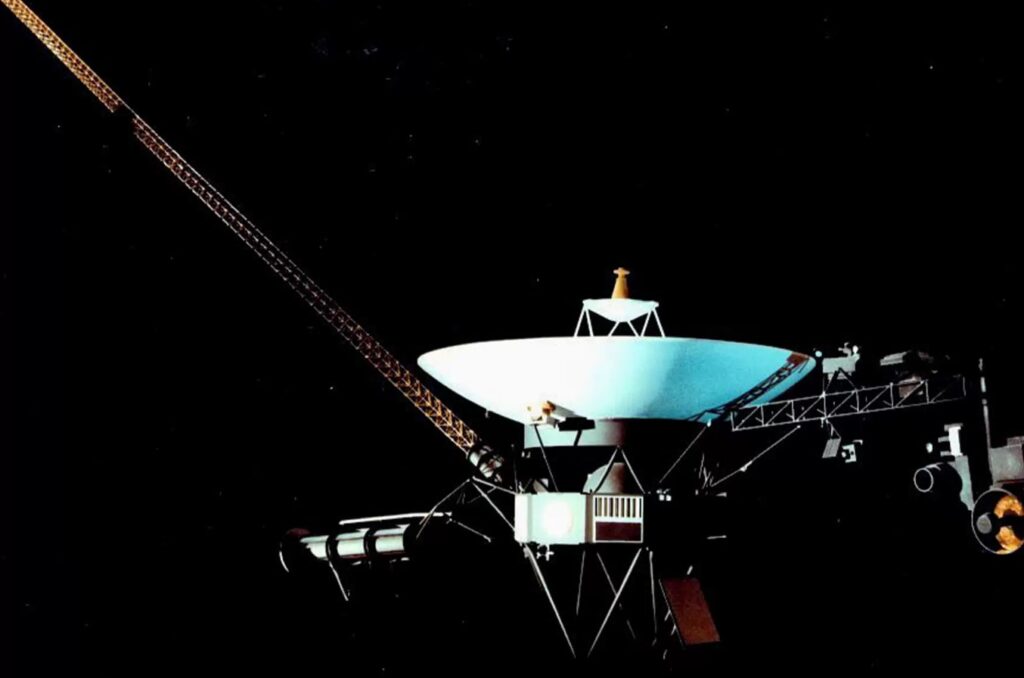
One of the Voyager spacecraft.
The Oort Cloud: the true gravitational frontier
The real outer edge of the Solar System is generally considered to be the Oort Cloud. Unlike the relatively flat Kuiper Belt, the Oort Cloud is a colossal spherical swarm of billions of icy bodies enveloping the Sun in every direction, like a shell.
According to data from the Great Russian Encyclopedia, this structure begins at approximately 5,000 AU, and its outer edge may reach 50,000 to 120,000 AU — nearly two light-years from the Sun. At those extreme distances, the gravity of passing stars begins to overpower the Sun’s pull, stripping icy bodies away and sending them into interstellar space.
An important scientific caveat: astronomers have never directly imaged the Oort Cloud. The icy objects within it are too small and too far from the Sun to reflect detectable light. Its existence has been mathematically inferred from the trajectories of long-period comets that arrive from that distant region.
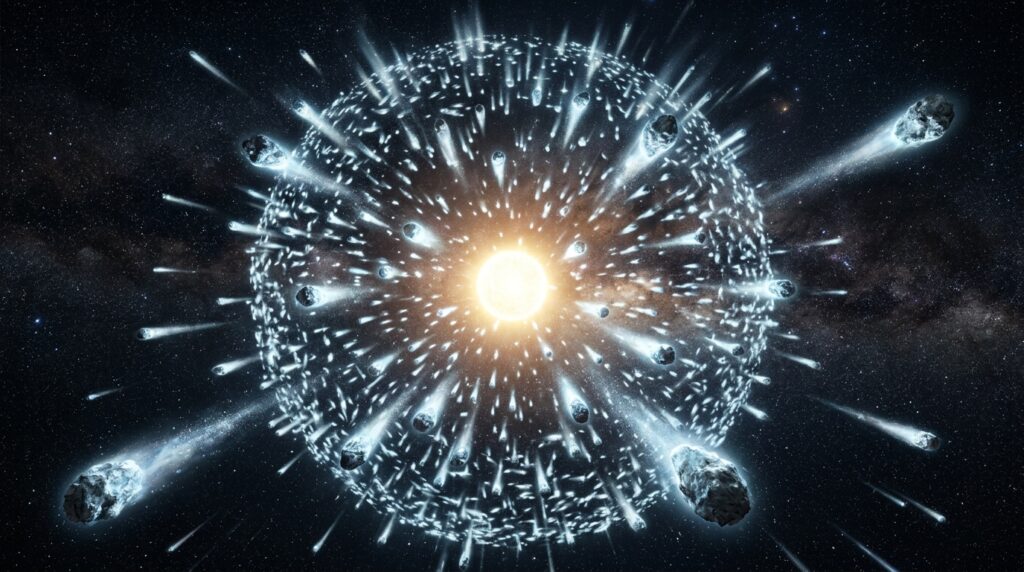
A vast swarm of icy objects at the farthest reaches of the Solar System forms a spherical shell.
A scale model that puts it all in perspective
The numbers involved are so large they resist intuition. A helpful thought experiment: imagine shrinking the Solar System so that its outer gravitational edge sits exactly 100 kilometers from the Sun. At that scale:
- Earth would be just 1 meter from the Sun.
- Neptune would orbit at 30 meters.
- The heliopause would lie about 120 meters out.
- The inner Oort Cloud would not begin until 5 kilometers away.
In this model, the Voyager probes — after nearly half a century of flight — have traveled only about 150 meters from their starting point. They still have almost 100 kilometers of emptiness to cross before the Sun’s influence finally dissolves into the broader galaxy.