Around 280 million years ago, an insect with a wingspan exceeding 71 centimeters patrolled the skies of the Permian period. Meganeuropsis permiana, often called a giant dragonfly, was in fact a member of the extinct order Meganisoptera — close relatives of modern dragonflies but not the same group. According to the U.S. National Park Service, these creatures lacked a key wing structure called the nodus, a flexible hinge that gives today’s dragonflies their extraordinary aerial agility. Without it, Meganeuropsis was a powerful straight-line flier but far less maneuverable — well-suited to open spaces, poorly suited to dense forest.
What you need to know
- Meganeuropsis permiana had a wingspan of about 71 cm and a body length of 41–43 cm, making it roughly four times larger than the biggest modern dragonflies.
- Its estimated mass was around 150 grams — comparable to a large rat — distributed across a long, narrow body with massive flight musculature.
- A 2026 study in Nature suggests that high atmospheric oxygen alone does not fully explain insect gigantism; the absence of airborne vertebrate competitors and favorable climate conditions were also key factors.
- The species’ exact dimensions are reconstructed from fossilized wing fragments; no complete specimen has been found, so body coloration and patterning remain unknown.
How large was the biggest insect ever?
The headline figure paleontologists cite is a 71-centimeter wingspan. To put that in perspective, a single wing was longer than a standard A4 sheet of paper. The body itself measured an estimated 41 to 43 centimeters. The largest dragonflies alive today are nearly four times smaller than their Permian ancestor.
Despite its impressive span, the insect weighed only about 150 grams. That mass was spread across a long, slender frame dominated by powerful flight muscles — a body plan built for sustained aerial cruising rather than quick bursts of speed.
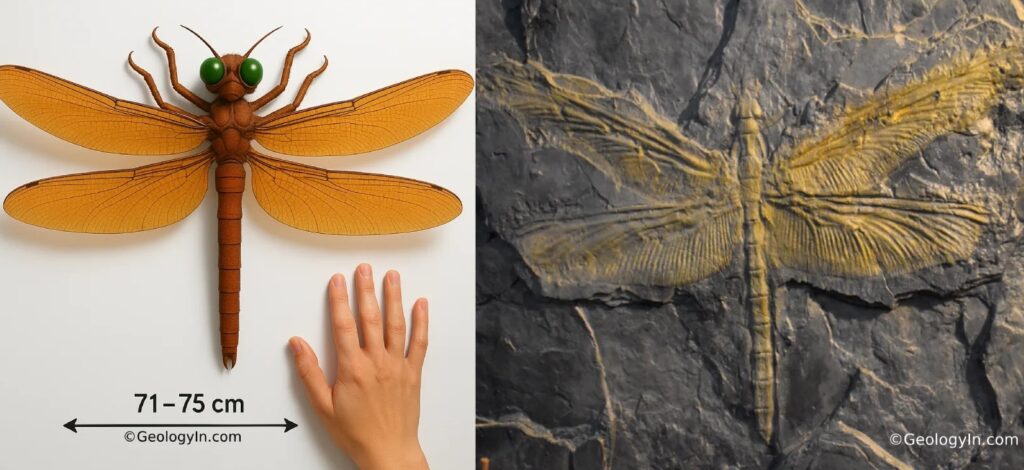
Reconstruction of the ancient giant dragonfly. Image source: GeologyIn.com
How the Permian giant hunted
Meganeuropsis permiana was an aerial interceptor. Rather than ambushing prey from foliage, it patrolled continuously in flight. Its enormous compound eyes allowed it to spot potential victims at a distance, after which it would pursue them in a direct chase.
Its legs were lined with stiff spines and could fold beneath the massive thorax to form a catching basket. Once the insect overtook its prey, it would scoop the victim up with these spiny limbs and dispatch it with powerful chewing mandibles. Its diet most likely consisted of other large arthropods of the era.
Researchers suggest that an evolutionary arms race between predators and prey drove size increases on both sides: prey grew larger to avoid being caught, and predators grew larger to keep catching them.

How the giant dragonfly would have looked on a human hand
Why ancient insects grew so large
The traditional explanation for Permian insect gigantism centers on atmospheric composition. Insects breathe through a network of microscopic tubes called tracheae, and it was long assumed that a surplus of oxygen was the sole factor enabling gas exchange across such a large body. However, oxygen levels were already declining during the Permian, complicating that simple narrative.
A study published in 2026 in Nature found that tracheal volume is not the only hard constraint on insect body size. The research suggests gigantism became possible through a combination of factors:
- The absence of agile airborne vertebrate competitors and predators.
- An abundance of large, nutritious flying prey.
- Favorable climatic conditions and higher air density at the time.
Why giant insects went extinct
During the latter half of the Permian period, proto-dragonflies began shrinking rapidly, and by the start of the Mesozoic era they had disappeared entirely. Crucially, this happened long before the first birds or pterosaurs took to the skies, undermining the popular myth that flying vertebrates outcompeted Meganeuropsis.
The actual cause, according to current understanding, was global climate change and ecosystem restructuring. The drying of humid habitats and the catastrophic Permian mass extinction left these giant insects with no viable ecological niche.
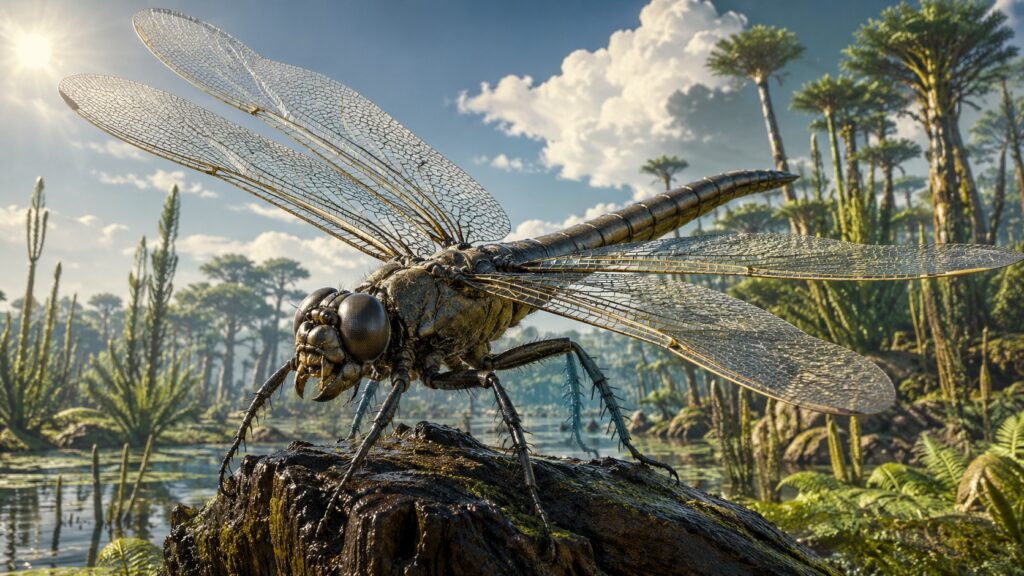
Ancient dragonflies were the size of a pigeon — and there are explainable reasons for it
What we still don’t know
It is important to note that no fully preserved specimen of Meganeuropsis permiana exists. The insect’s dimensions have been reconstructed from fragments of fossilized wings, which give reliable information about its size but reveal nothing about its coloration or body patterning. Those details may remain a mystery permanently.