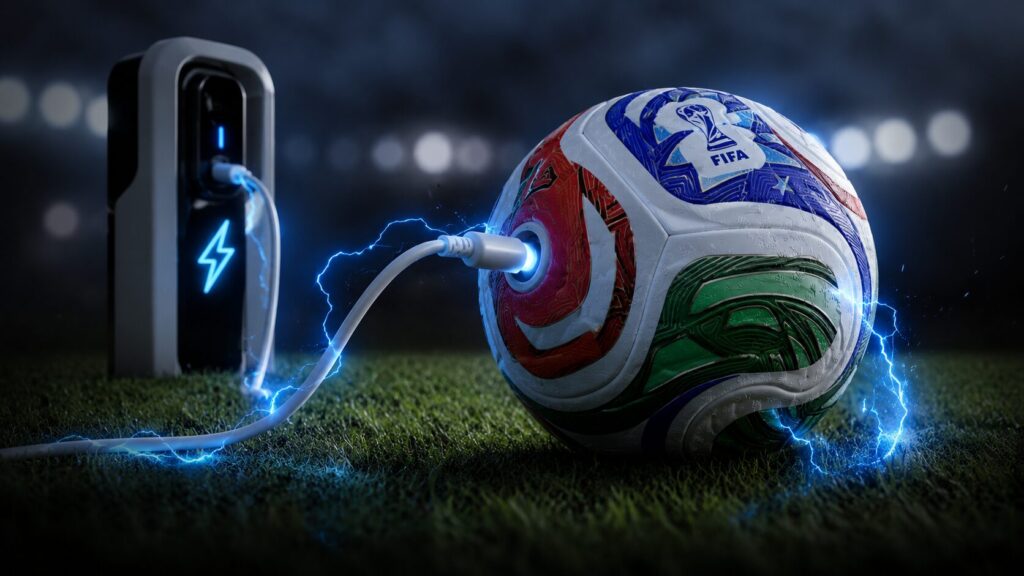
Spoiler for those who read image captions: the charging is not for the ball itself, but for a special sensor inside the ball that resolves disputed moments
The official match ball of the 2026 FIFA World Cup is called Trionda and for the first time requires charging before every match. On the outside, it’s a regular sports ball in the colors of the three host countries — red for Canada, blue for the USA, and green for Mexico. But inside, there’s hidden electronics that turn the ball into a source of useful data, and it’s precisely for this reason the ball needs to be charged. Let’s take a closer look.
What Sensor Is Hidden Inside the Trionda Ball
Inside the Trionda is a so-called IMU sensor — an inertial measurement unit that combines an accelerometer, gyroscope, and magnetometer. It weighs only 14 grams and is built into one of the ball’s four panels. The three remaining panels act as counterbalances: they compensate for the mass difference and maintain symmetry during flight, so the electronics don’t affect gameplay in any way.
Previously, things were done differently. In the ball for the 2022 World Cup in Qatar, the chip was suspended in the center, while in Trionda the chip is located inside a specially created layer under one of the four panels. Counterbalances in the three remaining panels ensure flight stability and balance are maintained. Moving the sensor to the wall freed up the center of the bladder for the battery and charging components. There’s no hint of electronics on the outside, and players don’t feel it.
The Adidas Trionda contains a 500-hertz inertial measurement unit that records ball movement data 500 times per second — a new reading every two milliseconds. Every touch, strike, and deflection becomes a data point with a precise timestamp. The sensor registers ball touches, speed, spin, movement, and trajectory in real time.
Why a Smart Ball Is Needed — What It Can Do
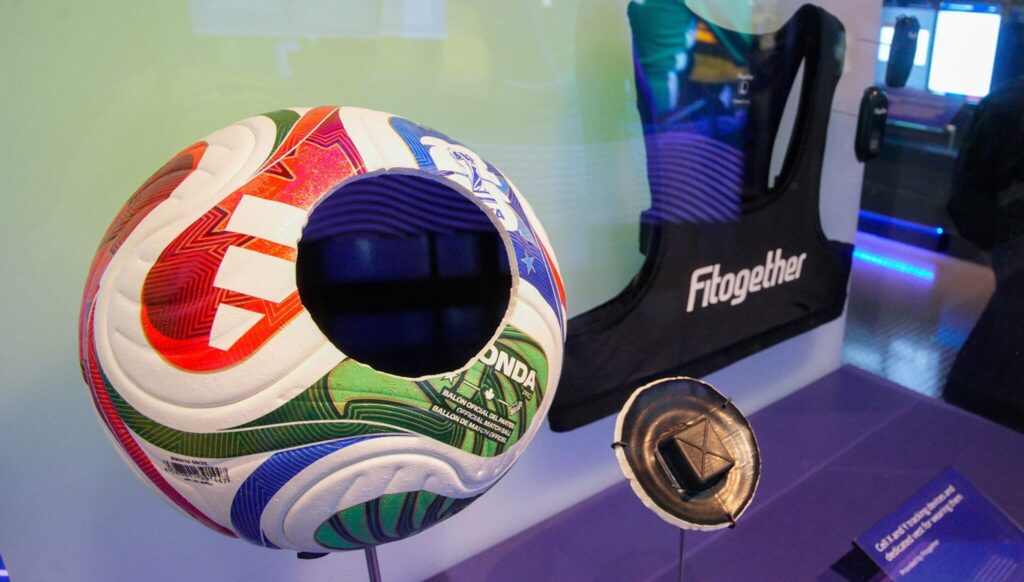
Here is that very IMU sensor
The sensor’s main value is speed. Regular TV cameras simply can’t capture the millisecond when the ball leaves the kicker’s foot, and it’s precisely this moment that determines the correctness of an offside decision. A camera at 60 frames per second takes a new shot roughly every 16.7 milliseconds, and even a 120-frame stream leaves about 8.3 milliseconds between frames.
The sensor in the ball fills these gaps with a much denser data stream. When offside is disputed, the decisive variable is the exact moment of the ball being struck, and readings at 500 hertz allow determining it with single-frame accuracy instead of guessing between video frames.
There’s a second scenario where the sensor is indispensable — handball in tight contests. On regular footage, it can be difficult to tell which body part a player used to touch the ball. The system can also help referees determine ball contacts, saving time on potential handball decisions. The sensor captures the nature of the touch, cameras provide the exact position of limbs — together this allows an episode to be analyzed without lengthy replay reviews.
How Data from the Ball Reaches the Referees
Data from the sensor doesn’t go directly to the referee but into a multi-layered system. Optical cameras installed under the roof of each stadium track the players. The cameras track 29 points on the body 50 times per second and combine this with ball-strike data to automatically draw the offside line. The ball and cameras transmit information simultaneously, and artificial intelligence correlates player positions with the exact moment of the strike, building a three-dimensional picture of the episode.
The main purpose behind all of this is accurate offside detection. Previously, the video assistant referee would evaluate frames independently and relay the decision to the field, which took minutes. The offside system is semi-automatic: AI and sensors measure the player’s position and the moment of the strike, but the final decision is made by the referee, especially regarding whether the offside player interfered with play.
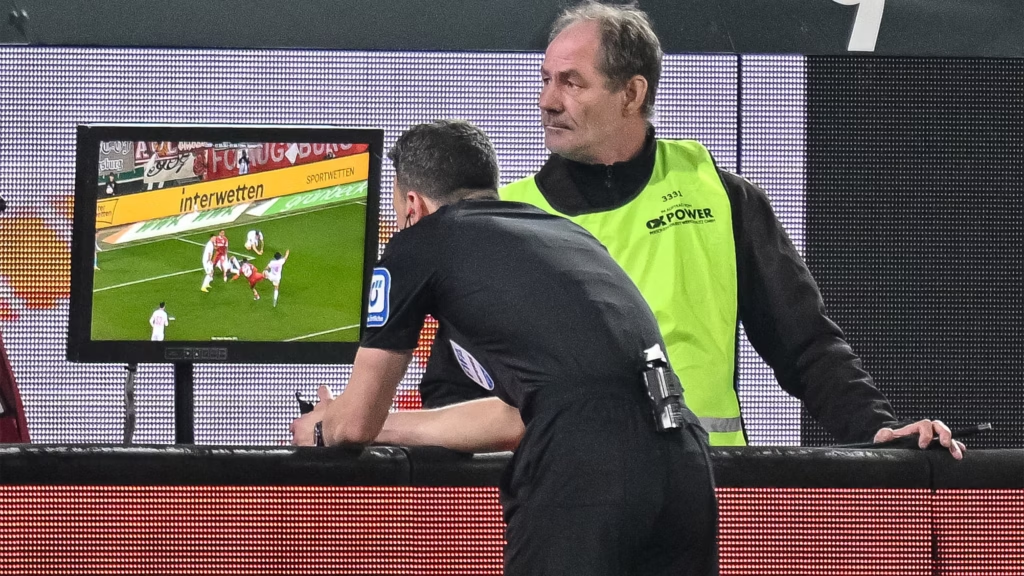
The human eye can’t see everything, but you can’t fool a sensor
According to sources, compared to previous tournaments, the sensitivity threshold has been reduced from 50 to 10 centimeters. This means the automated system now handles nearly all positional offsides: previously it stayed silent if a player went beyond the defensive line by less than half a meter, and such situations were resolved manually with pauses and rewinding. At the same time, the system doesn’t claim to handle everything: subjective situations like obstructing the goalkeeper without touching the ball remain the referee’s call.
The Smart Football with a Built-in Battery — Charging
The sensor runs on a built-in battery, without which it simply doesn’t function. Since the sensor is battery-powered, the ball needs to be charged before matches — a first for a World Cup ball. It sounds unusual, but that’s the price for having what is essentially a tiny computer working inside the ball.
To power the chip, the ball charges in 90 minutes to last six hours on the pitch. Charging is wireless — via a special cradle stand at the stadium before the game. And when the ball is not in play, it automatically enters hibernation mode: this extends the charge and allows the ball to be stored in working condition for several days.
The logical fear is that the ball might die right during a match. In practice, this hasn’t happened yet: according to an Adidas representative, throughout all testing and at the two previous World Cups, as well as at Euro 2024 and the 2025 Women’s European Championship, there was never a need to replace a ball due to a dead battery. In case of an emergency, spare charged balls are always available on the sideline.
How Trionda Differs from the Smart Ball Used in Qatar
The technology of a ball connected to refereeing systems didn’t debut today. The 500-hertz frequency itself isn’t new — Adidas introduced the same sampling rate in the Al Rihla ball at the 2022 World Cup in Qatar. So Trionda is an evolution of an already proven idea, not a revolution from scratch.
The main changes for 2026 are structural. What changed is the sensor placement: in the Qatar ball, the electronics were suspended in the center of the bladder, while in Trionda the chip sits inside a special layer under one of the four panels, with counterbalances placed under the other three panels to maintain balance and flight stability with a simplified internal construction. The number of panels also changed: Trionda has only four, whereas traditional balls had 32. Fewer seams mean fewer air turbulences and more predictable flight. Trionda is used in all 104 matches of the tournament.
The main takeaway from this whole story isn’t the fact that the ball now needs charging, but what it’s done for. The smart ball addresses a narrow bottleneck in officiating: the moment of the strike that no regular camera can see. Going forward, it will be more interesting to watch how far automation goes and where the boundary remains beyond which decisions are still made by humans.