
A woman in sunglasses eating melting pink and yellow ice cream
Slightly melted ice cream tastes sweeter not because it contains more sugar, but because strong cold can dull our perception of sweetness. As ice cream warms, the tongue picks up sugar more readily and aromas reach the nose more easily. Straight from the freezer, a scoop can taste pleasant but only mildly sweet. Let it soften a little and the flavor becomes richer, sometimes even cloying. The difference lies in how the tongue and nose perceive the dessert, not in the recipe.
What you need to know
- Strong cooling can weaken the perception of sweetness. The amount of sugar stays the same, but our sensitivity to it changes.
- In a 2025 study, 22 volunteers rated a warm vanilla custard dessert (about 59 °C) as sweeter than the frozen version (about −3 °C): 20.5 versus 13.3 points on a taste-intensity scale.
- The study used a custard dessert, not commercial ice cream, and the link between tongue temperature and sweetness was fairly weak.
- Melting also releases aroma compounds more readily, and vanilla aroma itself can enhance the sense of sweetness.
Cold mutes sweet taste
The tongue contains taste cells that detect sugar and send signals to the brain. Strong cooling can weaken the perception of sweetness. As ice cream warms in the mouth, its taste becomes more noticeable. The amount of sugar in the serving does not change. What changes is our sensitivity to it.
This is why the same product can seem very different at different temperatures. An ice-cold soda tastes refreshing, while a warm one often seems too sweet. Ice cream works in a similar way, except that its unusual structure also plays a role alongside temperature.
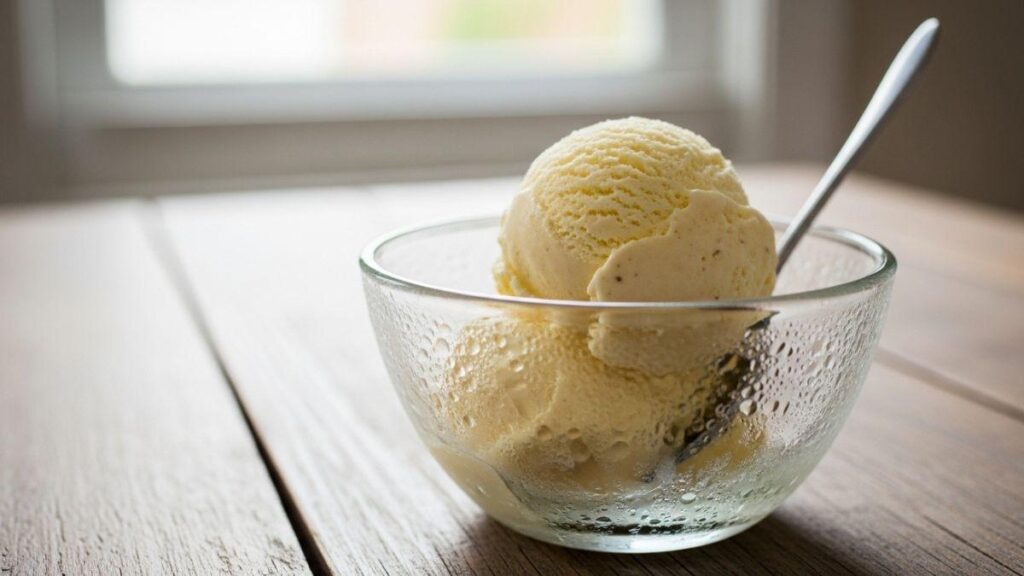
Classic vanilla ice cream in a glass dessert bowl. Its dense, still-frozen texture is clearly visible.
Researchers compared one dessert at four temperatures
In 2025, researchers tested this effect with 22 volunteers. Participants were given a vanilla custard dessert in four versions: frozen (about −3 °C), chilled (about 5 °C), room temperature (24 °C) and warm (about 59 °C). An infrared camera measured the surface temperature of their tongues.
Participants rated the warm dessert as noticeably sweeter than the frozen one: 20.5 versus 13.3 points on a taste-intensity scale. On average, the warmer the tongue became, the stronger the sweetness and vanilla flavor were perceived, although this relationship was fairly weak.

Four servings of ice cream
An important limitation
The researchers studied a custard dessert, not store-bought ice cream. That means it cannot be claimed that any ice cream becomes sweeter by a specific percentage as it melts. The temperature effect itself, however, appears to be real.
Melting also releases more aroma
Ice cream is not simply frozen milk and sugar. It contains ice crystals, fat, tiny air bubbles and aroma compounds. While the dessert is very cold, aromas are released more slowly. As it melts, they reach the nose more easily, including from the mouth while eating. Research on ice cream supports this.
The brain perceives taste and smell together. That is why slightly softened ice cream can seem creamier, more vanilla-like or more chocolatey. Vanilla aroma on its own can also enhance the sensation of sweetness. The result is a double effect: the tongue detects sugar better, and the nose picks up more aroma.
Why sugar can’t simply be removed from the recipe

Ingredients for homemade ice cream laid out on a wooden surface
If melted ice cream tastes so sweet, why don’t manufacturers simply add less sugar? Because sugar is also needed for the right consistency. It affects how the mixture freezes, how ice forms and how soft the finished dessert is. Without it, the result could be a much harder, icier mass instead of a smooth, creamy ice cream.
For this reason, ice cream is formulated with its frozen state in mind. Once it melts completely, the flavor balance shifts, and sweetness that was previously muted comes to the fore.
Slightly softened is good; fully melted is not
For a more vivid flavor, there is no need to turn ice cream into a milkshake. Waiting a few minutes is enough for a scoop to soften slightly, so a spoon slides in without effort. At that point the aroma is more pronounced while the familiar creamy texture is still intact.

A woman tasting melting ice cream
Don’t refreeze a melted tub
A melted tub is better not put back in the freezer. Refreezing changes the structure of the ice cream and produces larger ice crystals. If the ice cream has sat in a warm place for a long time, there is also a risk of bacterial growth.
Food safety guidance recommends discarding ice cream that has fully thawed, even though many people find it hard to throw food away.