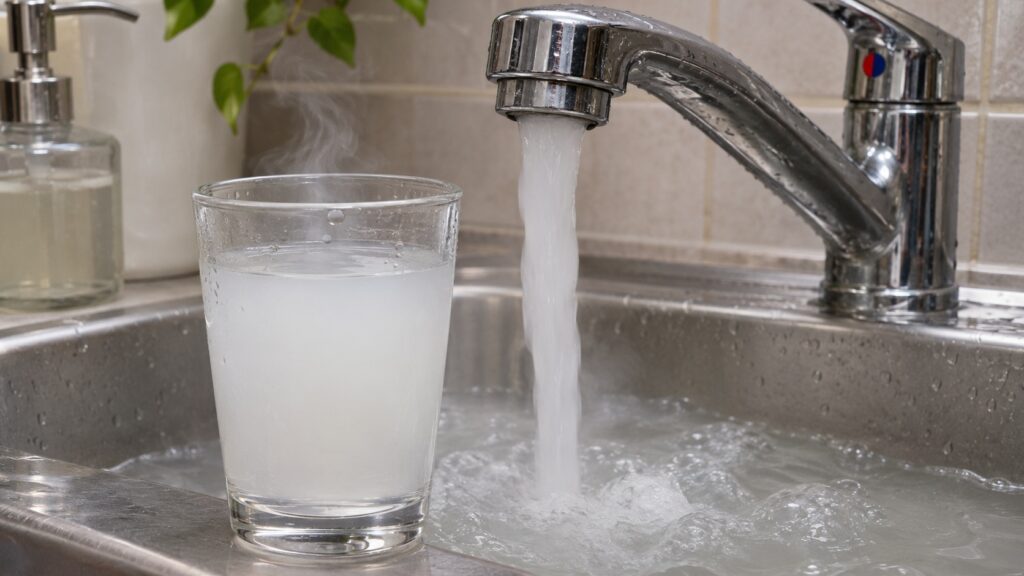
Cloudy hot water in a sink
Hot tap water can come out milky white while cold water from the same faucet stays clear. Often the cause is harmless: dissolved air escaping as tiny bubbles. Sometimes, however, cloudiness points to rust, scale or sediment from pipes or a water heater. A simple test with a clear glass can help tell the difference in about a minute, without laboratory analysis.
What you need to know
- The U.S. Geological Survey (USGS) names dissolved air as one of the main causes of whitish tap water and says the air itself is harmless.
- If cloudy water clears from the bottom up within about a minute, the cause is almost certainly air bubbles rising to the surface.
- Persistent cloudiness, flakes, yellow-to-brown color or an unusual smell can indicate rust, scale, sediment or other plumbing problems.
- Clear water is not automatically safe: dissolved metals can be present even in perfectly transparent water.
White cloudiness is dissolved air
Tap water always contains dissolved gases, mainly the nitrogen and oxygen that make up ordinary air. While water travels through pipes under pressure, these gases stay dissolved and are invisible.
Opening the faucet triggers two effects at once. First, the pressure drops sharply: it is higher than atmospheric pressure inside the pipes, but in a glass the water is at normal pressure. Second, hot water holds less gas than cold water, so heating already prepares some of the air to leave. At the tap, both effects combine, and thousands of tiny bubbles form.
These bubbles scatter light, which makes the water look white. The same thing happens in a freshly poured fizzy drink, although its bubbles are larger. The USGS identifies dissolved air as one of the main reasons tap water looks whitish and stresses that the air itself is harmless.
Other causes: rust, scale and heater sediment
Cloudy water can look much the same from the outside while having different causes. Besides air, hot water may contain:
- Rust particles. Corrosion products build up in old metal pipes. After a period of disuse or a pressure surge, they can reach the tap, turning the water yellowish, orange or brown.
- Scale. Calcium and magnesium salts dissolved in water partly precipitate as a solid deposit when heated, and white grains of it are sometimes flushed out of the heater or pipes.
- Sediment from pipes and water heaters. Deposits accumulate inside equipment over the years and may come out as flakes, grains of sand or dark specks after repairs or a change in flow.
Some contaminants cannot be seen at all. Dissolved metals can be present even in perfectly clear water, so appearance alone cannot tell you whether water is safe.
The one-minute clear-glass test
The USGS recommends a simple test. Pour the cloudy hot water into a clear glass, leave it for about a minute and watch what happens:
- The water clears from the bottom up: this is almost certainly air. The bubbles rise, so the bottom clears first.
- The cloudiness stays, or flakes and sediment appear: the water probably contains solid particles such as rust or scale.
- The water is yellow, orange or brown: iron and pipe-corrosion products are the likely cause.
- There is an unusual smell: this is a separate reason to have the plumbing checked, especially if the smell does not go away.
If air is the cause, the water sometimes clears before your eyes, and the white haze soon disappears completely.
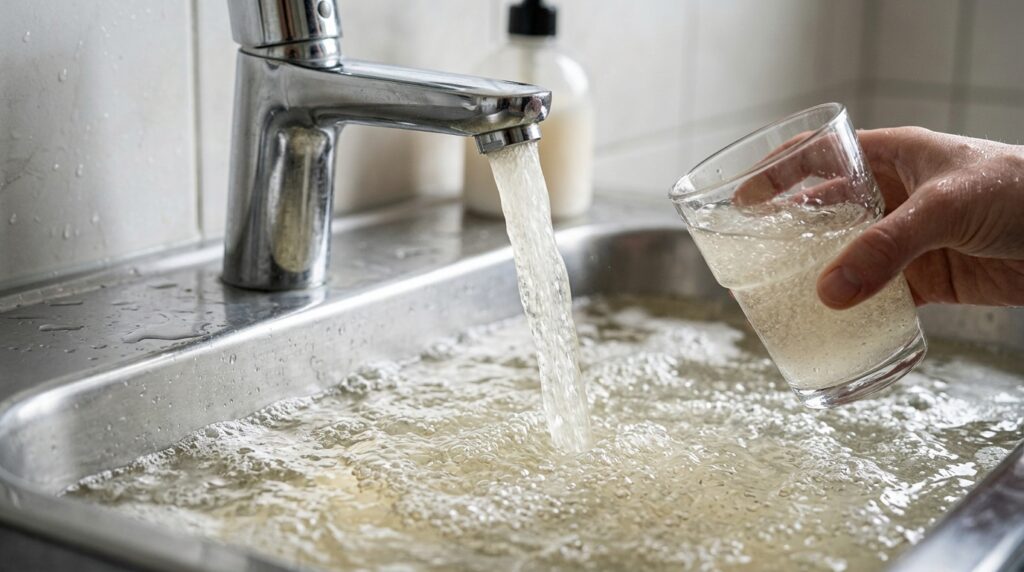
Cloudy water flowing from a faucet into a metal sink
Why cold water is the better choice for drinking and cooking
It is more reliable to drink and cook with cold tap water, provided it meets drinking-water standards, and to heat it yourself. The bubbles are not the reason. Hot water passes through additional equipment and stays in contact with pipes, faucets and heaters for longer, and at high temperatures substances from these materials pass into the water more quickly.
Hot water dissolves lead faster from plumbing components that contain it, so only cold water should be used for drinking, cooking and infant formula. This does not mean every home has lead: it depends on what the plumbing is made of. But it is a reasonable precaution, especially in apartment buildings where hot water comes from a shared system rather than being heated right before the tap.
Boiling does not solve this problem. It kills many disease-causing microbes but does not remove dissolved lead. Prolonged boiling can even raise the concentration of non-volatile impurities, because some of the water evaporates while those impurities remain.
Why hot-water temperature limits exist: the Russian example
In Russian apartment buildings with centralized hot water supply, water at the tap must be no colder than 60°C and no hotter than 75°C, as set out in the sanitary rules SanPiN 2.1.3684-21. A deviation of up to 3 degrees is permitted during the day and up to 5 degrees at night, from midnight to 5 a.m. These figures apply to Russia and should not be assumed to apply elsewhere.
The lower limit is not about comfort. Below 60°C, bacteria can multiply in pipes, including Legionella, which causes a severe form of pneumonia. The upper limit protects against burns: water hotter than 75°C can scald skin within seconds.
When cloudy water is a reason to check the plumbing
If white cloudiness clears quickly and the water becomes transparent, no action is needed. The warning signs are water that consistently runs orange or brown, carries flakes or sand, or has an unusual smell. These can indicate pipe corrosion, accumulated deposits or a faulty water heater.
Owners of a water heater should check its condition and find out whether it needs servicing. If hot water comes from a centralized system, contact the building’s management company or the organization responsible for the water supply. Until the cause is found, it is better not to drink or cook with discolored water or water containing sediment.
The rule of thumb is simple: if water turns white and clears within a minute, that is ordinary physics. But clarity does not guarantee safety, so for tea, coffee and food it is more reliable to draw cold drinking water and boil it yourself.