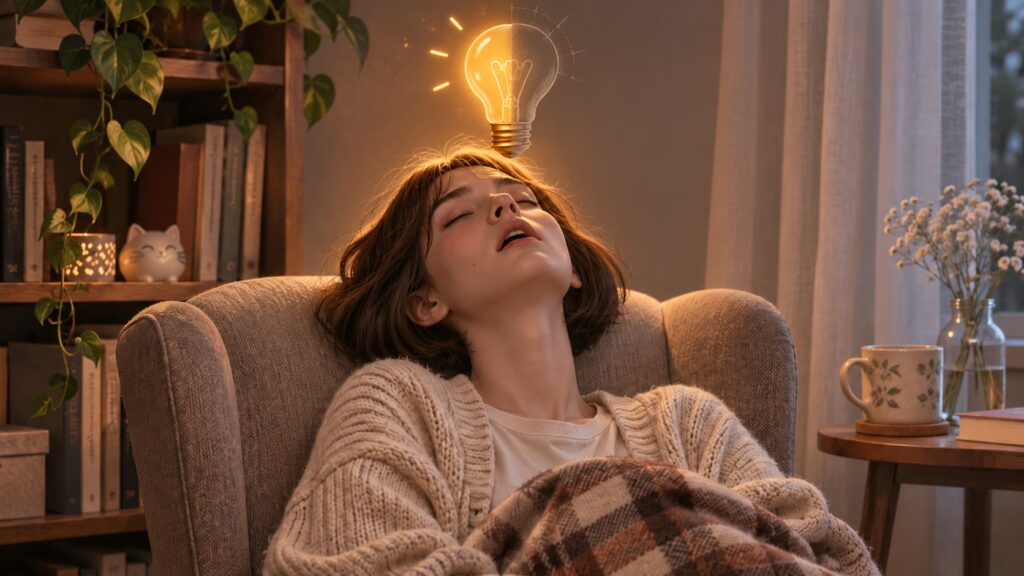
A young woman asleep while sitting in an armchair
A very short nap may help you approach a stuck problem from a new angle, but probably not in the way you expect. In an experiment at the Paris Brain Institute, 83% of participants who briefly dozed off later discovered a hidden shortcut in a series of math problems, compared with about 30% of those who stayed awake. As little as 15 seconds of the lightest stage of sleep was enough. The catch: falling into deeper sleep erased the advantage, and the insight did not arrive at the moment of waking.
What you need to know
- Of 24 participants who woke during the onset of sleep, 20 (83%) later found a hidden shortcut in a math task, versus about 30% of those who never fell asleep.
- Only 2 of 14 participants who slipped into the next, deeper sleep stage found the shortcut, so the timing of waking appears to matter.
- The insight did not come on waking: participants needed an average of 94 more attempts, and the content of their micro-dreams did not predict success.
- The finding comes from a single lab study on one specific type of problem, and the underlying mechanism is still unexplained.
Salvador Dalí and the key-in-hand nap
Online stories often claim that Edison, Tesla, Einstein, da Vinci and Dalí all fell asleep holding something heavy. When the object dropped, the noise woke them, and they could capture strange images before those faded. Popular Science looked into the story and found reliable confirmation for only one of the five: Dalí.
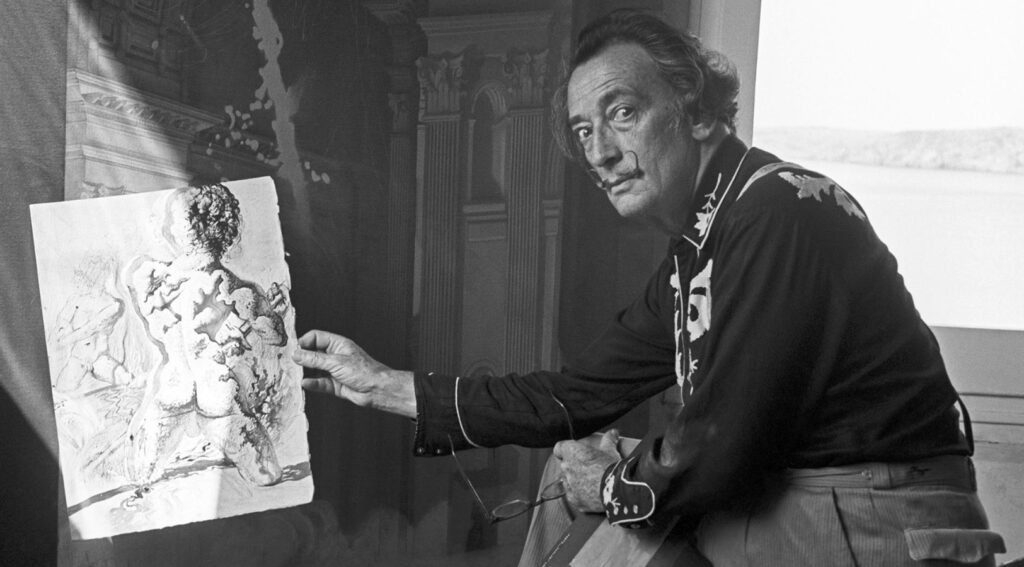
The artist Salvador Dalí. Image source: timeout.com
In his book 50 Secrets of Magic Craftsmanship, Dalí describes a technique he called “sleep with a key.” You sit in a hard chair, hold a heavy key between your fingers and place a plate on the floor below. As you drift off, the key slips and clatters against the plate. According to Dalí, even a few seconds of this kind of sleep could yield invaluable creative discoveries.
It sounds like the habit of an eccentric artist, but the trick may have a scientific explanation, one tied to the very first moments of sleep.
The first stage of sleep, where the mind starts to drift
The brain does not switch off all at once when we fall asleep. It first passes through the lightest stage of sleep. Muscles relax, and dream-like images assembled from recent impressions begin to appear, much like seeing falling blocks after a long session of Tetris before bed.
People woken at this stage often insist they were not asleep at all, yet whole “micro-dreams” with fairly complex scenes can unfold in these moments. Consciousness has not shut down, but it has loosened its grip on logic, and thoughts begin to link to one another more freely.
This borderline state between wakefulness and sleep is what caught researchers’ attention: could it help people think in unconventional ways?
People with narcolepsy scored higher on creativity tests
The researchers first turned to people with narcolepsy, a disorder in which a person frequently and suddenly slips between wakefulness and sleep, regularly passing through that intermediate state.
They compared 185 patients with 126 people who sleep normally. The narcolepsy patients scored higher on every creative-thinking test. There was also a pattern: the more often a person experienced these mixed states between sleep and wakefulness, the higher their score.
That did not prove the first stage of sleep was responsible. People with narcolepsy differ in many ways, and any of those differences could have influenced the results. So the next step was a direct experiment with ordinary sleepers.
The bottle experiment: 83% found the hidden solution
The study was carried out at the Paris Brain Institute and led by Célia Lacaux and Delphine Oudiette. Participants worked through a series of similar math problems. Hidden in them was a shortcut that allowed the answer to be found almost instantly, but no one was told about it.
Those who had not spotted the trick after 30 attempts were given a 20-minute break in a dark room. They held a plastic bottle in one hand, much as Dalí held his key. If they fell asleep, the bottle dropped and woke them. Throughout the break, electrodes recorded their brain activity so the researchers knew whether, and how deeply, each person had slept.
The results were notable:
- Of the 24 people who dropped the bottle while falling asleep, 20 later found the shortcut, or 83%.
- Among those who never fell asleep, about 30% worked it out.
- Even 15 seconds of light sleep was enough.
- If a participant sank into the next, deeper stage of sleep, the advantage disappeared: only 2 of 14 such participants found the rule.
In other words, the point is not simply to nap, but to wake up at the right moment. The bottle or key acts as an alarm that pulls a person out of the useful state before sleep becomes deep.
The insight does not arrive on waking
On one important point, the science did not back Dalí. The artist described waking up with a brilliant idea already in mind. The study participants experienced nothing of the sort: on average, they needed another 94 attempts to crack the problem.
Nor were they solving math in their sleep. After waking, participants were asked to describe what they had seen, and the content of these micro-dreams had no bearing on how quickly they found the answer. The link between brief sleep and ingenuity turned out to be more diffuse and puzzling. Light sleep seems not to hand over a solution, but to somehow reset thinking so that it becomes easier to look at the problem from a different angle afterward.
Exactly how this works remains unclear. The researchers identified a characteristic pattern of brain activity that accompanies this “creative window,” but cannot yet explain why it helps.
Can you use the trick yourself?
In theory, yes. The study’s authors reportedly take daytime naps holding a plastic bottle themselves, and researchers at the Massachusetts Institute of Technology are also looking for practical ways to use the effect. But there is no reason to expect miracles:
- The experiment tested one specific problem, not creative ability in general.
- It was conducted in a lab where sleep was monitored with instruments; at home, it is hard to tell whether you have slipped too deep into sleep.
- The effect does not appear immediately and is not guaranteed for everyone.
If you are stuck on a problem, a short doze with a key or bottle in hand is unlikely to do harm, but it will not turn you into a genius. It is more honest to treat it as a way to give your brain a small jolt when work has hit a dead end.
What remains to be tested
Scientists still need to find out whether the effect holds for other types of problems and in everyday life, not just in the lab. For now, there is one carefully conducted study and an intriguing hint, not a ready-made recipe.