When a large ship enters dry dock, an almost comical detail is revealed: its underside is bright red. While the vessel is afloat, this section stays hidden beneath the waterline, making it easy to dismiss the color as maritime tradition or a design quirk. In reality, the red paint works where the hull faces its toughest challenge — in saltwater teeming with bacteria, algae, and mollusks. The coating keeps the ship fast and prevents the ocean from turning bare metal into a small living reef.
What you need to know
- The red color comes from cuprous oxide (Cu₂O), a red-brown compound long used as the active biocide in antifouling paints.
- According to the International Maritime Organization, a slime layer just 0.5 mm thick covering half a ship’s underwater surface can increase greenhouse-gas emissions by 20–25%.
- Tributyltin (TBT) antifouling paints were banned under an IMO convention that entered into force in 2008; restrictions on cybutryne followed from January 1, 2023.
- Modern antifouling coatings come in many colors — black, blue, green, gray, even near-white — so red is no longer mandatory, though it remains the most common choice.
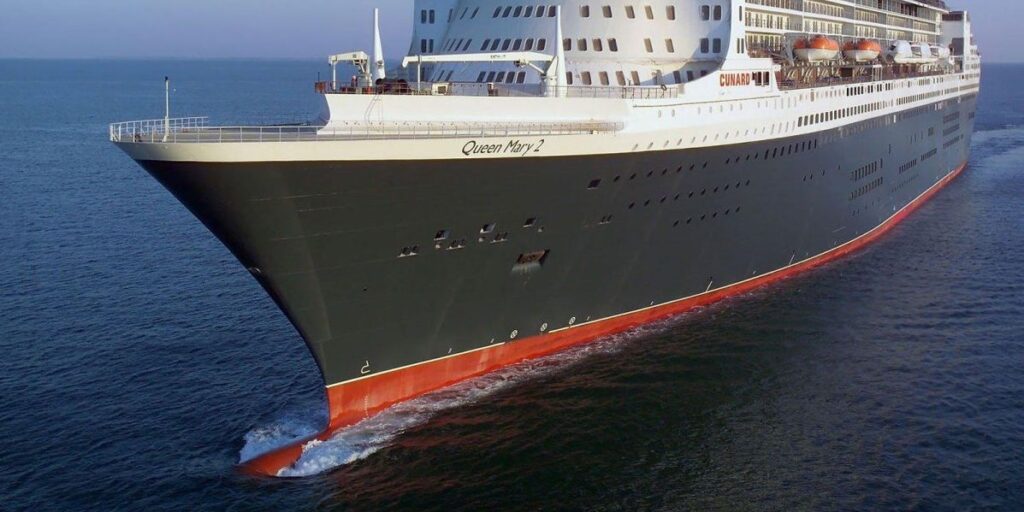
Why are ship hulls painted red? Image source: ixbt.com
The red hull protects against biological fouling
Any surface submerged in the sea for an extended period quickly stops being clean. First a thin biofilm of bacteria and organic matter forms. Then algae, mollusk larvae, and barnacles — small crustaceans in hard calcareous shells — attach themselves. Gradually, a smooth hull becomes covered in a genuine underwater ecosystem.
This process is called biofouling. On ships it affects not only the hull itself but also rudders, propellers, water-intake grilles, and other components in constant contact with seawater. To combat it, shipbuilders apply specialized antifouling coatings.
The visible red layer is typically not a simple enamel but the outermost part of a multi-layer system. Beneath it sit an anticorrosion primer and a tie coat that shield the steel from water and oxygen. The external layer discourages marine organisms from attaching. Some paints gradually release small amounts of biocides; others create a surface that is too smooth or slippery for organisms to grip. Experimental coatings that avoid toxic components altogether are also in development.
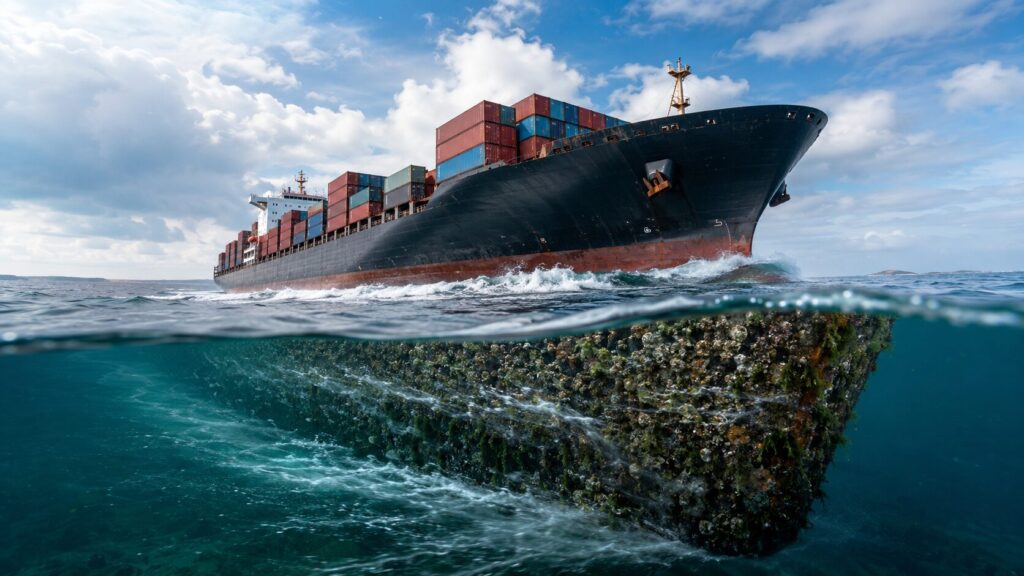
Ship hulls are painted red to protect them from biofouling.
Where the red color comes from
The traditional hue was never about aesthetics. One of the main active ingredients in antifouling paints has long been cuprous oxide — a compound with the formula Cu₂O. According to the PubChem chemical database, it is a red or reddish-brown powder.
Cuprous oxide gradually interacts with seawater, creating conditions near the hull surface that make it harder for many algae, mollusks, and crustaceans to settle and grow. Because the pigment is present in high concentrations, its natural color dominates the paint’s overall appearance.
Copper has been used to protect ships long before the modern chemical industry existed. Wooden hulls were sheathed in copper plates to ward off marine organisms. Particularly dangerous were shipworms — actually mollusks capable of boring through timber from the inside.
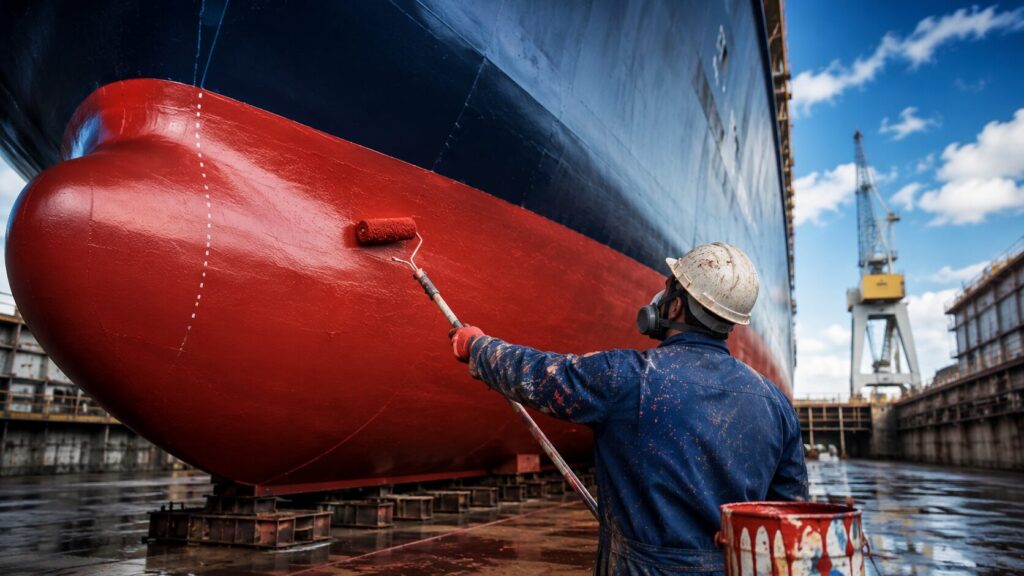
The tradition dates back to the age of sail, when wooden hulls were attacked by marine organisms that could damage and destroy the structure.
Later, copper migrated from metal sheathing into paint formulations. The red hull is therefore a legacy of an old and highly practical technology. The popular notion that the color merely masks rust is an oversimplification: corrosion protection comes from the lower layers of the coating system, while the visible red paint primarily fights biofouling.
A fouled hull dramatically increases fuel consumption
A few barnacles on the bottom may look harmless, but for a large vessel even a thin layer of growth becomes a serious problem. A smooth hull glides through water easily; a fouled one resembles a rough wall that engines must force forward.
According to an estimate by the International Maritime Organization, a slime layer just 0.5 millimeters thick covering half of a ship’s underwater surface can increase greenhouse-gas emissions by 20–25%. The exact figure depends on hull shape, speed, and sailing conditions, but the scale is striking — this is a film thinner than a bank card, not a thick carpet of shells.
The added drag forces the ship to burn more fuel, reduces its ability to accelerate, and diminishes maneuverability. Engine loads rise in parallel. Ship owners must therefore regularly inspect, clean, and repaint the hull in dry dock.
Saltwater also accelerates electrochemical corrosion of metal. Ordinary steel at sea requires especially thorough isolation, whereas stainless steel is protected by a thin chromium-oxide layer. Even expensive alloys, however, do not eliminate the need to maintain the underwater portion of the hull.
Modern hulls do not have to be red
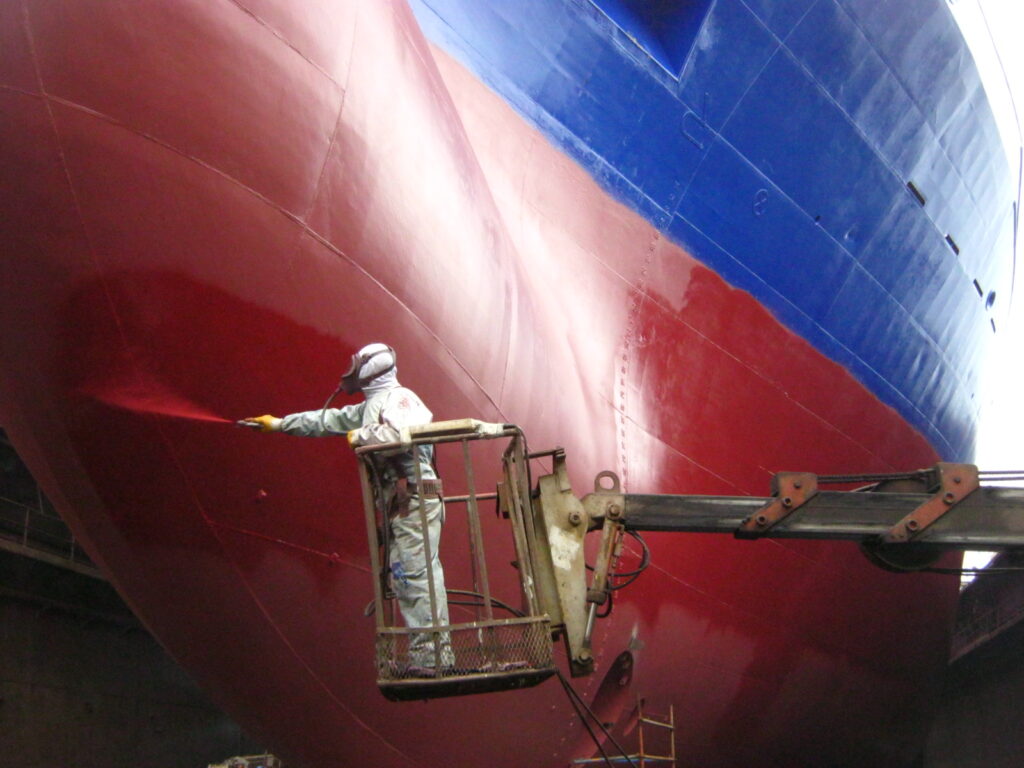
Other antifouling pigments and dyes have since appeared, so today a hull can be any color. Most ships, however, remain red.
Today red remains the most recognizable hull color, but it is no longer mandatory. Antifouling coatings are available in black, blue, green, gray, and even near-white. The color depends on the pigments used, the paint formulation, and the shipowner’s requirements.
The working principle is also evolving. Self-polishing coatings very slowly renew their outer layer while the ship is underway. Water gradually acts on the binding polymer, removing the old surface and exposing a fresh layer containing antifouling agents. The hull stays relatively smooth throughout.
Another approach uses silicone and fluoropolymer coatings with low surface adhesion. Marine organisms may briefly attach, but they hold poorly and are dislodged by the ship’s movement or during cleaning. Hydrogels, micro-textured surfaces inspired by marine-animal skin, and copper-free formulations are also under development.
The red hue persists thanks to habit, the widespread use of cuprous oxide, and a vast body of established manufacturing processes. But color alone cannot reveal the exact composition of a paint.
The most effective paints had to be banned
In the 1960s, coatings based on tributyltin (TBT) appeared. They excelled at preventing fouling and could last for years. The problem emerged later: tin compounds did not stay on the hull — they leached into the water and accumulated in bottom sediments.
Even low concentrations of TBT disrupted the development of oysters and other mollusks. In some marine snails it caused imposex — females developed male sexual characteristics and lost the ability to reproduce normally. An effective ship paint had become a threat to entire coastal ecosystems.
The International Maritime Organization adopted a corresponding convention on October 5, 2001. It entered into force on September 17, 2008, banning the use of organotin compounds as biocides on ship hulls. From January 1, 2023, restrictions were extended to cybutryne, another substance used against algae.
Copper-based paints remain permitted in many countries, but their use is regulated: excess copper can accumulate in enclosed harbors and harm organisms that were never going to settle on a ship. An ideal coating therefore does not yet exist. It would need to work for a long time, keep the hull smooth, and avoid turning the surrounding water into a pesticide solution.
The red stripe does not show how loaded a ship is
The red portion of the hull is often mistaken for the waterline, but the two are not quite the same thing. The paint boundary marks the area designed for constant or frequent contact with water. The actual water level changes depending on cargo, fuel reserves, waves, and water density.
On many ships a narrow dark band runs between the red bottom and the main hull paint. This is called the boot stripe or variable-waterline belt — a zone that alternates between submersion and exposure to air and becomes dirty especially quickly.
The permissible load is indicated by a separate mark on the side of the hull — the load line, or Plimsoll disc. The red bottom therefore does not reveal how many containers are inside a ship. It communicates something else entirely: this entire section of the hull must remain smooth, protected from corrosion, and as unappealing as possible to marine life.
The bright red paint is almost always hidden from passengers, yet speed, fuel consumption, and the health of the sea depend on it directly. It may not be the most visible part of a ship — but it is one of the most important.