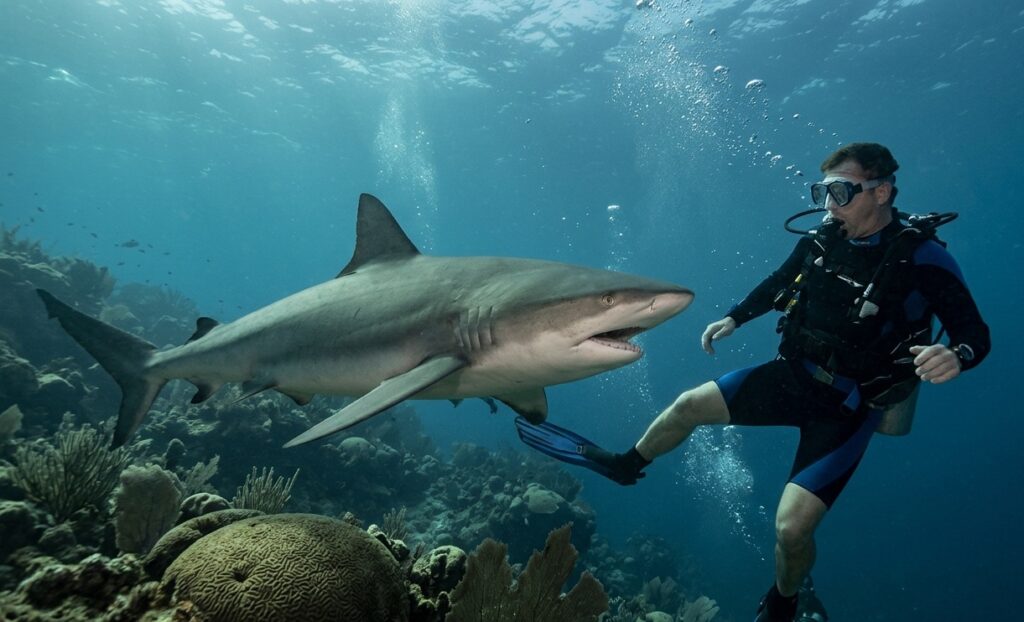
For a shark, a human is very bony food, but they still attack us
Every year, millions of people swim in the ocean, but the moment we swim a little longer, an ancient anxiety awakens in our minds. We fear that a huge jaw will appear from the darkness, even though in reality humans almost never interest sharks as food. Let’s figure out why shark attack statistics on humans are negligibly low, yet this fear remains one of the strongest in our culture.
How Often Do Sharks Attack Humans
Judging by the news, it might seem that marine predators patrol coastlines daily in search of tourists. However, the figures from the International Shark Attack File tell a different story: in 2025, scientists confirmed 65 unprovoked bites worldwide, of which only nine resulted in death. The previous year, this number was even lower — just 47 cases.
Against the backdrop of millions of surfers, divers, and ordinary vacationers, this is a negligibly small probability. Each year, only dozens of confirmed unprovoked incidents occur worldwide, making the ocean far safer than the car ride to the beach. But every shark attack on a human looks so terrifying that our brains refuse to trust the dry statistics.
Why Sharks Don’t Eat Humans
The main secret behind human safety lies in the fact that we are not a normal part of the marine environment. In terms of body composition, we are completely unlike fatty seals or sea lions, which provide predators with the necessary energy. Oceanologists who study how and why sharks attack humans confirm that we appear in the water only occasionally and represent too bony a target.
Fish don’t have hands to touch an unknown object, so their only way to explore the world is through a bite. Most incidents occur due to simple shark curiosity. This is especially true for surfers on small boards, because from below their silhouette closely resembles pinnipeds. One study showed that a young shark often confuses a surfer with a seal due to the peculiarities of light refraction and its own inexperience.
In most cases, the animal takes an exploratory bite, realizes its mistake, and swims away. The problem is that even a single bite from a large specimen is mortally dangerous for the fragile human body due to blood loss. It’s worth remembering that sharks are among the animals with the most powerful bite force. At the same time, the predator does not set an initial goal of dining on a tourist.
Why Sharks Swim Near Beaches
Of the hundreds of existing species, only a few are considered truly dangerous to humans, including the great white, tiger, and bull shark. Most serious incidents involve this big three, while the remaining species feed on small fish, crustaceans, or plankton.
Dangerous encounters near shores don’t happen because fish come out to hunt humans. The risk increases when our recreation zones overlap with predators’ feeding grounds. If the water becomes murky, a school of small fish approaches the shore, or fishermen are actively working nearby, the probability of an encounter increases sharply.
Additionally, some bites are elementary self-defense. Daredevils often swim too close, try to capture dramatic footage with action cameras, or touch the fish with their hands. In such situations, the survival instinct kicks in, and the animal simply defends its personal space from intrusive attention.
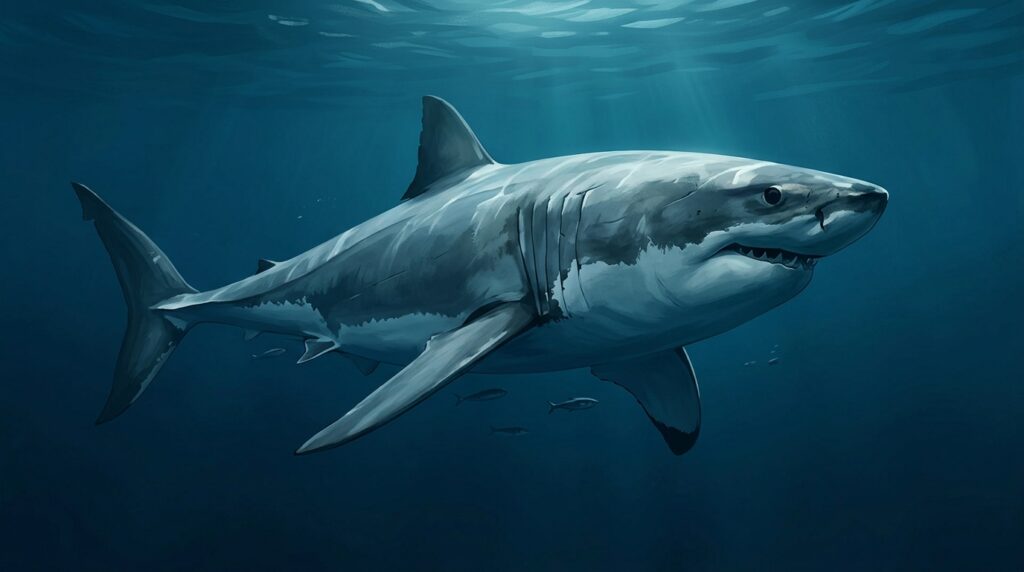
Large shark species approach shores exclusively following migrating fish
Why People Are Afraid of Sharks
If the risk is so small, why do we continue to be terrified? The first reason is that our brain considers more probable whatever is easy to recall. News about a beach tragedy with vivid details becomes etched in memory for years, while millions of peaceful swims go unnoticed.
The second powerful reason lies in pop culture. After the release of the film “Jaws,” the image of the marine predator definitively became a symbol of sudden and invisible death from the darkness. In the water, we are weak, slow, and nearly blind, which completely strips us of any sense of control over the situation.
Popular myths about sharks don’t help either. There’s a misconception that a predator can detect the smell of fear or swim to a single drop of blood from kilometers away. In reality, these fish have developed electrosensory organs that help detect the electric fields of living creatures, but they cannot read emotions. It’s not your inner fear that’s dangerous, but panic — because chaotic arm flailing and splashing make a person visually resemble an injured fish.
How to Avoid Becoming a Shark Victim
For many of us, this problem isn’t particularly pressing, since sharks in Russia are virtually nonexistent. However, when planning a vacation in Egypt, Australia, South Africa, or the Bahamas, it’s worth following simple safety rules to minimize any risks.
Experts recommend observing the following precautions:
- Don’t swim at dusk or at night, when predators are most active in searching for food;
- Avoid areas near fishing boats and spots where rivers flow into the sea;
- Don’t enter the water with fresh scratches or heavy bleeding;
- Remove shiny jewelry, which underwater resembles fish scales;
- Don’t panic or create excessive splashing if a fish appears nearby.
If an encounter does occur, the main rule is to maintain eye contact and slowly retreat toward the shore or a boat. Try to hold any object in front of you — whether it’s a fin, a surfboard, or an underwater camera — to create a barrier.
It’s important to remember that today it is humans who pose the greatest threat to the ocean. Due to predatory fishing and climate change, populations of many sharks have critically declined, and about a third of species are now threatened with extinction. Sharks don’t need our admiration or our fear — they simply require respectful treatment and the maintenance of a reasonable distance.