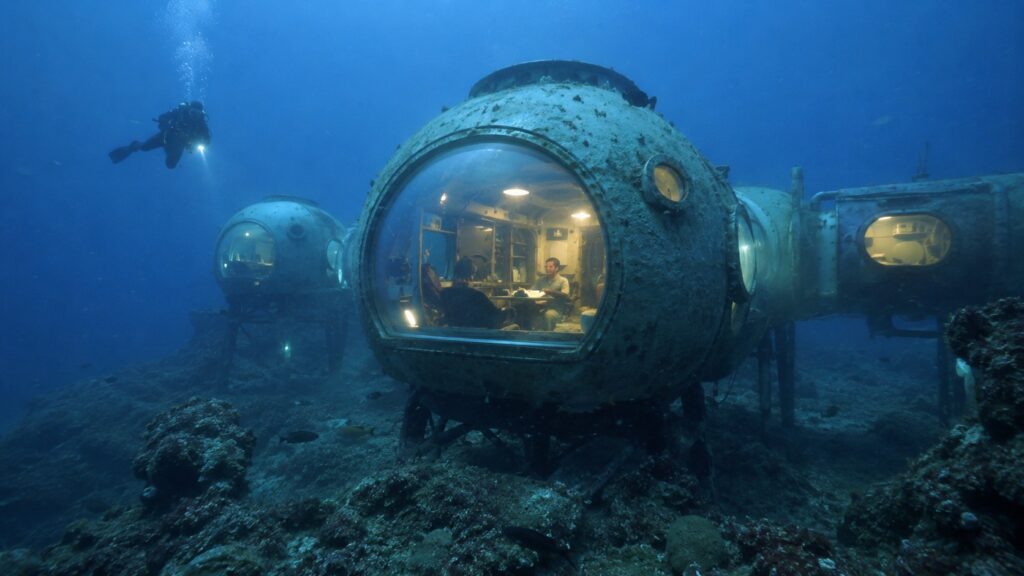
People wanted to live underwater, but several factors prevented it
Humanity has successfully landed on the Moon and sends probes beyond the Solar System, but has never built underwater cities on its home planet. Half a century ago, scientists were confident that life underwater would become a reality: people would ride trains along the ocean floor and spend vacations in submerged hotels. Let’s explore how technological progress first opened the ocean depths to us and then forced us to abandon the idea of settling there permanently.
How People Planned to Live Underwater
According to Popular Science, in the early 20th century, engineers seriously considered relocating familiar terrestrial infrastructure to the ocean floor. For example, in 1932, a French inventor proposed creating an unusual hybrid of a car and a submarine. Passengers were supposed to descend into a sealed cabin on caterpillar tracks and travel along the seabed, watching fish through portholes.
The same project also described an underwater railway, where special passenger cars would be pulled along rails directly beneath the water. Even then, ocean exploration was seen as the first step toward creating permanent underwater settlements and tourist routes for ordinary people.
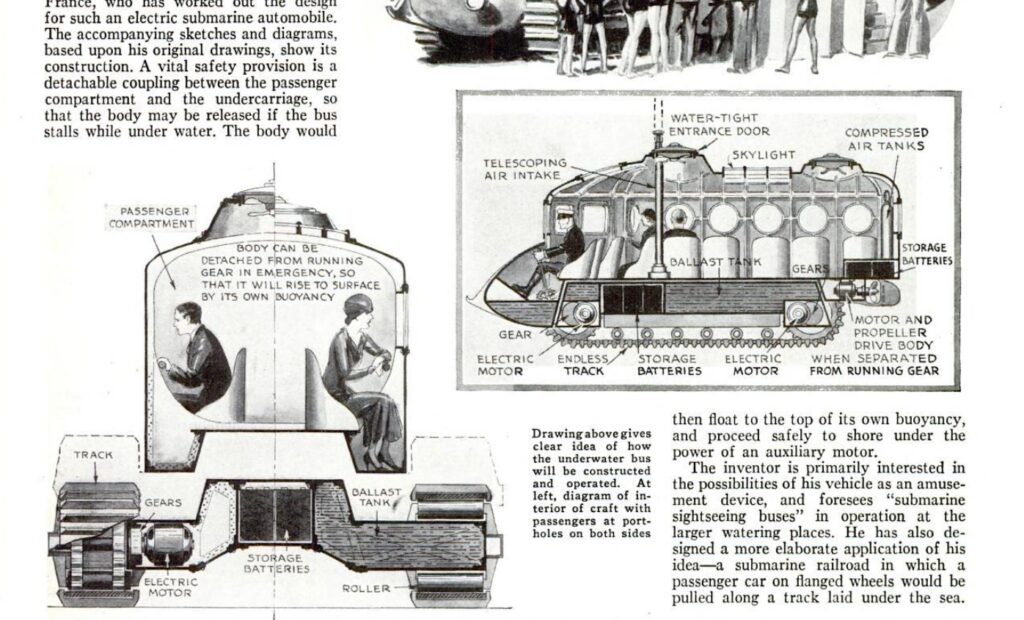
A hybrid of a car and a submarine. Image source: popsci.com
The Influence of Space Technologies on Ocean Exploration
Surprisingly, the first steps into the abyss were made possible by technologies created for conquering the skies. Swiss explorer Auguste Piccard, who ascended into the stratosphere in 1931 aboard a sealed gondola of his own design, realized that the same physical principle could be applied in reverse.
Instead of using light gas to rise into the air, he attached a heavy steel sphere to special floats filled with gasoline (which is lighter than water), creating a new type of vessel — the bathyscaphe. It was aboard such a craft, named the Trieste, that the inventor’s son Jacques Piccard and U.S. Navy Lieutenant Don Walsh completed a descent to the bottom of the Mariana Trench in 1960. They successfully reached the deepest point on the planet, proving that humans can survive under colossal pressure.
When the First Underwater Tourism Projects Appeared
Interest in the ocean depths quickly went beyond dry science. In 1959, Walt Disney opened the Submarine Voyage attraction at his theme park, where visitors “dived” to the ruins of the lost Atlantis. Although the submarines actually just floated slightly below the waterline of an artificial lagoon, the attraction demonstrated enormous commercial demand for underwater tourism.
The real breakthrough came in 1964 at the national exhibition in Switzerland. Jacques Piccard launched a mesoscaphe — a tourist submarine carrying 45 passengers — on Lake Geneva. Over a single summer, the vessel made more than a thousand successful dives, showing the real underwater world to 33,000 ordinary people. At that moment, it seemed that mass excursions to the bottom were about to become commonplace.
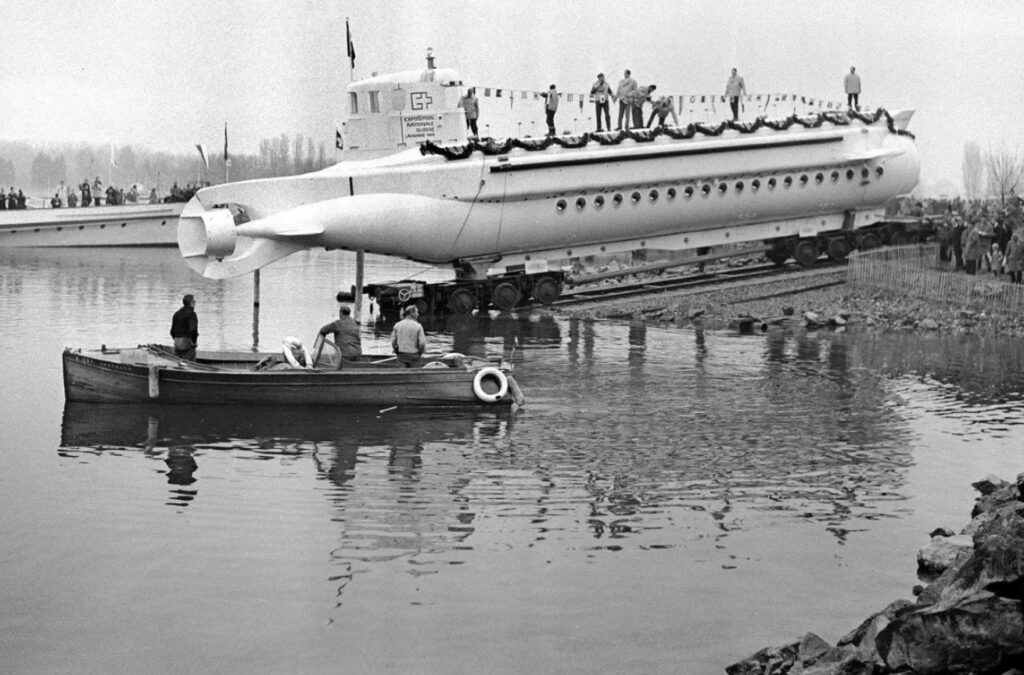
The first tourist mesoscaphe Auguste Piccard. Image source: mirkapitanov.ru
How Aquanauts Lived on the Seabed
While tourists admired shallow waters, engineers were solving the main physiological problem: how to make the human body function at great depth. In 1962, inventor Edwin Link conducted successful saturation diving tests. This technology allows a diver’s body to fully adapt to the high ambient pressure, enabling a person to live at depth for weeks, undergoing the long and grueling decompression only once at the very end of the mission.
Soon, the famous Jacques-Yves Cousteau launched experiments with Conshelf stations in the Mediterranean and Red Seas. His specially trained divers, aquanauts, lived in underwater metal habitats at depths of up to 100 meters for several weeks.
NASA also got involved. As part of the Tektite program, scientists lived on the Caribbean seabed for months. The agency used these stations not to train divers, but to study how crews cope with prolonged isolation in confined spaces. This was invaluable experience for planning future long-duration space flights.
Why the Dream of Underwater Cities Failed
The turning point came in 1969. While the world watched breathlessly as Apollo 11 astronauts took their first steps on the Moon, the ambitious U.S. Navy underwater project Sealab III ended in disaster. At a depth of nearly 200 meters, aquanaut Berry Cannon died due to a life support system malfunction.
This event triggered a chain reaction of decline in underwater programs, driven by several main causes:
- The triumph of the space program, which drew all public attention, media coverage, and government funding;
- The difficulty of ensuring safety, proven by Berry Cannon’s death and, in 1973, the tragic deaths of two more researchers during an Edwin Link expedition;
- The enormous cost of creating reliable materials capable of withstanding water pressure for years.
Due to these factors, government experiments in underwater living were permanently discontinued. Billions of dollars definitively shifted to the aerospace industry, and ocean bases became history.
Modern Underwater Hotels
Despite the closure of government programs, private enthusiasts continued building underwater hotels for wealthy tourists. Back in 1986, Jules’ Undersea Lodge opened in Florida — a converted research station where guests still have to scuba dive down to a depth of six meters.
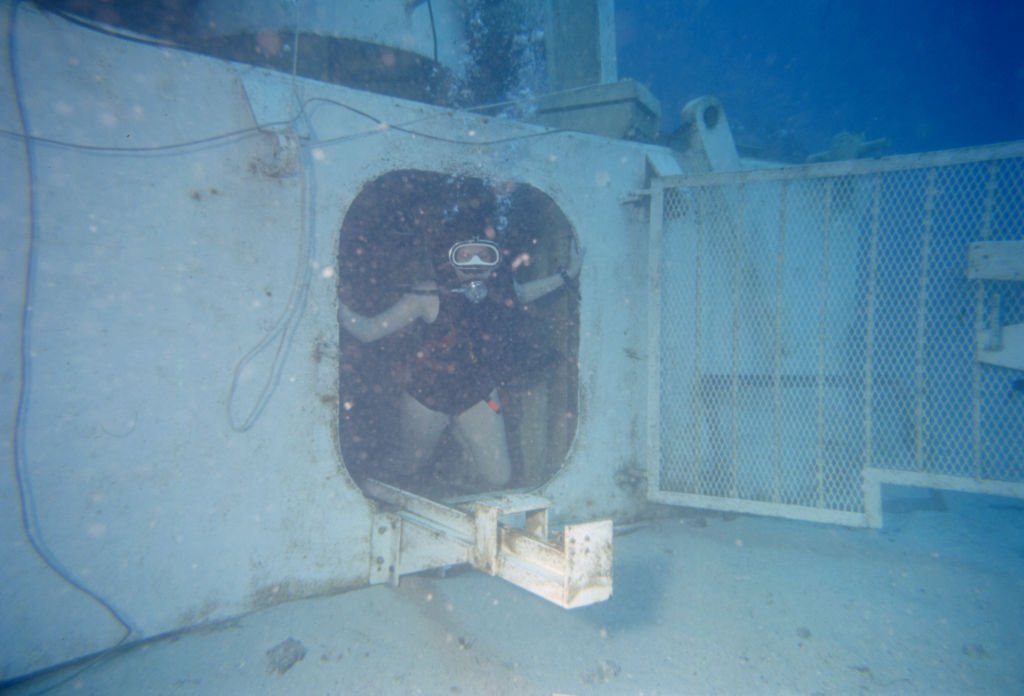
A bedroom in a modern underwater hotel in the Maldives
Modern projects look far more luxurious but remain few in number and incredibly expensive. For example, in the Maldives, The Muraka hotel features a bedroom located underwater beneath a transparent acrylic dome. A single night there costs approximately $50,000. Meanwhile, more ambitious plans, such as the Poseidon resort in Fiji with dozens of rooms, never made it past the drawing board. The main obstacle was the enormous cost of manufacturing thick curved glass capable of withstanding the pressure of the ocean depths.
Why the Ocean Is Explored Less Than Space
Today, the conquest of ocean depths relies mainly on the enthusiasm of private individuals and the commercial interests of corporations. For example, director James Cameron descended into the Mariana Trench at his own expense, spending a sum equal to one-third of the U.S. annual budget for ocean floor research. At the same time, companies are actively obtaining licenses for deep-sea mining of valuable metals such as cobalt.
The main reason for the technological lag in this field is the colossal gap in funding distribution. In recent years, space exploration budgets have exceeded government spending on ocean research by roughly 175 times.
If humanity had invested even a fraction of its space budgets into studying its home planet, perhaps a vacation on the ocean floor would already be a familiar experience. And most importantly, we would have a much better understanding of how the ocean works.