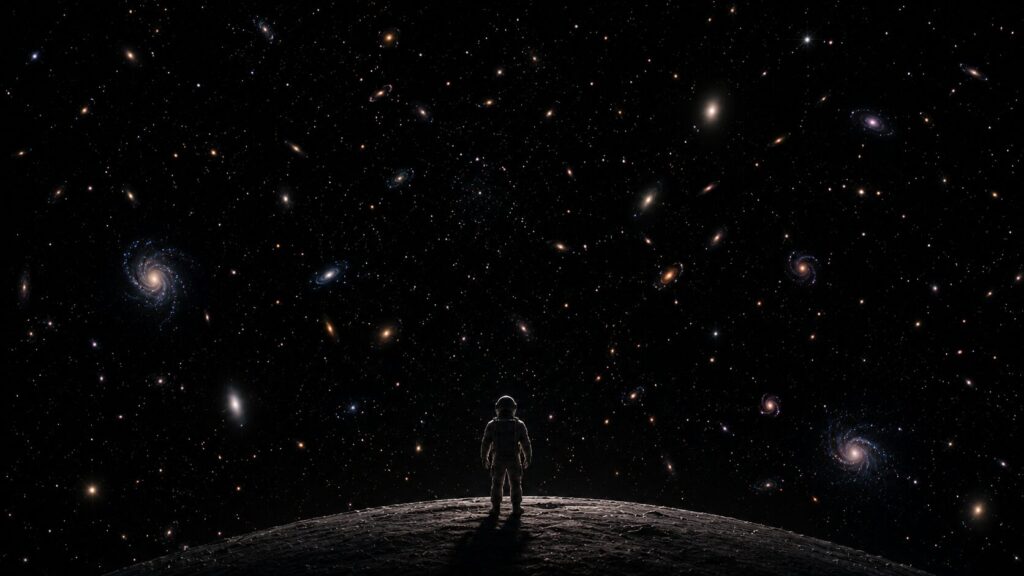
Why is space black?
The night sky appears almost empty: a few bright dots with solid blackness between them. But the Universe contains billions of galaxies, each harboring billions of stars. It would be logical to expect their light to fill the entire sky without a single dark gap. So why does space remain black, and why can the naked eye see only a small fraction of the stars around us? The answer lies not in a lack of light, but in the age, expansion, and structure of the Universe itself.
Why the Entire Sky Should Have Been Bright
It seems logical that a distant star shines more dimly than a nearby one. If you double the distance to it, its apparent brightness decreases by a factor of four. At first glance, that should be enough to keep space dark.
But at the same time, the volume of space also increases. In a hypothetical spherical shell located twice as far away, roughly four times as many stars would fit. Each one would shine four times more dimly, but there would be four times as many of them. As a result, the total brightness would remain nearly unchanged.
The next shell would add just as much light, then another one — and so on, endlessly. In an infinite, old Universe, every patch of sky would eventually be covered by a star. The sky would look not like a scattering of dots, but roughly like the surface of the Sun. This is precisely the contradiction described by Olbers’ paradox.
Light from Distant Stars Hasn’t Had Time to Reach Us
The main clue lies in the age of the cosmos. The Universe has existed for approximately 13.8 billion years, and light travels at a finite speed — about 300,000 kilometers per second. This means we physically cannot see light that has been traveling toward us for longer than the age of the Universe.
Furthermore, stars didn’t appear immediately. After the Big Bang, the cosmos was hot and opaque for some time, followed by what are known as the dark ages. According to NASA, the first stars ignited only hundreds of millions of years later. Before that, there was simply nothing to illuminate space.
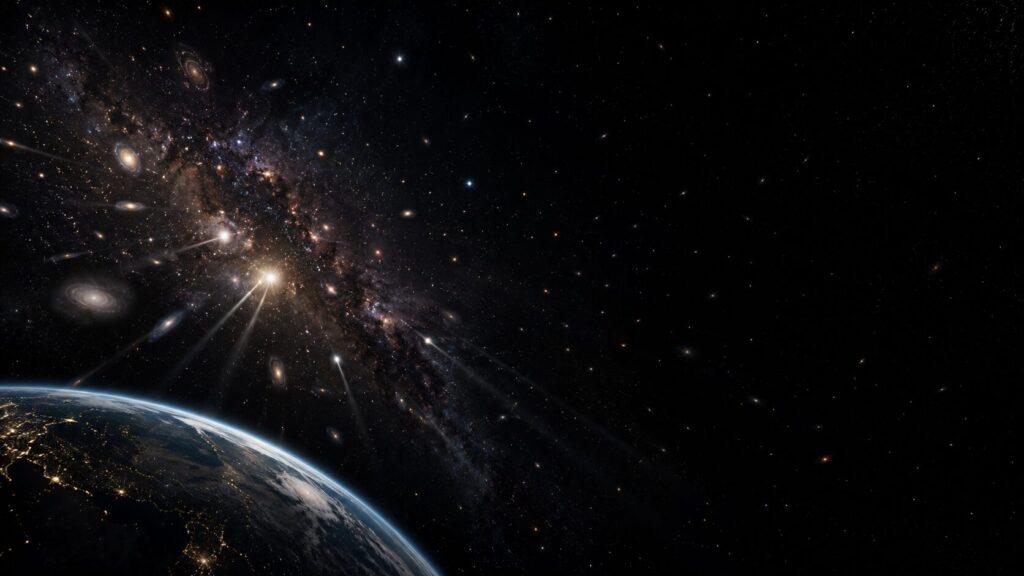
We can only see the part of the cosmos whose light has had time to reach us.
It turns out there aren’t infinite layers of luminous shells around us. We can only see the part of the cosmos whose light has had time to reach Earth. This is precisely why the age of the Universe is directly related to the color of the night sky. The darkness exists because of a lack of time, not a lack of stars.
The Expansion of the Universe Stretches Light
There is also a second reason. While a photon travels through space, space itself continues to expand. Along with it, the light wave stretches: first it shifts toward the red end of the spectrum, then moves into the infrared and microwave ranges.
This phenomenon is called cosmological redshift. The farther away a galaxy is, the more its light is stretched and the less energy we receive in the visible range. Ancient radiation doesn’t disappear without a trace — the human eye simply stops noticing it.
It was precisely through redshift that astronomers realized galaxies are moving away from each other. The cosmos turned out to be not an eternal, motionless backdrop, but a constantly changing system. The mechanism of the Universe’s expansion explains in detail why the most distant objects are better seen by infrared telescopes rather than by the human eye.
Why Cosmic Dust Can’t Hide the Stars
When astronomers first tried to solve Olbers’ paradox, a simple explanation emerged: perhaps the light of distant stars is absorbed by clouds of gas and dust. Such a barrier can indeed hide an individual star or an entire region of a galaxy.
However, for an infinite, eternal Universe, this explanation doesn’t work. Dust, by absorbing radiation, would gradually heat up. Sooner or later it would reach an equilibrium temperature and begin emitting just as much energy as it received. The sky would still become bright; the peak of the glow would simply shift to a different wavelength range.
In the real cosmos, dust does indeed change the color and brightness of objects, absorbing visible light and re-emitting it in the infrared range. But it doesn’t solve Olbers’ paradox. For that, you need the finite age of the Universe and its expansion.
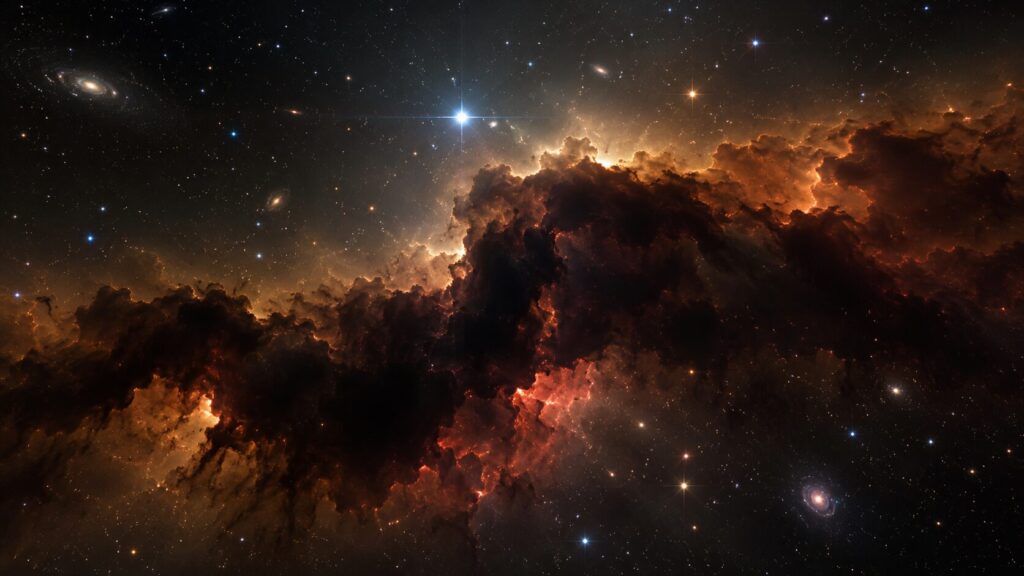
A cluster of cosmic dust.
Space Is Not Actually Completely Black
Space only appears black to our eyes. The entire Universe is filled with the cosmic microwave background radiation — ancient light that began to propagate freely approximately 380,000 years after the Big Bang. Over billions of years, the expansion of space stretched its wavelengths and cooled it to 2.726 kelvin, or approximately −270 degrees Celsius.
Today, this radiation falls in the microwave range. Telescopes detect it almost uniformly in all directions, although it is completely invisible to humans. If our eyes could perceive microwaves, instead of a black sky we would observe a continuous faint glow. Its precise temperature was measured by the COBE, WMAP, and Planck space missions, as reported by ESA.
In addition to it, there are infrared, X-ray, and gamma-ray backgrounds, as well as scattered light from distant galaxies. Therefore, absolute blackness in space is virtually nonexistent. There are only wavelength ranges that our eyes are unable to perceive.
The ordinary night sky turned out to be an important cosmological observation. Its blackness shows that the Universe has not been filled with stars forever, has a finite age, and continues to expand. The light of many objects has not yet had time to reach us, and some of the ancient radiation has long since stretched to invisible wavelengths.
It turns out to be a curious thing: billions of stars don’t prevent space from being black precisely because the Universe is alive and changing. If it were infinite, motionless, and had existed forever, we would never have seen true darkness.