Why flying east is faster than flying west
If you’ve ever flown far and back, you may have noticed something strange: the outbound and return trips take different amounts of time, even though the plane flies along nearly the same route. For example, a flight from London to Vancouver takes about 9 hours and 45 minutes, while the return trip is just under nine hours. The distance is the same, the plane is the same, yet there’s almost an hour’s difference. What’s the catch? The most common explanation goes like this: the Earth rotates to the east, so the plane “catches” that movement. It sounds logical, but it’s not true. The real reason has to do with invisible rivers of wind high above our heads.
Why Earth’s Rotation Doesn’t Affect Flight Speed
It seems obvious to many: since the planet spins from west to east, flying in that direction should be easier. In reality, Earth’s rotation does not directly affect the speed of an airplane. The entire atmosphere rotates along with the planet, as does the airplane itself, and you in your seat — so there’s nothing to “fall behind” or “outrun.”
Here’s a clear example: when you walk through a moving train car, it’s not easier to walk toward the rear just because the train is moving forward. You’re moving along with it. It’s exactly the same with an airplane and the atmosphere. However, Earth’s rotation does play a role — just an indirect one. It influences weather and air movement.
What Are Jet Streams
The real reason for the time difference is jet streams. To put it simply, these are narrow currents of very fast wind at high altitude — right where passenger airliners fly. Imagine an invisible river in the sky that flows from west to east and can carry an airplane along with it.
These currents form due to two things: uneven heating of the atmosphere by the sun and the Coriolis effect — a phenomenon caused by the planet’s rotation that deflects moving air currents sideways. Together, these factors accelerate air to enormous speeds.
Jet stream speeds range from 130 to 225 km/h, and sometimes reach up to 440 km/h. This is exactly why a plane flying “downstream” to the east arrives noticeably earlier than one fighting headwinds to the west.
The strongest currents are the polar and subtropical jet streams. The polar one is more powerful, and it’s the one most commonly used by airlines on long-haul flights across the Atlantic and Pacific oceans.
How Airplanes “Catch” Tailwinds
Pilots don’t just know about jet streams — they specifically plan routes to catch a tailwind going east and avoid headwinds going west. This saves fuel, time, and money. Air routes are rarely just a straight line on a map: sometimes planes fly around entire regions, such as the skies over Tibet.
Tailwinds were first used as early as 1952 on a Tokyo–Honolulu flight. It turned out that flying along a jet stream cut the journey from 18 hours to 11.5 — nearly in half. After that, airlines quickly realized the advantage.
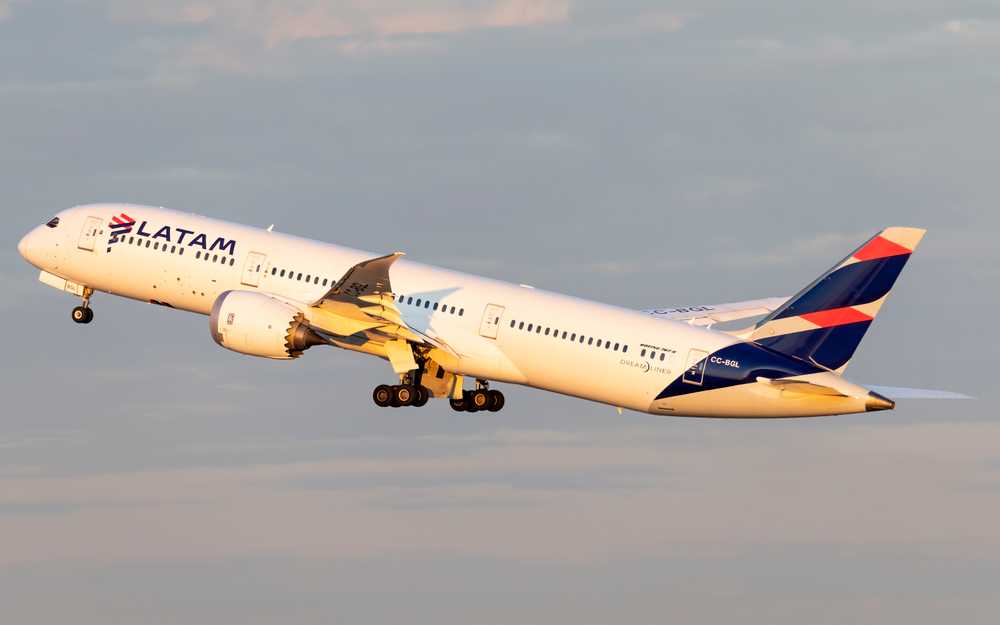
Long-haul flight routes are planned with jet streams in mind
The effect works even on short distances. On flights between New York and Los Angeles, wind can change the travel time by about an hour. And on long transpacific routes, the difference is even more noticeable: from Tokyo to Los Angeles — about 10 hours, but the return trip — nearly 11 hours and 40 minutes. Same plane, same route, but in one direction the wind helps, and in the other — it hinders. By the way, weather in the sky affects not only speed — it also explains why airplanes sometimes encounter zones of severe shaking.
Clear-Air Turbulence as the Flip Side of Tailwinds
Jet streams have an unpleasant side effect — so-called clear-air turbulence (CAT). This is sudden, severe shaking in completely cloudless skies, without a single cloud ahead.
It occurs where a slow air flow meets a fast one — a zone of strong vortices forms at the boundary. The treacherous part is that this kind of turbulence cannot be seen with the naked eye and doesn’t show up on onboard radar. The pilot simply doesn’t know what lies ahead. Thunderstorms are simpler: pilots can see dangerous clouds in advance, but even there the main threat is often not lightning but wind shear.
How serious this can be was demonstrated by an incident in 1997 on a flight from Tokyo to Honolulu — ironically, the very route where jet streams were first put to practical use. Sudden turbulence caused the plane to drop sharply by about 30 meters. Eighteen people were injured, and one passenger who wasn’t wearing a seatbelt died. This is the best argument for keeping your seatbelt fastened throughout the entire flight, even when the sign is off.
When Wind Determines Flight Duration
Sometimes headwinds become not just an inconvenience but a real problem for airlines. This is especially noticeable on ultra-long-haul routes, where every extra kilogram of fuel already matters. A good example is Air New Zealand’s flight from Auckland to New York. Westbound, it takes 17.5 hours and operates at the limit of the Boeing 787-9’s range.
Because of this, even a slight increase in headwinds leads to unpleasant decisions: they have to take fewer passengers and less baggage to free up weight for additional fuel. There have been cases where people were sent on their way without suitcases or rescheduled to another day entirely. The return flight, however, benefits from a tailwind, so it takes 15.5 hours and experiences almost none of these problems.
Airlines see the solution in new aircraft with greater range, for which extra gusts of wind won’t be as threatening. But as long as airliners are pushed to the maximum of their capabilities, weather in the upper layers of the atmosphere remains the factor that truly controls the schedule.