Why airplanes don’t fly faster due to Earth’s rotation: debunking a popular myth
The Earth spins beneath us at over fifteen hundred kilometers per hour. And many people have probably had a logical question: why doesn’t a plane just hover in the air and wait until the desired city “arrives” from below? This question regularly pops up on the internet — and the answer is simpler than it seems, yet it touches not only the enormous speed of Earth’s movement but also fundamental laws of physics.
The Popular Myth About Earth’s Rotation and Airplane Speed
In one publication by flat Earth theory supporters, a post appeared with roughly the following reasoning: if a plane flies from east to west at 300 miles per hour (~480 km/h), and the Earth rotates from west to east at about 1,400 miles per hour (~2,250 km/h), then the plane should arrive at its destination faster — by 1,400 miles per hour. But this doesn’t happen. Moreover, the return trip is neither longer nor shorter. Therefore, the Earth doesn’t rotate.
At first glance, the logic seems sound. But it’s based on two serious misconceptions: about the nature of inertia and about the behavior of the atmosphere. Let’s examine both in order.
Inertia: After Takeoff, the Plane Retains Earth’s Rotational Speed
Imagine you’re standing in a train car moving at a constant speed. You jump — and land right back in the same spot. Not because the train is stationary, but because your body was already moving along with it. This is inertia — a body’s property of maintaining its velocity until an external force acts upon it.
The same thing happens with you, the airplane, the air, and everything else on Earth’s surface. At the equator, a point on the surface moves at about 1,674 km/h; at higher latitudes, the speed is significantly lower. For example, near Moscow it’s about 936 km/h. But you don’t feel it because you’re moving along with the planet.
If flat-earthers’ logic worked, then an ordinary trampoline jump at the equator with a three-second “hang time” in the air would send you nearly one and a half kilometers to the west. Obviously, nothing like this happens — children on trampolines don’t scatter at airliner speeds.
When an airplane sits on the runway, it’s already flying along with the Earth. During takeoff, the engines create additional force that moves it relative to the surface. But the original “terrestrial” speed doesn’t go anywhere — the airplane doesn’t lose Earth’s rotational inertia at the moment it lifts off the runway.
Earth’s Atmosphere Rotates Together With the Planet Around Its Axis
The second misconception is even more interesting. The myth’s authors silently assume that the atmosphere stays in place while the Earth spins beneath it, like a ball inside a stationary bubble of air. This is not the case.
The Earth drags its atmosphere along through friction forces. The air near the surface rotates at practically the same speed as the planet itself. If this weren’t the case, we would live in a world of constant hurricanes: at the equator, wind would blow in your face at over 1,600 km/h. There would be no need to worry about “long flights” — surviving in such conditions would be impossible.
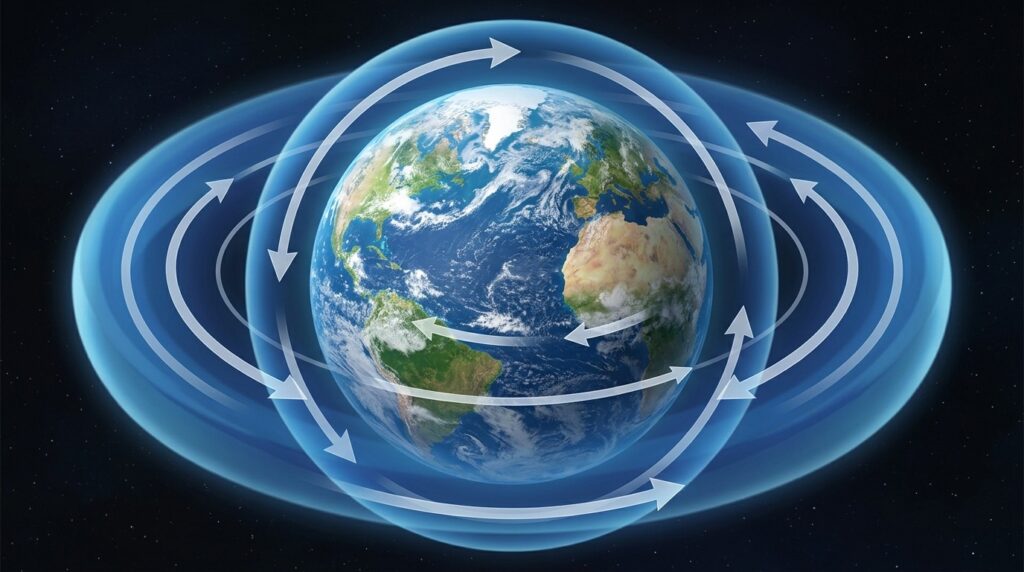
The atmosphere rotates together with the Earth, not standing still
So the air in which the airplane flies moves together with the planet. This makes the cartoon trick impossible: simply rising into the air and waiting for the Earth to rotate to the desired city.
How Earth’s Rotation Affects Winds and Airplane Routes
Does all this mean that Earth’s rotation has absolutely no effect on flight duration? Not quite. There is an effect, but it’s indirect — through jet streams.
Jet streams are narrow air currents at an altitude of about 9–12 kilometers that blow predominantly from west to east. Their speed usually ranges from 150–300 km/h but can reach 400 km/h. These high-altitude winds can be associated with aircraft turbulence, and they are the main reason why eastbound flights take less time than westbound ones.
Here’s how it works. Near the equator, Earth’s surface moves faster than near the poles. Air moving from the equator toward the poles retains its eastward speed, while the surface beneath it slows down. This creates a powerful eastward-flowing stream. This is a manifestation of the Coriolis effect — a force that deflects moving objects on the rotating Earth.
Airlines actively use jet streams when planning routes. The first commercial flight to “ride” a jet stream took place in 1952: Pan Am from Tokyo to Honolulu reduced flight time from 18 to 11.5 hours — by more than a third.
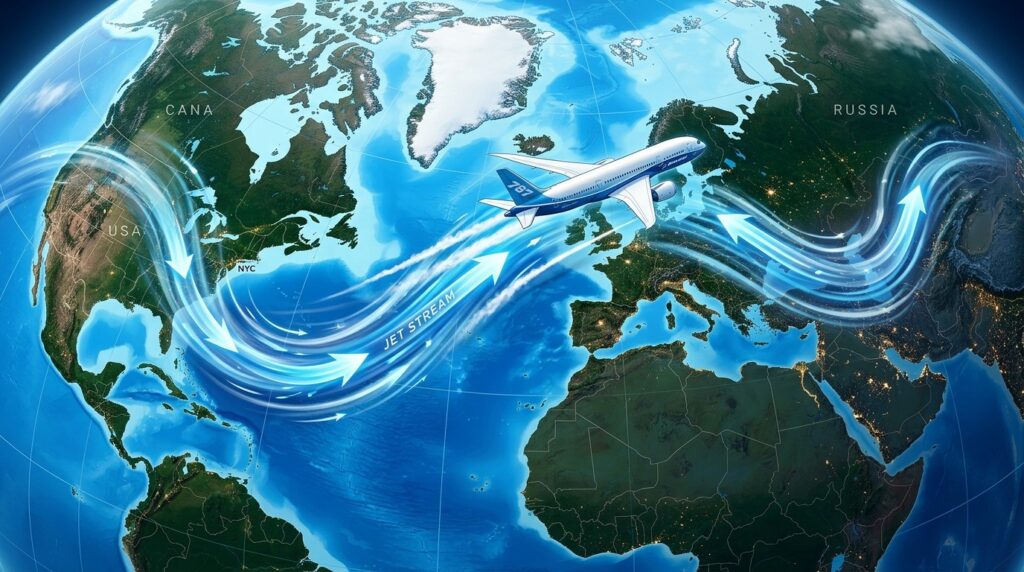
Jet streams blow from west to east and affect airplane routes
Eastbound and Westbound Flights: Difference in Flight Time
The difference in flight time depending on direction can be quite noticeable. For example, a flight from Moscow to Vladivostok takes an average of about 8 hours 30 minutes, while the return trip from Vladivostok to Moscow takes about 9 hours. On the Moscow — Yuzhno-Sakhalinsk route, the journey one way takes about 8 hours, and the return nearly 9. A transatlantic flight from New York to London takes 6–7 hours, while the return trip takes 7–8 hours. On the Tokyo — Los Angeles route, the eastbound flight lasts about 10 hours, while westbound it’s nearly 12.
On shorter routes within a continent, jet streams can change flight time by roughly half an hour to an hour. Pilots flying westbound try to choose routes that bypass the strongest headwinds — sometimes this means significant deviations from a straight line.
It’s important to understand: the difference in flight duration is created specifically by winds, not by the Earth “spinning” in the right direction. Exact figures depend on the aircraft, route, weather, and schedule, but the general principle holds: on eastbound flights, tailwind high-altitude winds often help, while on westbound flights they can hinder.
The Main Error in the Popular Myth About Airplanes and Earth
It’s easy to laugh at people who believe the Earth is flat. But the question itself — why rotation doesn’t directly affect flight — actually touches on non-obvious physical principles. Inertia is counterintuitive. We don’t feel that we’re flying through space, and that’s normal. Intuition suggests that if you’ve lifted off from the ground, you should “fall behind” it — but physics works differently.
In the 17th century, this very argument was used against the idea of Earth’s rotation: if the planet spins, why does a thrown stone fall back to the same point? The answer — inertia — was given by Galileo and Newton, but it remains non-obvious to many even today.
So Earth’s rotation does indeed affect flights, but not directly — rather through the formation of global wind patterns. Rising into the air and “waiting” for the desired destination won’t work. We don’t live in a cartoon. But we do live on a planet whose physics allows airlines to save millions of tons of fuel by skillfully utilizing those very jet streams generated by Earth’s rotation.