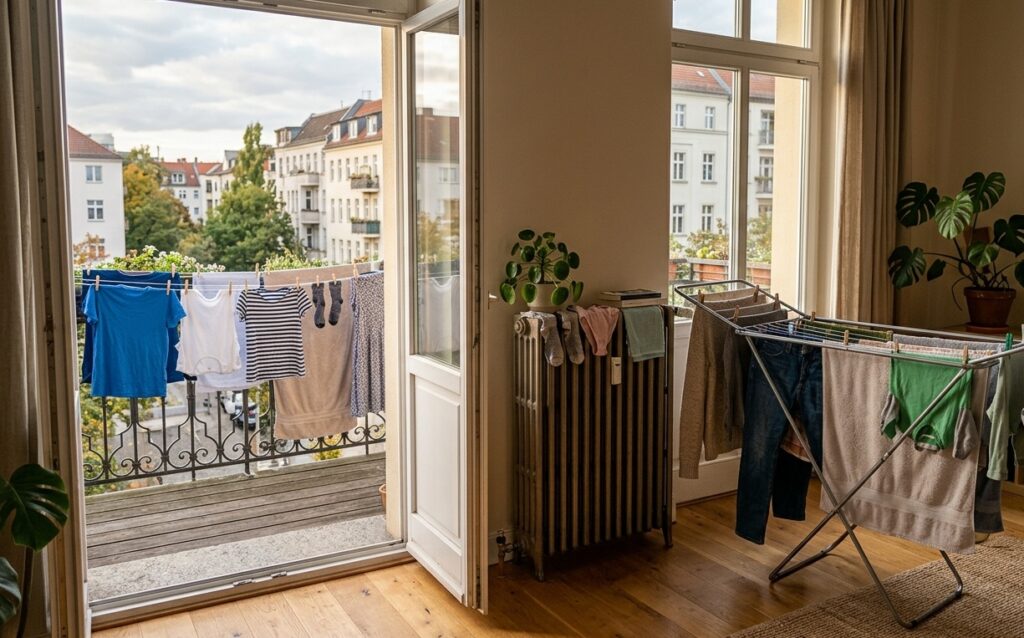
We live in a world where even drying clothes requires some thought
Doing laundry is an everyday routine, but few people think about where clothes dry best. We tend to assume that the hotter the air, the faster moisture will disappear, so many people habitually drape wet T-shirts over radiators. In reality, drying speed depends on air circulation, and choosing the wrong spot can easily trigger black mold growth on your apartment walls.
What You Need for Clothes to Dry Quickly
Clothes don’t dry just because there’s a heat source nearby. The main goal is for water to leave the fabric fibers and dissipate into the surrounding space. This requires a constant flow of air.
If you hang wet items in an enclosed room, the humidity around them will quickly reach its maximum. Water evaporation will stop, and moisture will start settling on cold surfaces as condensation.
To speed up clothes drying without harming your home, you need to remove excess water from the fabric while it’s still in the washing machine. If the material allows it, use an extra spin cycle. After that, shake each item thoroughly, because the absence of creases speeds up moisture evaporation several times over.
Why You Shouldn’t Dry Clothes on Radiators
Many people think a hot radiator is the ideal option for quick drying. A T-shirt will indeed become dry in a couple of hours, but this method is absolutely unsuitable for regular use.
Russia’s consumer protection agency Rospotrebnadzor warns that placing wet clothes and laundry on a radiator sharply increases humidity in living spaces. The radiator ends up spending energy on evaporating water rather than heating the room. As a result, the apartment cools down, and the air becomes heavy and damp.
On top of that, direct contact with hot metal damages the clothes themselves. Cotton becomes stiff, knitted fabrics lose their original shape, and elastic bands and synthetic fibers break down quickly. A radiator should only be used in an emergency for a pair of socks, but never for everyday laundry drying.
How to Use a Floor-Standing Drying Rack
If you can’t take your laundry outside, a folding drying rack becomes your main salvation. However, you can’t just set it up in the middle of the bedroom and leave it overnight.
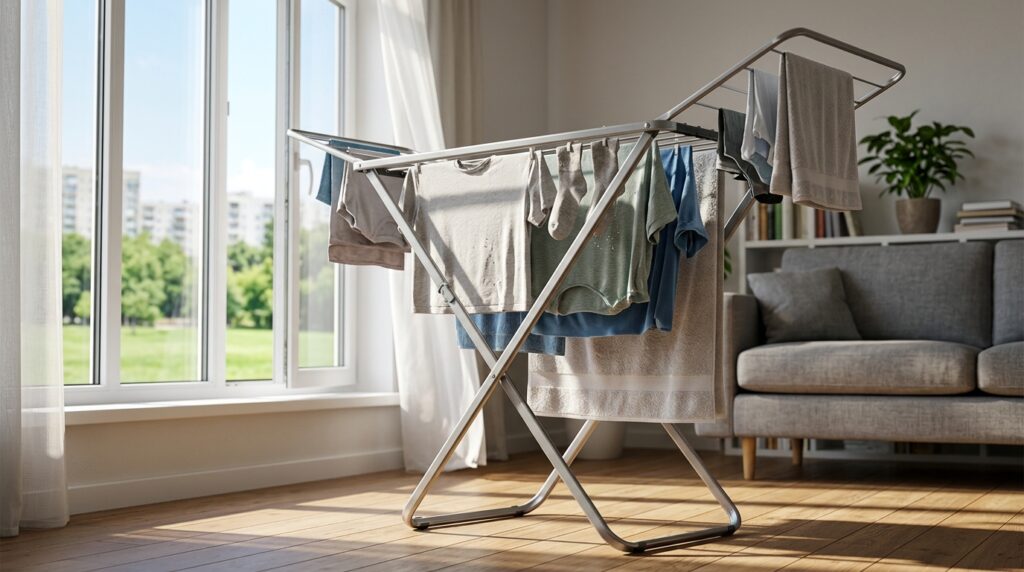
A folding drying rack works well only with good ventilation
All the water that leaves your duvet covers and towels ends up in the air of your apartment. If humidity exceeds 60 percent, ideal conditions are created for mold to thrive. Mold spores cause allergies, chronic coughing, and asthma flare-ups.
To avoid problems, follow these basic rules:
- Place a floor-standing drying rack only in a room with a slightly open window or in a bathroom with a powerful exhaust fan;
- Never place it right up against a wall to avoid creating a stagnant humid zone;
- Hang clothes loosely, leaving space for air circulation;
- Don’t dry a lot of items in a children’s room or bedroom overnight.
If the room is too damp, point a running fan at the laundry. It won’t heat the fabric, but it will provide constant airflow, and the process will finish much faster.
Why It’s Better to Dry Clothes on a Balcony
Wet clothes and laundry are best dried somewhere outside the apartment. On an open or well-ventilated balcony, there is natural air movement that handles the task better than any radiator.
Even in winter, this method works perfectly. In freezing temperatures, water in the fabric first turns to ice and then gradually evaporates, bypassing the liquid phase. Moreover, clothes dried on a balcony acquire a distinctive fresh frosty scent.
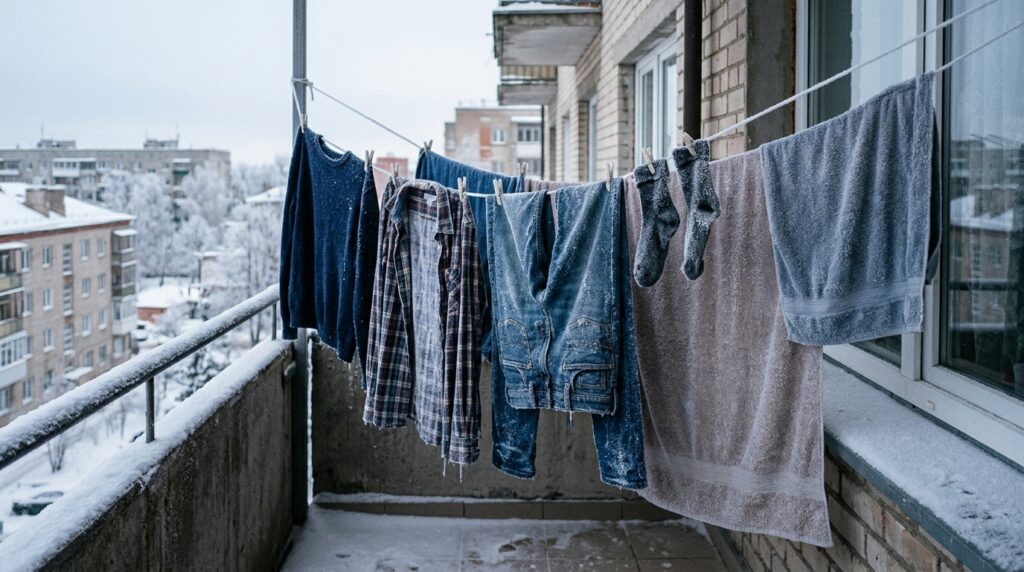
In winter, laundry on a balcony dries through ice sublimation
However, this method has its limitations. If your windows face a busy highway, wet fabric will act as a filter, collecting exhaust fumes and road dust. And in summer, direct sunlight fades dark fabrics, so black jeans and T-shirts should be turned inside out or placed in the shade. Lawyers also remind us that hanging dripping laundry beyond the building’s facade is prohibited, as it violates municipal beautification regulations.
How to Avoid Dampness When Drying Laundry at Home
Sometimes freshly washed items start giving off an unpleasant musty smell. This happens when moisture lingers in folds for too long, creating an environment for bacteria to multiply.
To prevent this, take items out of the washing machine drum as soon as the cycle-end signal sounds. Heavy hoodies and sweatshirts should be turned over periodically, as their dense structure dries unevenly. Bed linens and terry towels are best not folded into multiple layers at all.
Special attention is needed for cashmere, fine knitwear, and wool sweaters. They should not be hung on a line, as they will stretch under their own weight. Such items should only be dried flat on an even surface, with a dry towel placed underneath to absorb excess moisture.
Ultimately, the secret to proper garment care comes down to a simple formula: laundry should dry from air movement, not from extreme heat. If you ensure good ventilation, your clothes will dry quickly without harming the atmosphere in your home.