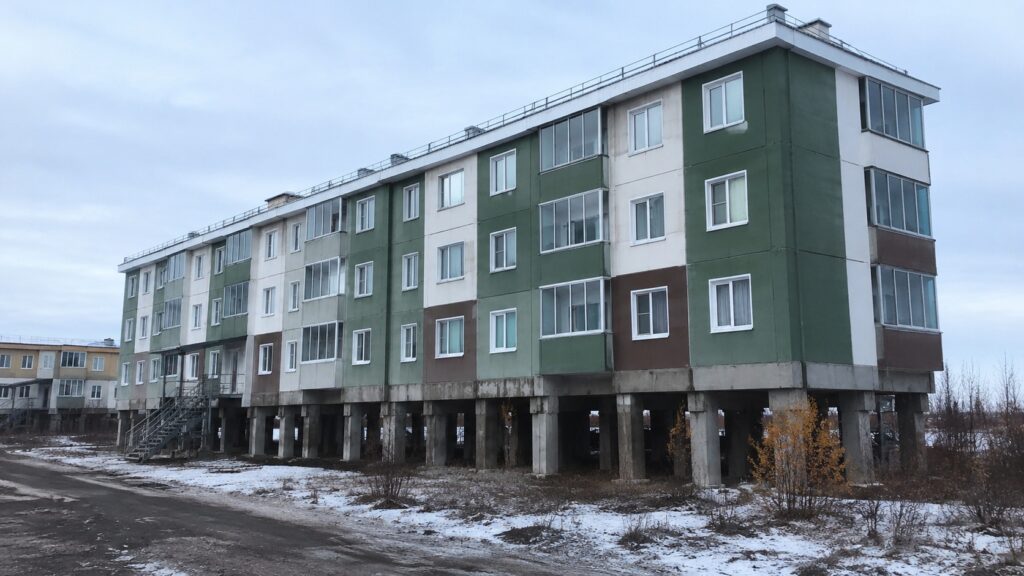
In Yakutia, houses are raised above the ground, and there are compelling reasons for this
If you travel to northern Russia, the first thing that catches your eye is the unusual architecture. Almost all houses in Yakutia are raised above the ground on massive concrete pillars, making apartment buildings look as if they’re floating in the air. This is not a design choice or protection from spring floods, but a vitally important engineering trick that prevents buildings from destroying themselves. Yes, it’s related to the fact that Yakutia has many record-breakingly cold cities.
Why It’s Difficult to Build Houses in Yakutia
Many people assume that frozen ground is a solid block on which you can safely erect heavy structures. Indeed, as long as the temperature remains steadily below zero, underground ice firmly bonds sand and clay together, turning them into an ultra-strong foundation. But this natural reliability is extremely deceptive.
The entire problem lies in the topmost layer of soil. Every summer it thaws to a depth of half a meter to three and a half meters. During this period, the reliable base turns into an unstable mush of mud and melted water. Engineers critically need to punch through this seasonal slush and anchor houses in the Republic of Sakha on the part of the ground that remains cold and solid year-round.
Why Houses in Yakutia Are Elevated
However, simply driving long piles deep into the ground isn’t enough. The main reason why houses in Yakutia stand on stilts comes down to the basic physics of heat. Any residential building constantly radiates thermal energy into the surrounding environment — from hot radiators, heated floors, water pipes, and simply from people’s daily activities.
If you place an apartment building directly on the frozen ground, it would act like a giant heating pad. The permafrost beneath it would begin to thaw rapidly. To avoid this, an open, wind-swept space is deliberately left between the first-floor slab and the ground surface.
The piles and the void beneath the building serve as a free natural refrigerator. In winter, frigid air freely flows under the building, additionally freezing the soil. In summer, this same air cushion prevents heat from the structure from escaping downward. If you tried to enclose this space with decorative panels, the ground would stop cooling, and houses in Yakutsk would risk losing their stability.
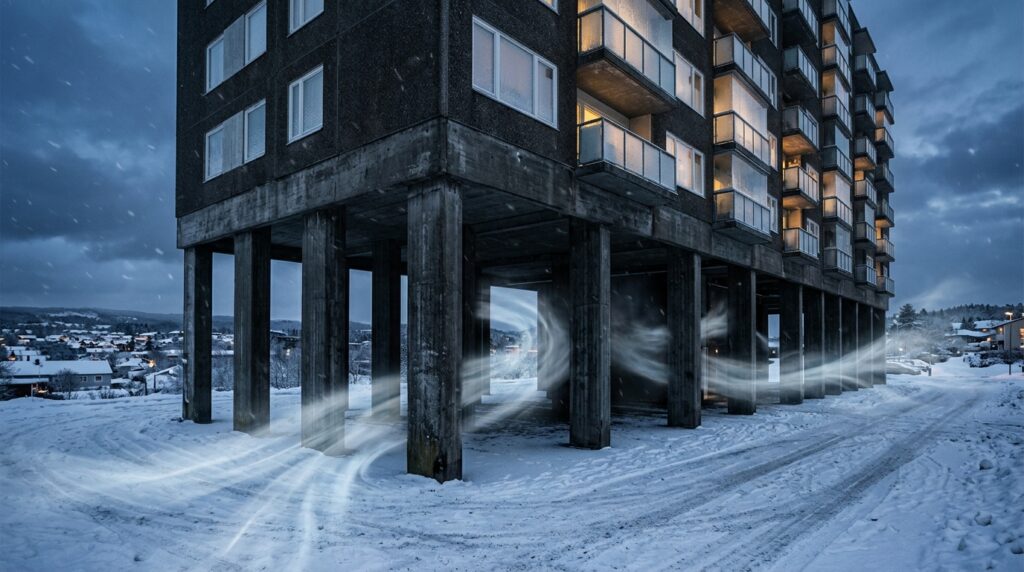
Cold air freely circulates under a multi-story building on pillars
What Happens If You Build a House in Yakutia Without Piles
So what happens if you ignore the northern rules and pour a regular foundation directly on the ground? At first, the structure will stand level. But gradually, a giant thaw bowl will form under the foundation, where the icy framework of the soil turns into water.
The most frightening thing is that the ground thaws unevenly. One corner might have a heating pipe running through it, while another accumulates rainwater. Because of this, the building begins to slowly tilt in different directions. The subsequent destruction scenario unfolds like an avalanche:
- The concrete foundation cracks due to the shifting;
- Load-bearing walls deform and doors stop closing;
- Strained heating and water pipes rupture;
- Boiling water gushing under the building instantly finishes off the remaining permafrost.
As a result, the building has to be declared unsafe and evacuated. Attempting to repair such a foundation is incredibly difficult and expensive.
Houses on Piles in Saint Petersburg
Piles are used not only in Yakutia. In Saint Petersburg, they also became a necessary engineering solution, but for a different reason: the city was built on marshy terrain at the mouth of the Neva River, where weak, water-saturated soils poorly support heavy buildings. Therefore, the load had to be transferred deeper, to denser soil layers, or distributed across entire fields of wooden piles. Under Peter the Great, many buildings were essentially placed on artificial “islands” of densely driven pine, spruce, larch, and oak piles, topped with a wooden pile cap. Houses on piles in Saint Petersburg do exist, but there aren’t as many as in Yakutia.
Unlike Yakutia, where piles protect permafrost from a building’s heat, in Saint Petersburg they combat the soft boggy ground. Old wooden piles there can last for centuries, but only as long as they remain underwater: without access to oxygen, wood barely rots. The problem is that due to the construction of the metro, underground parking garages, and other work, the groundwater level in the city center has dropped in some areas, and historic piles have begun to fall into a risk zone. Therefore, pile foundations for Saint Petersburg are one of the reasons the city was able to grow on swamps at all.
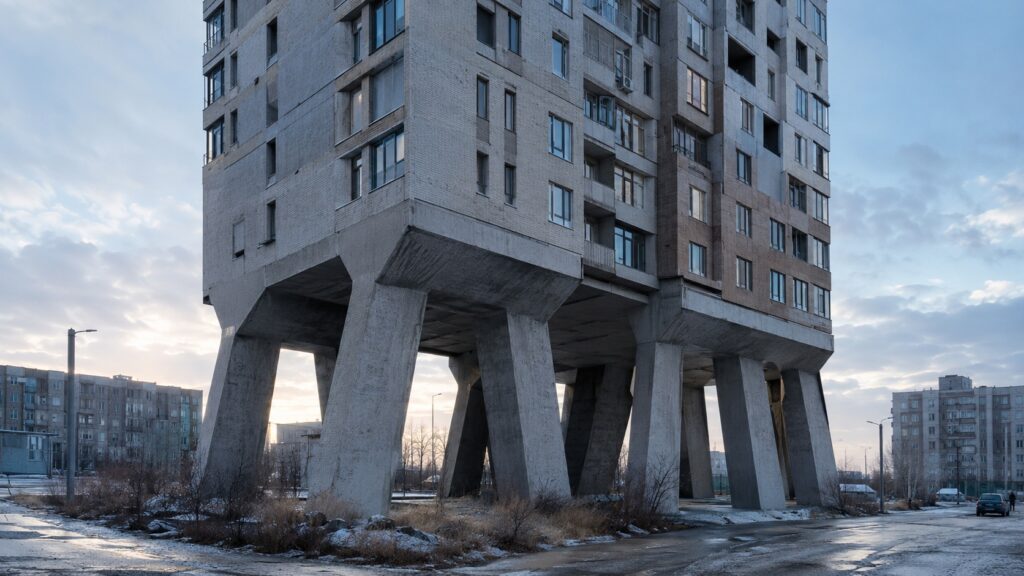
A house on columns in Saint Petersburg
How Global Warming Threatens Yakutia’s Houses
Today, the problem of preserving the icy foundation is even more pressing. The climate is changing, and permafrost is becoming increasingly vulnerable. It reacts to any urban changes: dark asphalt laid down, parks cleared, or new underground utilities installed.
This is precisely why northern cities are now deploying large-scale monitoring systems. Special thermal sensors continuously measure ground temperatures beneath residential areas. If the instruments show that the ground is beginning to warm dangerously, engineers will have time to install thermostabilizers and forcibly refreeze the soil.
In short, builders in Yakutia needed to find a way to coexist with harsh nature without disrupting its fragile balance. That is why pile foundations remain the main and most reliable tool that prevents the heat from human dwellings from melting the ground right beneath their base.