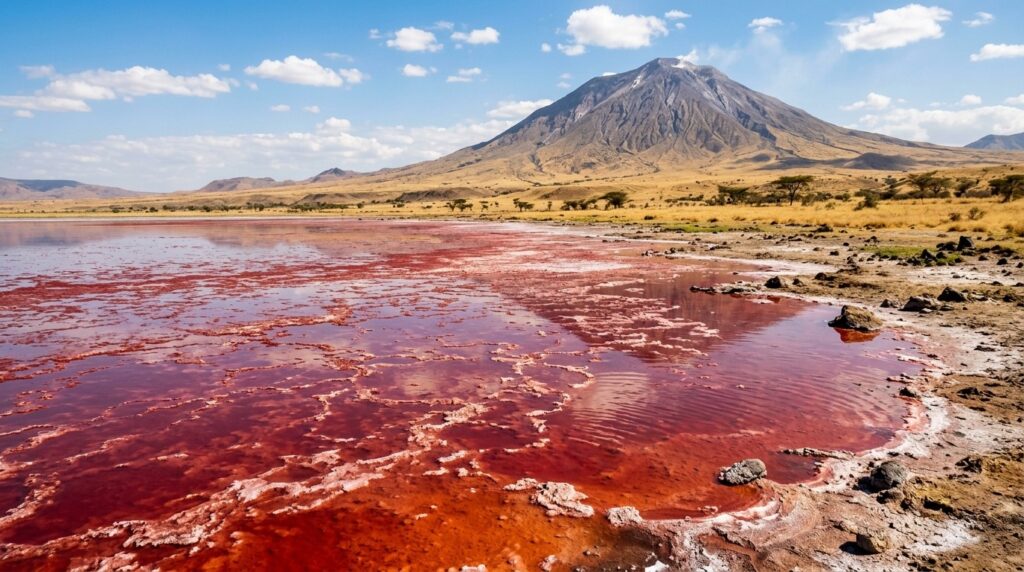
Lake Natron in Tanzania turns animals into mummies
In 2013, photographer Nick Brandt published a series of black-and-white photographs that instantly went viral online. In them, birds and bats looked as though they had turned into stone statues right on the shore of a lake in Tanzania. Bodies frozen in “lifelike” poses against the backdrop of an endless water surface — a sight both beautiful and terrifying. But what actually happens to animals that end up in this lake? No, there are no dangerous bacteria living there — the reason is something else entirely.
Why Lake Natron Kills Animals
Lake Natron is located in northern Tanzania, not far from the border with Kenya. At first glance, it’s an ordinary shallow lake — its depth rarely reaches even three meters. But look closer, and it becomes clear that you’re looking at one of the most hostile places for life on the planet. The lake is red, but this is far from a harmless pink-colored lake.
Let’s start with the temperature. The water in the lake heats up to 60 degrees Celsius, which is the temperature of freshly brewed coffee. At this heat, a person would receive third-degree burns within seconds. But that’s not all.
The lake’s water is extremely alkaline — the pH level sometimes rises to 12. For comparison, that’s roughly equivalent to household bleach. Alkali is the opposite of acid, but it corrodes tissues just as effectively. On top of that, the lake is extremely salty, and the concentration of salts is so high that the water literally eats away at organic materials. Photographer Brandt recalled that the lake water erased the labels from his Kodak film boxes within seconds.
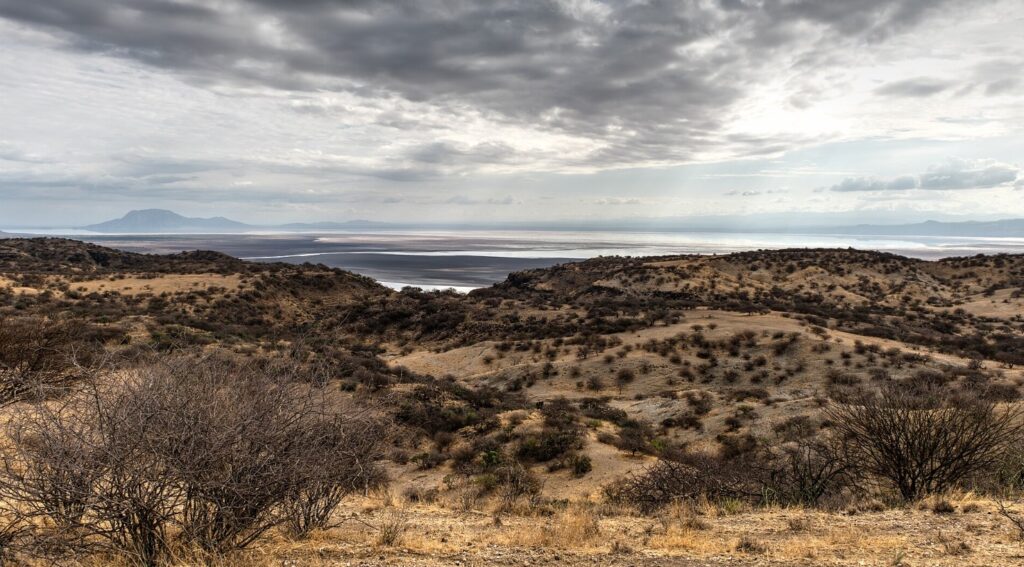
Panoramic view of Lake Natron. Image source: wikipedia.org
Why Lake Natron Is Dangerous
This extreme chemistry is the result of a unique combination of geological circumstances. Lake Natron is fed by just one river with a natural dam and is not connected to any sea. The area is so hot and arid that evaporation constantly outpaces the inflow of water. The salts are not washed away but accumulate, year after year, millennium after millennium.
But the main culprit in this hellish recipe is volcanism. Just 20 kilometers to the south rises the active volcano Ol Doinyo Lengai — the only volcano on Earth that erupts carbonatite lava, a molten mixture of sodium carbonate and calcium carbonate. These salts seep through rock along a system of faults and emerge through more than 20 hot springs that feed into the lake. As NASA explains, it is the region’s volcanism that determines the lake’s unusual chemistry.
Flamingos at Lake Natron
The blood-red color of the lake is not minerals or a sunset reflected in the water. It is created by halobacteria — salt-loving microorganisms that thrive where everything else perishes. These microorganisms, in turn, attract the algae spirulina, and spirulina attracts lesser flamingos.
The shores of Lake Natron are the only permanent nesting site for lesser flamingos in all of East Africa. It’s a risky choice: just look at the photo of a dead flamingo in the water from Brandt’s book to understand how a mistake can end. But the abundance of food and conditions that scare off most predators make the risk worthwhile — at least for those birds that know how to behave.
Migratory birds unfamiliar with the lake, however, often crash into its surface. The water is so reflective that it deceives their vision — birds mistake the mirror-like surface for empty sky. It’s not just birds that fall victim to this illusion: in 2007, a helicopter pilot was so disoriented by the reflection that he crashed directly into the lake.
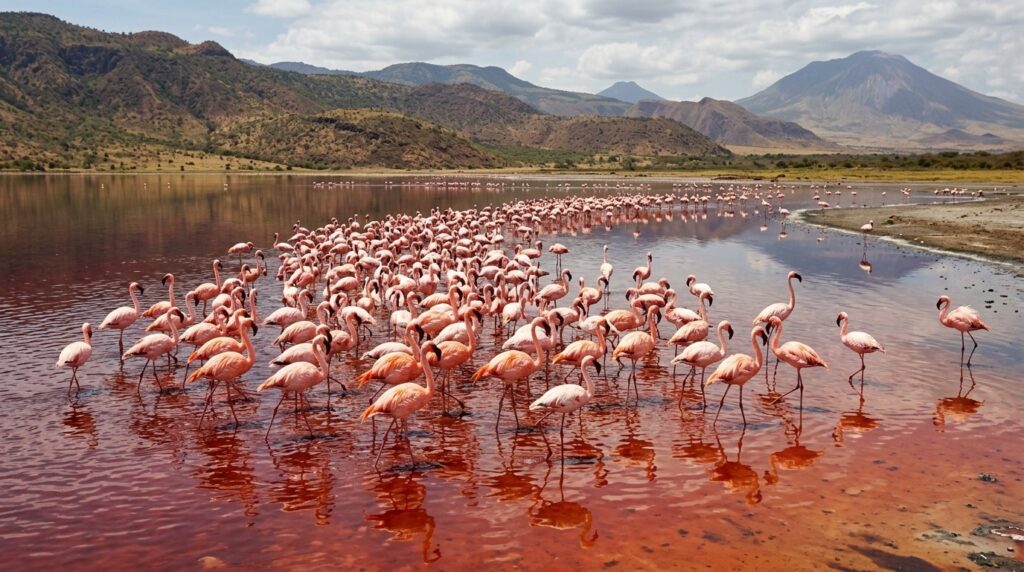
Flamingos in the shallows of Lake Natron
Mummification, Not Petrification
Lake Natron is sometimes called the Medusa Lake, after the mythical Gorgon who turned her victims to stone with a single glance. But in reality, the animals in the famous photographs are not fossils. If you look closely, you can see remnants of feathers and flesh on the bodies.
The thing is, these bodies didn’t petrify — they mummified and became covered with a mineral crust. Natron, the mixture of salts that gave the lake its name, is excellent at absorbing moisture and fat. This property was known to the ancient Egyptians, who used it for embalming mummies. Birds and bats that fall into the water die from burns and alkali, after which their bodies quickly lose moisture. An ironic death — to drown and yet dry out at the same time.
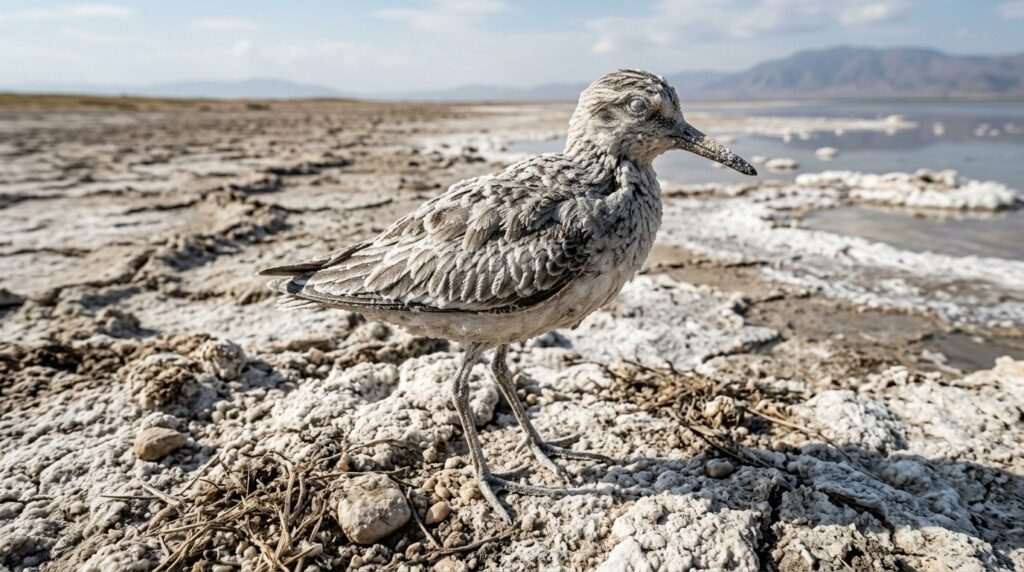
A mummified bird on the shore of Lake Natron, covered in mineral deposits, image generated by neural network
Mineral deposits dissolved in the water gradually envelop these hollow, dried-out remains, creating the illusion of stone statues. But it’s important to understand that this process takes time. The birds in Brandt’s photographs look as though they froze in a moment of life only because the photographer himself arranged them in “lifelike” poses.
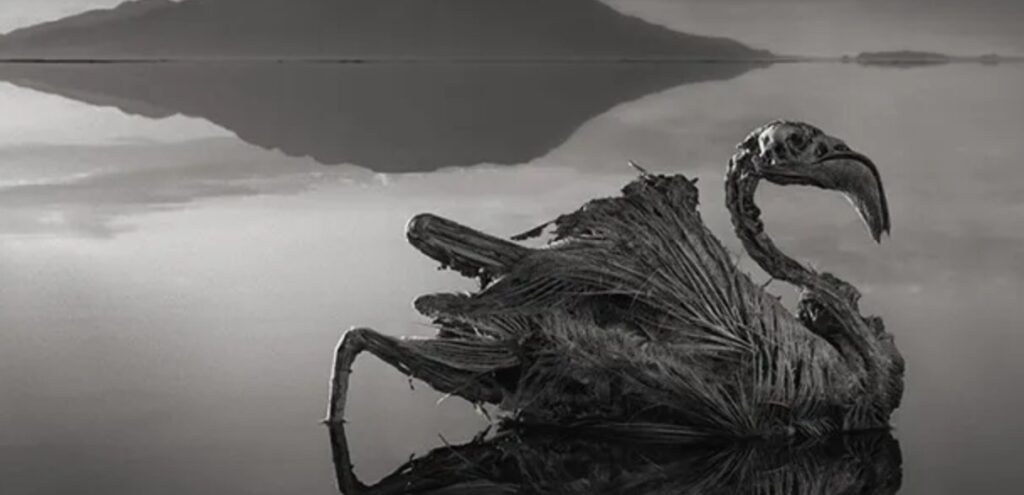
One of Nick Brandt’s photographs. © Nick Brandt 2013, Courtesy of Hasted Kraeutler Gallery, NY
What Would Happen if a Person Ended Up in Lake Natron
If you were to fall into Lake Natron, you wouldn’t turn to stone instantly. But it wouldn’t be pleasant. The water would burn your skin within seconds, the alkali would begin to corrode any wounds, and the salt would finish the job.
It’s so caustic that even if you have the smallest cut, it’s very painful, — Brandt told Smithsonian Magazine.
The story of Lake Natron is a good example of how viral photographs can create a beautiful but inaccurate myth. Animals here don’t turn to stone by magic. The reality is more prosaic and simultaneously more frightening: the lake’s unique geochemistry first kills, then preserves. The very same processes that thousands of years ago helped the Egyptians preserve pharaohs for eternity work in Lake Natron on their own, without any human involvement.