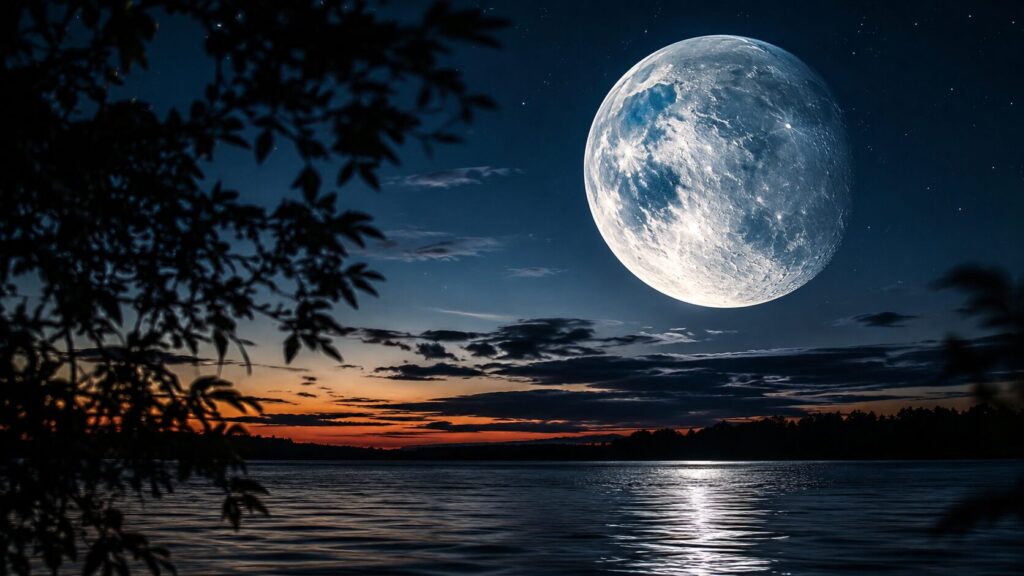
What Earth’s residents will see: a rare Blue Moon is coming soon.
On May 31, 2026, a Blue Moon will appear in the sky — it’s one of the major astronomical events of 2026, but don’t expect a blue disk. This full moon has another surprise: it will appear slightly smaller than usual and will be the most modest in size for the entire year. Still, you won’t want to miss it — such coincidences happen rarely, and next to the Moon you’ll be able to spot another bright celestial landmark. Let’s figure out why this full moon is called a Blue Moon, when is the best time to look at the sky, and how to take great photos instead of the usual white blob.
Blue Moon on May 31: Date, Time, and What It Actually Is
The Blue Moon will occur on May 31, 2026 at 08:45 GMT. But don’t rush outside right at that moment: the exact full moon time is an astronomical marker, and the Moon itself will rise closer to sunset. In Moscow, for example, it will appear above the horizon around 22:04 local time.
The main thing you need to know: a Blue Moon is the second full moon in a single calendar month. The first May full moon fell on May 1, and the second — on the 31st. It’s this second one that’s called the Blue Moon.
Why does this happen? The lunar cycle (from one full moon to the next) lasts approximately 29.5 days, which is slightly shorter than most months. So sometimes one full moon manages to “squeeze in” at the very beginning of a month, and a second one lands at its end. This doesn’t happen often, hence the English saying “once in a blue moon” — meaning “extremely rarely.”
Why It’s Called a Blue Moon Even Though It’s Not Blue
Let’s disappoint the romantics right away: the Moon on May 31 will remain its usual yellowish-white color. The name “Blue” has nothing to do with its hue and is related only to the calendar.
However, a genuinely bluish Moon is possible in nature — though for entirely different reasons. This happens when the atmosphere contains a lot of volcanic dust or smoke from forest fires. These particles scatter light in a special way, and the satellite can indeed take on a cool blue tint. This phenomenon is very rare and has nothing to do with the May full moon.
How Often Does a Blue Moon Happen and When Is the Next One
After May 31, the next full moon will arrive on June 29, 2026 — it’s called the Strawberry Moon. As for the next Blue Moon, you’ll have to wait: it will be on May 20, 2027, but it will be a seasonal one, not a calendar one. The next calendar Blue Moon won’t come until December 31, 2028.

Blue Moon calendar through 2032. Image source: starwalk.space
So you definitely shouldn’t miss the May event. Even though the Moon won’t turn blue, the sight is still worth it. All you need to do is wait for the evening, go outside, and simply look up at the sky.
The Smallest Full Moon of 2026: Why the Moon Will Be Smaller Than Usual
This full moon has another special feature. It will be a Micromoon — the smallest full moon of 2026. This happens because the Moon will be near apogee — the farthest point from Earth in its orbit.
The Moon doesn’t travel around us in a perfect circle but in an elongated ellipse. When a full moon coincides with the closest point, we get a spectacular supermoon — a large and bright Moon. But on May 31, it will be the exact opposite: the satellite will be at its maximum distance.
How much smaller? Approximately 5.5% smaller and 10.5% dimmer than a typical full Moon. Honestly, the difference is almost impossible to detect with the naked eye. However, if you photograph this Moon and then compare the shot with other full moons taken with the same settings, the difference in disk size will be clearly visible.
What You Can See Near the Blue Moon on May 31
The main bonus of this evening — the Blue Moon will shine right next to Antares, a bright red star and the “heart” of the constellation Scorpius. This beautiful pair is easy to see without any equipment: the orange-red star will glow right beside the full lunar disk.
Antares has a curious name. It comes from ancient Greek and means “rival of Mars”: ancient observers often confused the rich reddish color of this star with the hue of the Red Planet.
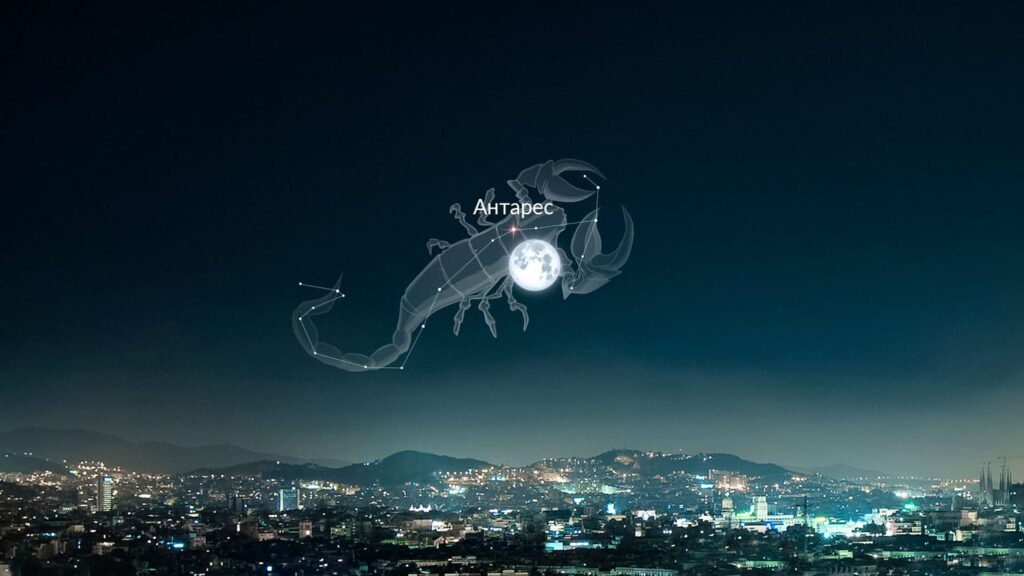
On May 31, look for the Blue Moon in the constellation Scorpius, with Antares nearby. Image source: starwalk.space
Residents of some southern regions will be even luckier. In Antarctica, Argentina, Chile, and Bolivia, the Moon will briefly completely cover Antares — this is called a lunar occultation. This spectacle won’t be visible in Russia, but the close pairing of the Moon and the star can still be easily observed.
How to Observe and Photograph the Blue Moon
You don’t need to wait for the exact moment of the full moon: to the eye, the Moon will appear full from May 30 through June 1. The best time for observation is moonrise or moonset, when it hangs low on the horizon, appears larger, and glows with a warm golden color.
A few simple tips to make your observations a 100% success:
- The full moon is perfectly visible to the naked eye. With binoculars, you can already make out the dark lunar seas and major surface details.
- On a smartphone, tap on the Moon to set focus, and reduce the exposure — otherwise the disk will turn into a bright white blob. Set a timer for a couple of seconds and take a series of shots.
- On a camera, switch to manual focus and set it to “infinity.” For a start, try ISO 200–400, shutter speed 1/250–1/500 second, and aperture f/5.6–f/8.
- To make the small Moon appear larger against the landscape, step farther back and use a long lens — 200 mm and above. This way the perspective will “compress,” and the Moon will look more impressive.