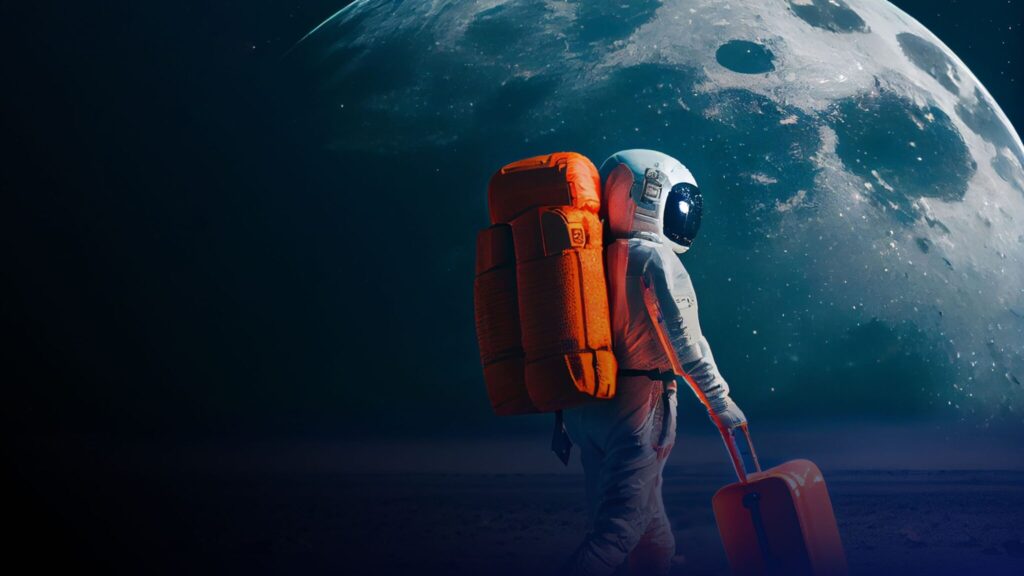
Space tourism is already a reality.
In 2026, flying to space is no longer science fiction — it’s a real service with a price list. The prices start at $750,000 and go up to tens of millions. The difference in cost is enormous, and it’s not accidental: for one price you get a couple of minutes of weightlessness at the edge of space, and for another — two weeks in orbit. Let’s find out who is selling what and for how much today.
Where Does Space Actually Begin
It might seem like the question of where space begins is simple — but there’s no single answer even among specialists. NASA and the U.S. Air Force draw the boundary of space at an altitude of 80 km, while the internationally recognized Kármán line — an imaginary boundary of outer space — sits at 100 km. It’s this line that determines whether a company has the right to say it “sent you to space.”
This is where the main division of the entire industry comes from — into two types of flights. Suborbital flights lift passengers to approximately 80–100 km, and then the vehicle simply falls back without making a single orbit around the planet. You get a few minutes of weightlessness and a view of Earth from above. Orbital flights work completely differently: the vehicle accelerates to approximately 28,000 km/h to stay in orbit. This is where the price difference comes from, which we’ll discuss below.
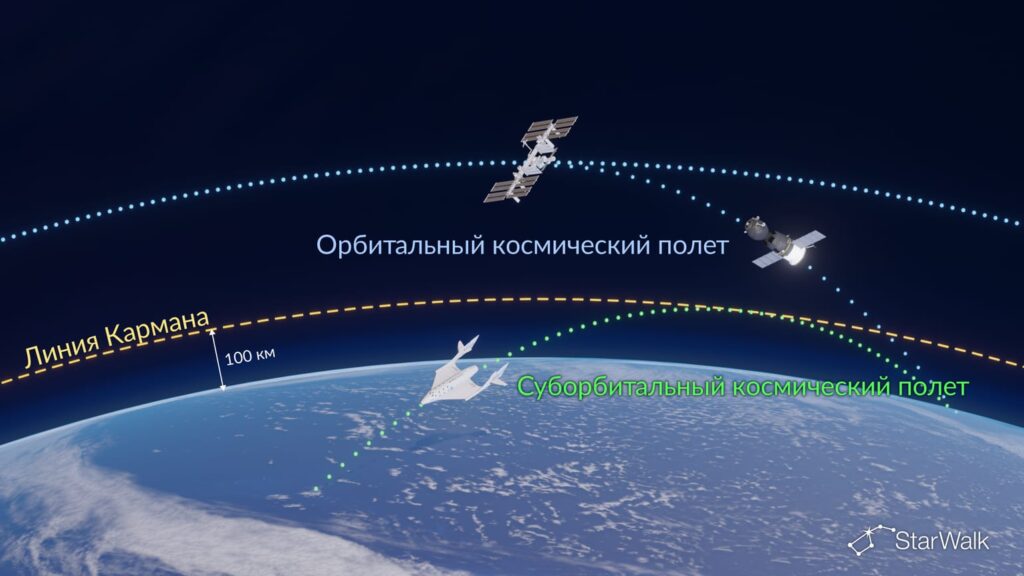
Visual illustration of suborbital and orbital spaceflight. Image source: starwalk.space
What Does a Person Feel in Space
The most anticipated part is weightlessness. During a suborbital flight, it lasts only a few minutes, while during an orbital mission, it accompanies the person for the entire flight. Many tourists also describe the so-called overview effect — a sudden shift in perception when you see the whole Earth from space for the first time.
But there’s a less romantic side too. During launch and reentry, passengers experience g-forces of about 3–4 g — meaning for a few seconds they weigh several times more than usual. Some people are hit with space sickness, especially during the first days of microgravity. Plus there’s an elevated level of cosmic radiation, although the dose remains small during a short mission.
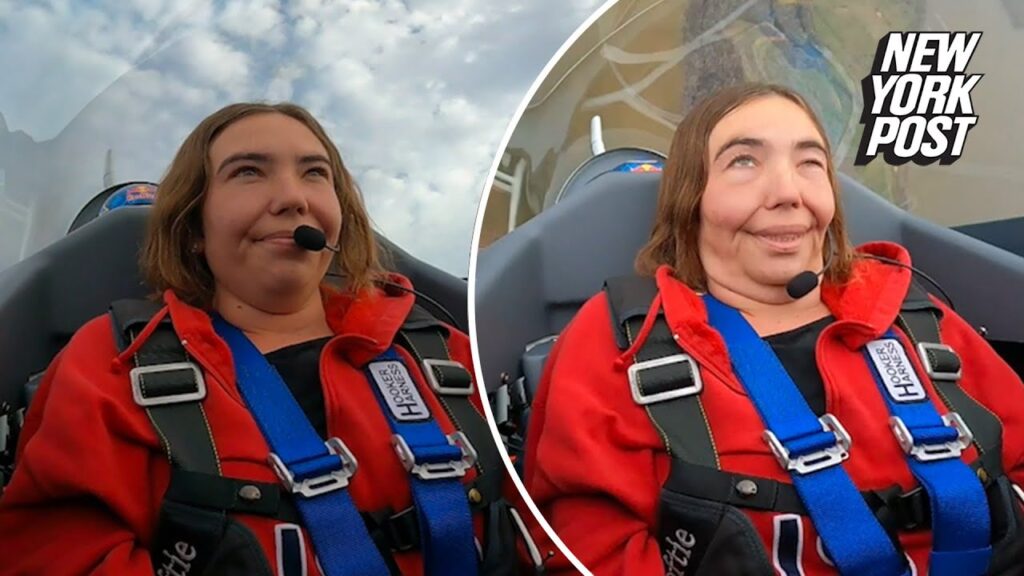
How g-forces affect the human body.
Who Is Selling Tickets to Space Right Now
There are several notable players on the market today, and they offer very different things:
- Blue Origin — short suborbital flights on the New Shepard rocket. A six-person capsule rises just above the Kármán line, provides several minutes of weightlessness and a view through large windows. However, on January 30, 2026, the company announced that New Shepard flights are suspended for at least two years.
- Virgin Galactic — suborbital flights on a spaceplane that takes off and lands like an airplane. The company honestly positions this not as reaching orbit, but as an opportunity to feel like an astronaut for a few minutes.
- SpaceX — orbital flights on the Dragon spacecraft, which carries up to seven people. This is not a short tourist trip, but individually organized private missions to low Earth orbit tailored to the client’s request.
- Axiom Space — private missions to the International Space Station. The next one, Ax-5, is planned for no earlier than January 2027, and the crew will stay docked to the ISS for up to 14 days.
- Space Adventures — more of an organizer-intermediary: missions to the ISS, a concept for a lunar flyby, and other exclusive options. However, their current availability is less obvious than the others.
How Much Does It Cost to Fly to Space in 2026
There is no single price for space tourism — it all depends on what exactly you’re buying. Virgin Galactic resumed limited ticket sales in early 2026 at $750,000 per seat — this is the most affordable option, a short jump to the edge of space. The company plans to bring its new-generation Delta ships into commercial operation in 2026.
Blue Origin does not list a fixed retail price on the New Shepard booking page — you can reserve a spot, but the exact amount is not published. SpaceX has a similar approach: the company accepts inquiries for private orbital flights, and the cost is apparently calculated individually.
A full-fledged orbital mission, however, is an entirely different order of magnitude. A seat on a private mission with a visit to the ISS costs approximately $55–65 million. For that money, you get not just a couple of minutes, but training and about two weeks in orbit. Space Adventures does not publicly disclose its prices for ISS missions and lunar flybys — those are available only upon request.
Why is the price gap so staggering? It comes down to physics, not corporate greed. Getting into orbit requires tens of times more energy than simply jumping up to the edge of space and coming back. A suborbital flight is like jumping very high, while an orbital flight is like accelerating so fast that you miss the Earth and circle around it. That’s where the multi-million-dollar difference comes from.
At the moment, space tourism is available only to very wealthy people.
Who Has Already Been to Space at Their Own Expense
Private flights began long before the current hype. The first space tourist was American businessman Dennis Tito back in April 2001 — he flew to the ISS through Space Adventures. He was followed by Mark Shuttleworth, Greg Olsen, Anousheh Ansari, Charles Simonyi, Richard Garriott, and Guy Laliberté, and in December 2021, Japanese entrepreneur Yusaku Maezawa and Yozo Hirano flew to the station.
In parallel, there was a boom in suborbital flights. Blue Origin completed a long series of New Shepard tourist flights — from NS-16 in July 2021 to NS-38 in January 2026. Virgin Galactic sent its first passengers on VSS Unity in August 2023, followed by five more flights. Separately, there are major private orbital missions — for example, Inspiration4 in September 2021, which is called the first fully civilian orbital mission, and Axiom Mission 1 in April 2022 — the first fully private flight to the ISS.
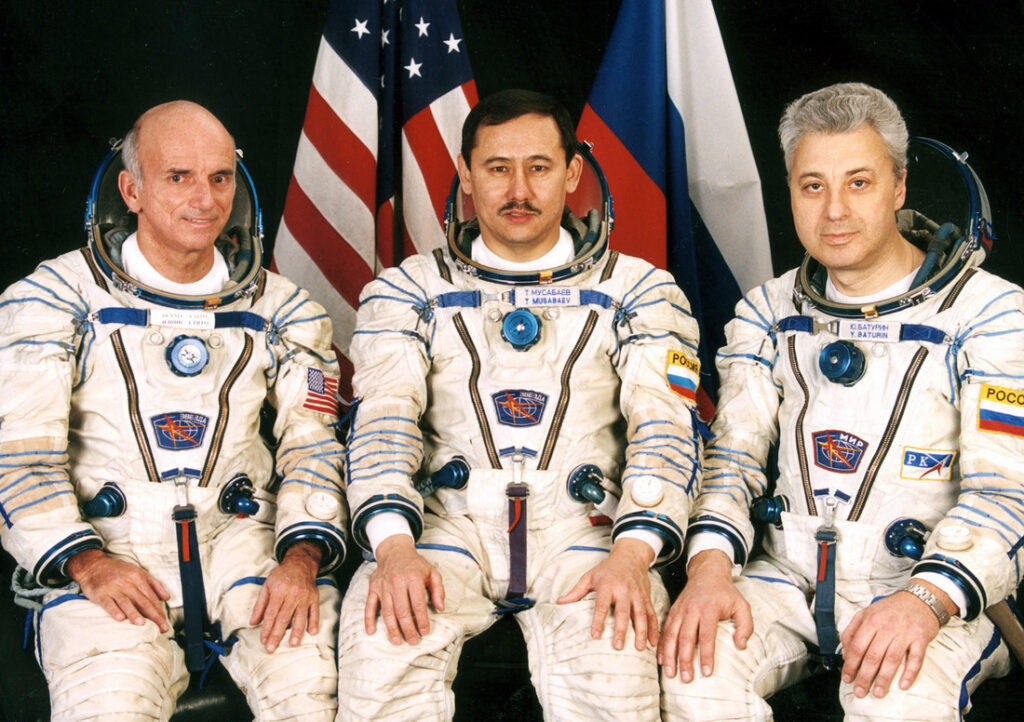
The very first real space tourist Dennis Tito (left), who paid $20 million for his flight that launched on April 28, 2001 and lasted 7 days 22 hours 4 minutes.
Failed Projects You Should Know About in Advance
Not everything that was loudly