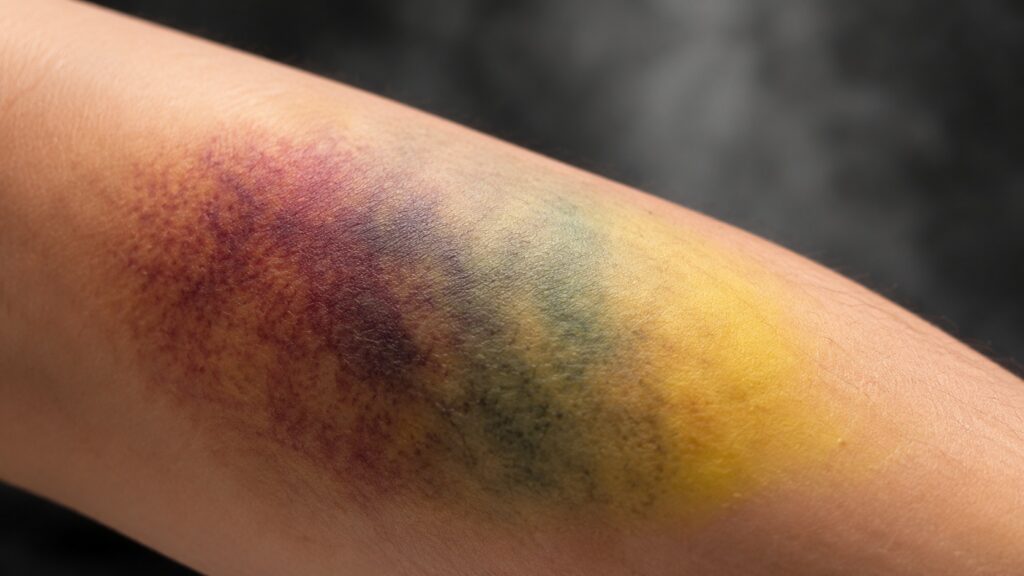
The appearance and disappearance of a bruise is a whole science hidden from our eyes
Have you also noticed that a bruise changes color? First it’s blue, then it turns green, then yellow, and finally disappears. This is just as strange a phenomenon as blue veins and red blood. Some people think that the skin heals in layers after an impact, but in reality the body simply breaks down the blood that leaked under the skin into different chemical elements. Capillaries burst, blood leaks out of the tissues, and cells arrive to dispose of the hemoglobin. Each of these stages has its own characteristic color.
What Causes Bruises
When you hit your leg against the corner of a table, small blood vessels under the skin are damaged. Blood escapes from the vessels but doesn’t leak out and accumulates in the tissues. That’s why pain, swelling, and a red or crimson spot appear first.
This spot at the site of vessel damage is what we call a bruise. It doesn’t stay crimson for long and over time acquires a greenish, and then a yellow tint. All this time, different processes are happening under the skin, and the bruise disappears after recovery.
Why a Bruise Is Red First and Then Blue
At first the bruise is red or crimson because there are still many fresh red blood cells (erythrocytes) under the skin. Their main pigment is hemoglobin, a protein that carries oxygen and gives blood its red color. But under the skin, blood doesn’t look like a bright red pool: the color is distorted by the skin itself, the depth of the hemorrhage, lighting, and the amount of oxygen in the hemoglobin.
Then the bruise often turns blue, purple, or almost black. This doesn’t mean the blood has literally turned blue. Two things are at work here: hemoglobin loses oxygen, and light passes through the skin and reflects from the deeper layer of blood differently than from the surface. That’s why the eye sees dark blue, purple, or brownish tones.
Why a Bruise Turns Green
A bruise turns green because of a substance known as biliverdin. When the body breaks down hemoglobin, it first gets to the heme — the pigment part of the molecule that contains iron. Heme is broken down by a special enzyme, and among the products is biliverdin, which is a green pigment.
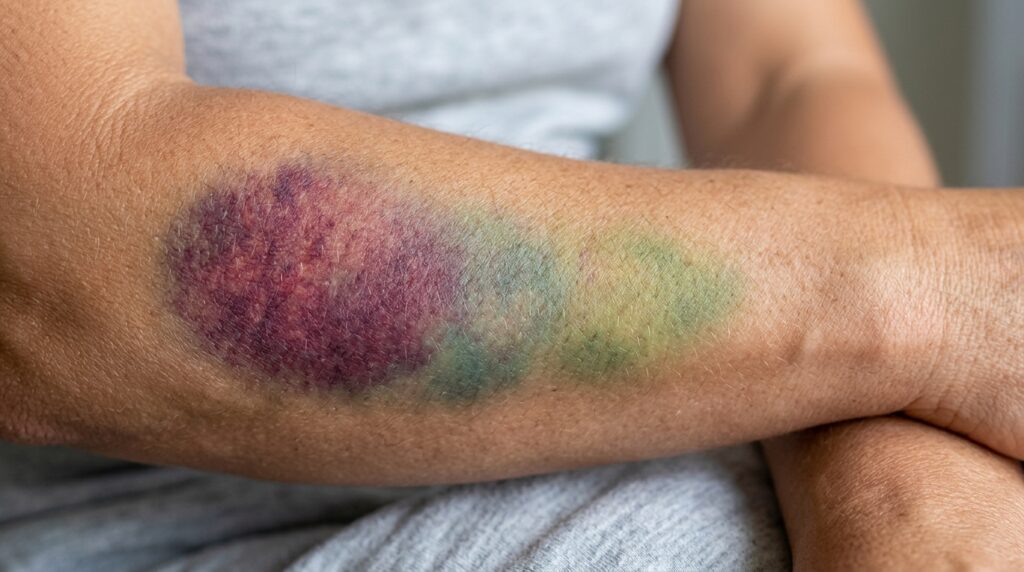
At this stage the bruise acquires a greenish tint
Medical educational sources describe this almost verbatim:
When red blood cells are damaged, heme is released, then it converts into biliverdin, which is why the bruise turns green.
Why an Old Bruise Turns Yellow
A bruise turns yellow because of a substance called bilirubin. Biliverdin is converted into bilirubin by the enzyme biliverdin reductase, and bilirubin has a yellow-orange tint. That’s why an old bruise looks yellow, yellow-brown, or dirty gold.
This is the same pigment associated with the yellow color of bile and jaundice. But in the case of a bruise, it is located locally in the tissues and by itself doesn’t indicate liver problems — the body is simply removing the remnants of decomposed blood.
If we put it all into one chain, here is how a bruise appears and disappears:
- Impact — capillaries burst, blood leaks under the skin;
- Hemoglobin gives red-blue-purple tones;
- Heme breaks down into green biliverdin;
- Biliverdin converts into yellow bilirubin;
- Remnants of pigments and iron are gradually removed by macrophages, immune system cells that dispose of cellular debris.
Macrophages here work like the body’s cleaning service, hauling away the “trash” after a minor accident under the skin.
How Long Does a Bruise Take to Heal
The timeline usually looks like this. In the first hours and days, the bruise is red, crimson, blue, or purple. After a few days it may turn green, then becomes yellow or yellow-brown. Most ordinary bruises heal in about two weeks, but the timing varies considerably.
The speed of bruise healing is affected by the force of the impact, the size of the hemorrhage, the person’s age, medications being taken, skin color, and the location of the injury. That’s why one bruise fades in a week while another lasts longer. Ice in the first 24 hours helps reduce swelling and the spread of blood in the tissues: it’s recommended to apply ice wrapped in a towel for about 15 minutes per hour.
When Bruises Are a Bad Symptom
A regular bruise after an impact is normal. But there are situations when you should be concerned:
- Bruises appear without an obvious impact or there are suspiciously many of them;
- The bruise grows rapidly, is very painful, and the area is hot;
- Pus appears, along with red streaks or a fever;
- The bruise lasts longer than four weeks, keeps growing, or becomes more painful.
The main takeaway is this: a bruise is not one color but a chemical time-lapse of blood breaking down under the skin. Blue and purple come from hemoglobin and blood, green from biliverdin, and yellow from bilirubin. And when the bruise disappears, it means the body has finally hauled away all the “trash” after the accident you had with the table corner. If bruises start appearing too easily and frequently, that’s a signal to watch yourself more carefully and see a doctor if necessary.