
Which profession destroys marriages: an honest job rating by divorce rate
It might seem like work and personal life are two separate worlds that can be kept apart. But the data says otherwise. A fresh analysis of professions and divorce rates in the USA has shown that some professionals see their marriages fall apart nearly three times more often than others. And it’s not about people’s character — it’s about the conditions of the job itself: schedule, income, and stress level.
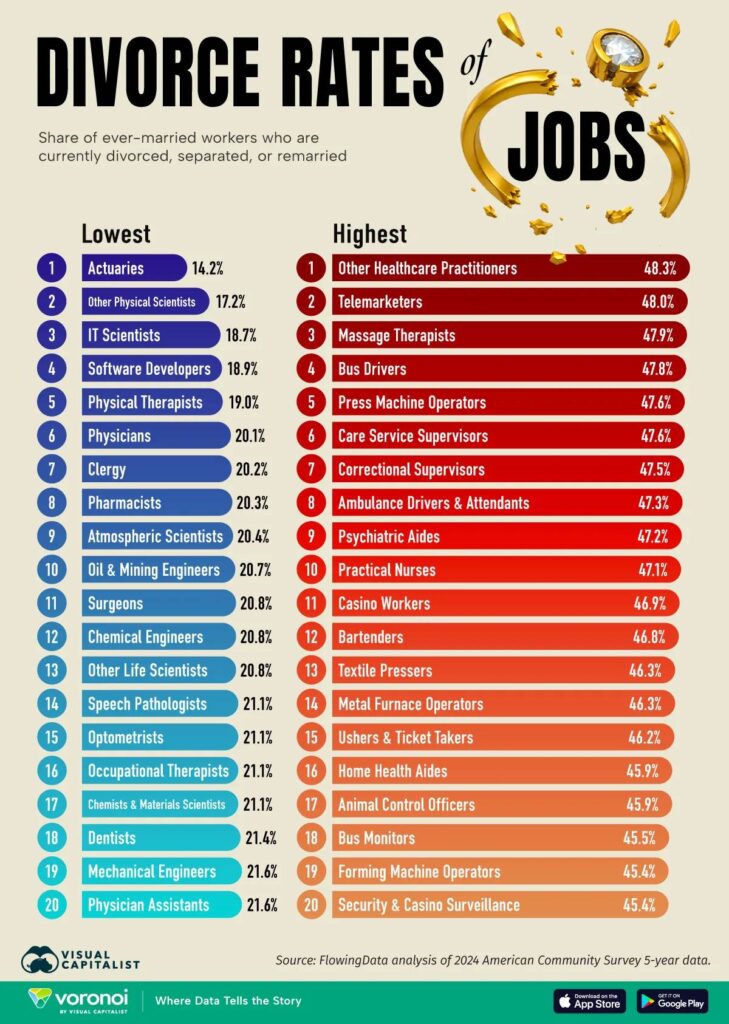
Professions with the Lowest Divorce Rates
In short: those who professionally assess risks and work in exact sciences divorce the least.
Here are the top five professions with the lowest divorce rates:
- Actuaries — 14.2%. Specialists who evaluate economic risks and probabilities for insurance companies
- Natural sciences researchers — 17.2%
- IT specialists — 18.7%
- Software developers — 18.9%
- Physical therapists — 19.0%
Interestingly, actuaries professionally deal with assessing probabilities — for example, they calculate when a person might die or the likelihood of a house being damaged by bad weather. The authors of the study wryly note: perhaps the habit of soberly weighing risks helps them in choosing a life partner as well. The rest of the top of the ranking is occupied by professions from the STEM field (natural sciences, technology, engineering, and mathematics) and healthcare.
Professions with the Highest Divorce Rates
On the other end of the spectrum are jobs with grueling schedules, constant stress, or low income. Here, the divorce rate approaches 50%.
The top five professions with the highest divorce rates look like this:
- Healthcare workers — 48.3%. Nearly every other one faces divorce
- Telemarketers — 48.0%
- Massage therapists — 47.9%
- Bus drivers — 47.8%
- Press machine operators — 47.6%
The most surprising finding here is that medicine ended up on both ends of the list. Healthcare workers top the divorce rankings, yet pharmacists, surgeons, and optometrists make it into the top 20 professions with the lowest divorce rates. The difference may be explained by the fact that some medical workers have lower salaries and more irregular schedules, which takes a toll on relationships.
Irregular schedules of healthcare workers are a common strain on families
Telemarketers come in second with a 48% divorce rate. It’s a stressful job with unusual hours and constant rejection from phone contacts — irritation and fatigue easily carry over into personal life.
Why Work Schedules and Stress Destroy Marriages
The main reason some professions are more “dangerous” for marriage isn’t the position itself but the working conditions. The authors of the analysis highlight two key factors.
The first is irregular or excessively long working hours. One of the most common causes of divorce is emotional distancing between spouses, when people stop feeling connected to each other. If one or both partners work unusual schedules, it’s simply harder for them to see each other and communicate every day. That’s why healthcare workers, telemarketers, and machine operators are in the risk zone — they rarely have a predictable “nine to five.”
The second factor is money and financial stress. Financial problems often become a source of discord, and this explains a lot in the ranking. Well-paid professions are noticeably more likely to be among those with low divorce rates.
How Much Couples Earn in Professions with High and Low Divorce Rates
The income gap between “stable” and “risky” professions is enormous, as shown by official statistics from the U.S. Bureau of Labor Statistics.
A few telling figures:
- Actuaries — over $125,000 in median annual income
- Software developers — over $131,000 per year
- Telemarketers — about $34,480 per year
A three-to-four-fold gap speaks for itself. Financial stability removes one of the main sources of conflict in a couple, while low income amplifies tension and mutual grievances. This doesn’t mean money buys a happy marriage, but it does eliminate some reasons for arguments.
What Divorce Statistics by Profession Really Mean
It’s important to understand the key takeaway: this is statistics, not a verdict. The ranking shows correlation — a link between profession and divorce rates — but doesn’t prove direct causation. A profession doesn’t “destroy” a marriage by itself; it merely creates conditions that can help or hinder relationships.
Behind the dry percentages are understandable human things: exhaustion from night shifts, anxiety about money, the feeling that you and your partner are living at different rhythms. And that’s something you can actually take into account in real life — discuss schedules, share the load, and don’t leave financial matters to chance. So the main takeaway isn’t which profession to choose, but rather that working conditions are worth honestly discussing with your partner in advance.