
The most ancient weapon was made by our distant ancestors but which ones exactly remains a great mystery
Museums hold tools that are older than our species. The most ancient known one is a wooden spear that is about 300,000 years old. It was found in Germany, and it proves that ancestors of Homo sapiens didn’t just gather roots but hunted in organized groups using technology. What did this weapon look like and why is its preservation considered a unique phenomenon?
The Ancient Spear from Clacton
The official record holder among wooden tools that have survived to our time is the so-called Clacton spear. This fragment, carved from yew wood, was discovered back in 1911 in the town of Clacton-on-Sea in eastern England. Today it is displayed at the Natural History Museum in London.
The age of the find exceeds 400,000 years. This means the spear is older than our own species, because the earliest known Homo sapiens fossils date to approximately 300,000 years ago. Scientists believe the weapon was made either by Neanderthals or by Homo heidelbergensis (Heidelberg Man) — a more ancient hominid that inhabited the territories of Eurasia and Africa.
The shape, size, and density of the wood indicate that this was a heavy close-combat weapon designed for thrusting strikes. The use of such a spear implies that hominids did not hunt alone but employed cooperative hunting strategies, driving large prey together as a group.
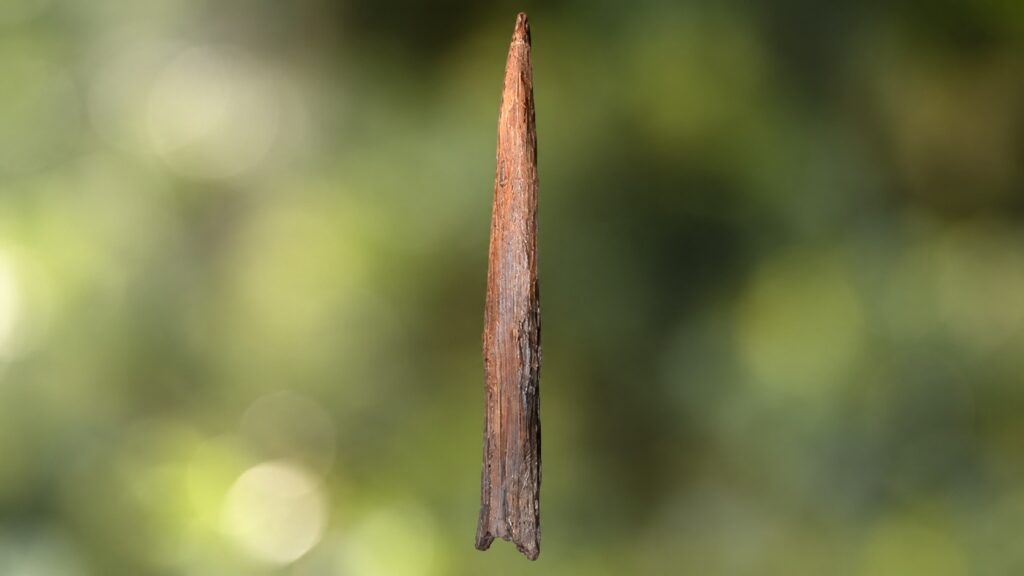
The Clacton spear
Throwing Spears from Schöningen
Another critically important archaeological site is located in Schöningen, Germany. Starting in 1992, researchers extracted between 20 and 25 wooden tools from the site, mostly carved from spruce and pine. According to specialists’ estimates, their age ranges from 200,000 to 300,000 years.
These finds are considered the world’s oldest completely preserved wooden tools. The level of their craftsmanship is staggering. Ancient craftsmen didn’t simply sharpen sticks — they deliberately hardened and charred the wood with fire to give it maximum strength.
Creating such an arsenal required deep engineering knowledge. When manufacturing weapons, ancient people had to perform several complex tasks simultaneously:
- select the right type of wood, resistant to strong impacts;
- shift the spear’s center of gravity so that it would fly accurately toward the target;
- treat the surface to protect it from moisture and decay.
Spears longer than two meters were used both for thrusting and throwing. Alongside them, archaeologists found shorter wooden clubs about 65 centimeters long — a typical throwing weapon. Interestingly, the entire arsenal was found next to butchered horse carcasses. This is direct evidence that early humans conducted purposeful and highly successful hunts of large and fast animals.
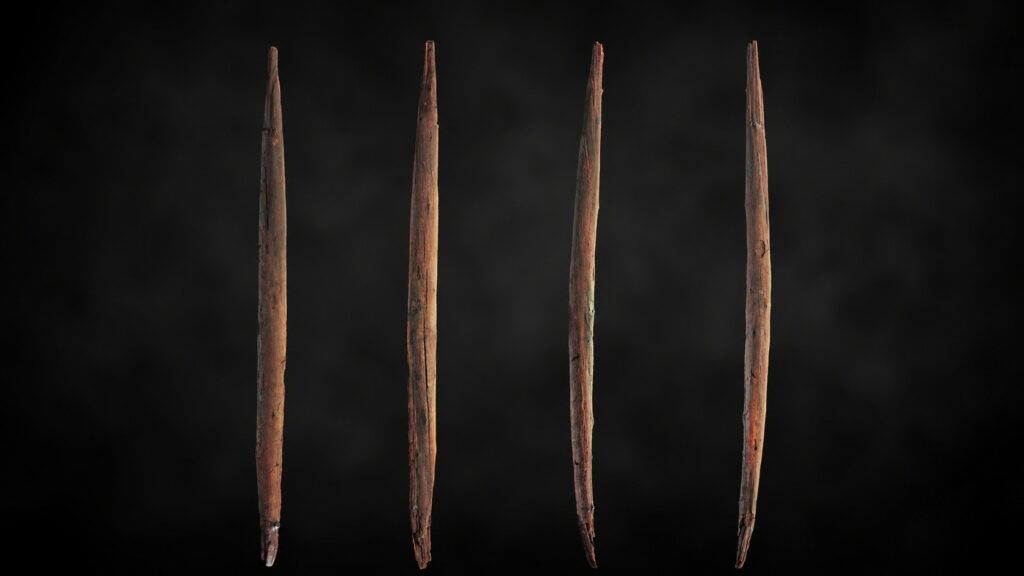
Various types of throwing sticks from Schöningen
Stone Points from Africa
While wooden weapons are primarily associated with cool Europe, Africa is rich in stone artifacts. It is generally believed that complex spears with stone points began appearing en masse between 200,000 and 300,000 years ago.
However, at the Kathu Pan archaeological site in South Africa, stone points approximately 500,000 years old were found. Wear on their edges and the characteristic shape of their bases suggest these were parts of heavy spears that were likely used for ambush hunting.
If this is the case, then the creators of this advanced technology were also representatives of Heidelberg Man. But in the scientific community, the find sparks heated debates. The problem is that the wooden shafts of these points decayed long ago. Without them, the evidence remains circumstantial, and skeptics argue these could have simply been handheld stone knives rather than full-fledged composite hunting weapons.
Why the Very First Weapon Will Forever Remain a Mystery
The finds presented above are only a tiny fraction of the arsenal that our ancestors actually possessed. The main problem of archaeology lies in time’s mercilessness toward the materials from which they were made.
Ancient humans certainly crafted objects from organic materials like wood and fibers, and also used natural adhesives and sinews. But unlike stone, organic matter decomposes quickly. Wooden artifacts survive for millennia only under exceptional conditions — for example, in peat bogs or dense clay without oxygen access.
Therefore, the Clacton spear remains the most reliable and indisputable answer to the question of the oldest weapon on the planet. These few surviving objects prove that weapons in the hands of early hominids were not merely tools for survival. They are important evidence of how our distant relatives learned to combine materials, apply abstract thinking, and share knowledge with one another.