
People in Monaco and Japan live long, but the reasons for their longevity are completely different
Every year, experts compile rankings of countries where people live the longest. And every time, the leader of this list comes as a surprise, because it’s not Japan, not Scandinavia, and not Mediterranean resorts, but a tiny nation that few people think about in this context. But even this top spot comes with a catch — statistics don’t always reflect the real picture, and the true secret of longevity is hidden in a completely different country. Recently, I decided to figure out where one should actually look for the recipe for a long life and why the explanations we’re used to don’t always work.
Where Do People Live the Longest in the World
If you look at the ranking of countries by life expectancy, there’s one clear leader right now — Monaco. According to Worldometer data for 2026, people here live an average of 86.73 years. Following behind are San Marino, Hong Kong, Japan, and South Korea.
At first glance, it’s simple: if you want to live long, move to Monaco. But this is exactly where things get interesting.
Why Monaco Has Such a High Life Expectancy
Monaco is a microstate with a population of about 39,000 people, and it’s a high-income country. When there are so few people, statistics start behaving unusually, and they depend heavily on who exactly lives there.
And the people who live in Monaco are mainly wealthy individuals with excellent access to healthcare, a high level of safety, and comfort.
Several factors work particularly strongly here:
- near-zero child mortality — in 2024, approximately one child under 5 died there per year;
- enormous healthcare spending — about $9,797 per person in 2023;
- few deaths from poverty, poor nutrition, and dangerous labor.
Child mortality deserves special mention. Life expectancy depends heavily not only on how long the elderly live, but also on how many children don’t survive to adulthood. When almost no one dies at an early age, the average figure rises sharply.
Therefore, long life in Monaco is not about some secret diet, but about a combination of money, medicine, safety, and a very specific population composition. Honestly, comparing a tiny wealthy principality with a country of tens of millions of people isn’t entirely fair.
Why People in Japan Are So Healthy
In Japan, on the other hand, people live long precisely thanks to their lifestyle. In the Worldometer ranking for 2026, it comes right after San Marino and Hong Kong with a figure of about 85.15 years. And in the OECD Health at a Glance 2025 report, Spain, Japan, and Switzerland are named as leaders among developed countries.
The key point here is this: Japanese longevity rests not on one miracle factor, but on an entire system. Diet, medicine, prevention, habits — all of this adds up to a result that you can’t replicate simply by buying a gym membership.
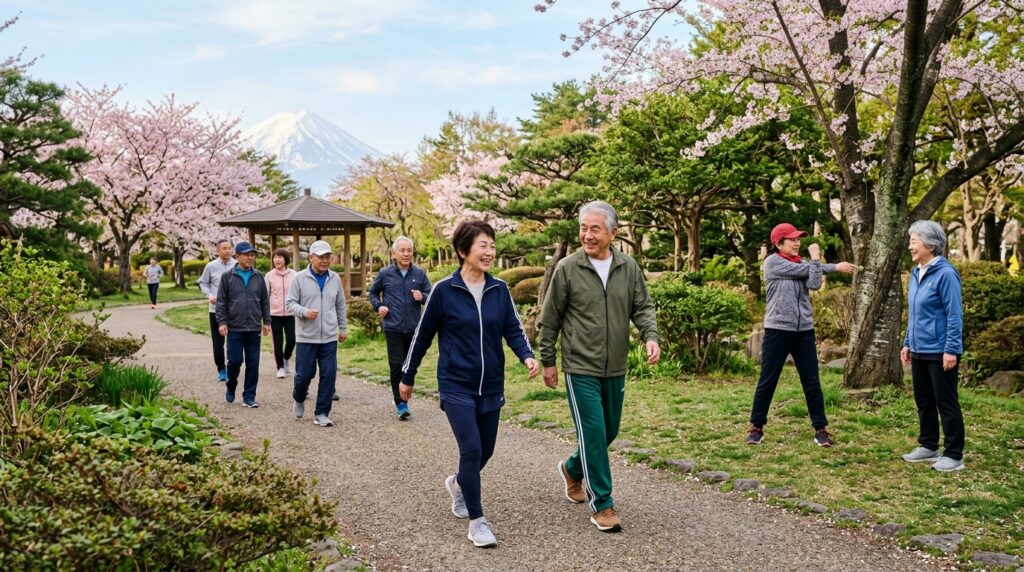
Japanese longevity is the result not of one habit, but of an entire lifestyle system
What Long-Lived Countries Have in Common
If you look closely at the ranking leaders, they share several common traits. Japan illustrates this especially clearly.
First, low mortality from heart disease and certain types of cancer. A scientific review in the European Journal of Clinical Nutrition directly states that the high life expectancy of Japanese people is linked to low mortality from ischemic heart disease and cancer. In developed countries, these diseases claim the most lives, so even a small reduction in risk noticeably raises average life expectancy.
Second, a distinctive dietary structure. Researchers link Japanese longevity to a diet low in red meat and saturated fats, but rich in fish and omega-3s, soy, vegetables, and unsweetened green tea. It’s important to understand the point: it’s not about eating sushi. It’s about the overall structure — less calorie-dense processed food and sugary drinks, more fish, legumes, and vegetables, moderate portions, and variety.
Third, low obesity rates. Japan has noticeably lower rates of excess weight and a lower average body mass index than the West. And obesity drags along type 2 diabetes, hypertension, heart disease, strokes, and some cancers.
There’s also an unexpected twist. For a long time, Japan had a serious problem — very high salt consumption, which increased the risks of strokes and stomach cancer. But habits changed: salt consumption dropped from approximately 14.5 grams per day in 1973 to 9.5 grams in 2017. This likely helped reduce blood pressure and stroke mortality.
What Life Expectancy Actually Means
It’s important to dispel a common misconception here. Life expectancy at birth is not a promised age of death. It’s a calculation of how long, on average, a newborn would live if current age-specific mortality rates remained unchanged in the future.
In other words, the phrase “people in Monaco live 86.7 years” doesn’t mean that most Monegasques die at exactly 86–87. It’s a statistical model, not a prediction for a specific person. The actual lifespan of today’s infants will depend on how medicine and living conditions change over the coming decades.
Which Longevity Habits You Can Adopt
The main practical takeaway is pleasing in that there’s no magic involved. To increase your chances of a long life, you don’t need to move to Monaco or become Japanese. It’s enough to copy those same systemic factors that work for the ranking leaders:
- eat more fish, vegetables, and legumes, less red meat and processed food;
- cut back on sugary drinks and calorie-dense food;
- keep your weight under control, because obesity brings an entire list of diseases;
- use less salt in food;
- don’t skip preventive care and see a doctor on time, especially regarding heart health.
None of these points works miracles on its own. The power lies precisely in the combination — just like in the countries with the longest lifespans.
Formally, the longest-lived people are in Monaco — about 86.5–86.7 years. But this is a special case, because it’s a small, wealthy, and safe country with near-zero child mortality and expensive healthcare, whose statistics are skewed by its tiny population.
And if you’re looking for a real example of longevity for a large country, it’s Japan. And its secret isn’t one magical product, but a combination of habits: moderate eating, lots of fish and plant-based food, low obesity, less salt, accessible healthcare, and few deaths from preventable causes. The good news is that most of these habits can be adopted by anyone, regardless of which country they live in.