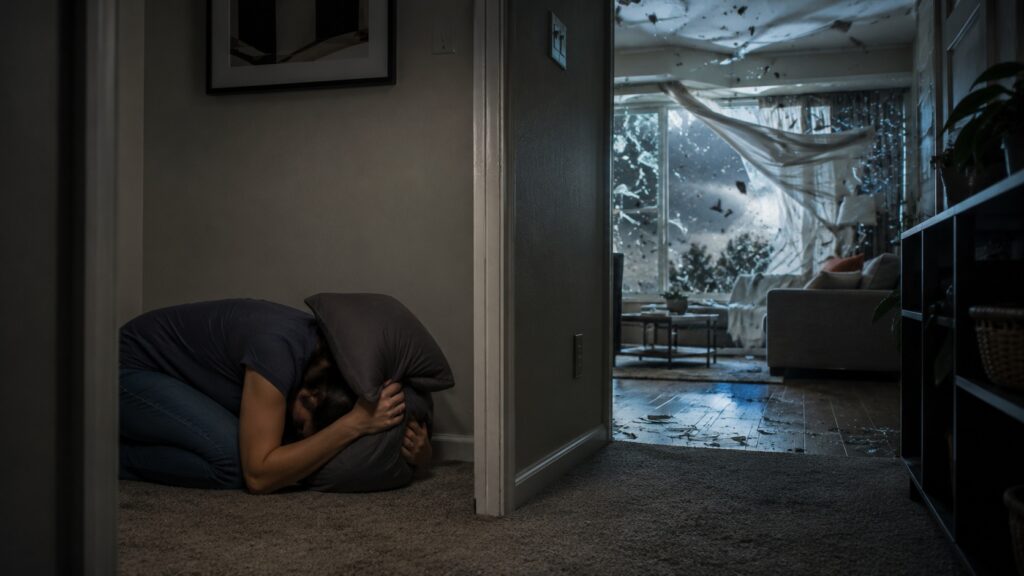
During an emergency, many people choose poor shelters
What would you do if a powerful hurricane starts, or an explosion goes off outside? Some people would hide under a table, others might rush into the stairwell, and so on. But usually instincts tell you one thing while reality demands something completely different. It turns out that familiar shelters that seem reliable can become a deadly trap. And the life-saving spot is often where you wouldn’t even think to go. Every second counts, but if you know where to run in case of danger, your chances increase dramatically.
Why You Should Never Stand Near a Window During a Hurricane or Explosion
Many people think the main threat during a natural disaster is structural collapse. In reality, most injuries are caused by flying debris and fragments from outside. A window, even covered with heavy curtains, will not protect you from impact.
During hurricanes and strong winds, glass cannot withstand pressure or impacts from flying objects. If we’re talking about an explosion, the situation becomes even more critical. The shock wave first knocks out flat surfaces — glass panes, storefronts, and doors. American emergency specialists note that in light damage zones, the vast majority of injuries are caused specifically by shattered glass. Curtains can only slightly slow down small fragments but will not save you from serious injury.
The Safest Place in Your Apartment During a Hurricane or Explosion
The ideal shelter option is a specially equipped basement, underground parking garage, or an official shelter. But if there’s no time or opportunity to get there, you need to find protection inside your home. Choose a small interior room without windows on the lowest accessible floor.
Good options include a central hallway, storage closet, walk-in closet, or bathroom. A bathroom will also work, but only if it has no window, large mirrors, or glass shower enclosures. The more walls between you and the outside, the higher your chances of staying unharmed. An ordinary dark storage closet in the center of your apartment will protect you much better than a spacious bedroom with a beautiful panoramic view.
If you live on the top floor, it’s worth planning escape routes in advance. But if the threat is already near, don’t rush around stairwells near glass entrance doors. It’s better to find a safe corner in your own apartment.
What to Do at Home During Strong Wind and a Hurricane
When a powerful storm begins outside, it’s important not to panic and to follow a clear plan of action:
- Immediately move away from windows, balconies, and exterior walls;
- Move to an interior room, hallway, bathroom, or walk-in closet;
- Sit below window level, preferably right on the floor with your back pressed against an interior wall;
- Be sure to cover your head and neck — a heavy blanket, jacket, pillow, or even a mattress will work;
- Stay in your shelter even during a lull. A hurricane can die down for a few minutes and then strike again with renewed force.
It’s important to understand that what to do during a hurricane until the official all-clear is announced is simply to stay put. Don’t go outside to assess the scale of destruction. If a storm catches you outdoors, the survival rules change drastically. At home, your main protection is concrete floor slabs.
There is a dangerous myth that during strong wind you should crack open windows to “equalize pressure.” You absolutely must not do this. You’ll only waste precious seconds and let destructive wind right into your home.
Where to Hide During an Explosion and How to Survive a Shock Wave
An explosion requires a completely different, instant reaction. If you hear a blast, see a flash, or receive a threat warning:
- Don’t run to the window to see what happened. This is the most common and fatal mistake. A secondary blast wave or facade collapse can hit you at exactly that moment;
- Instantly drop to the floor. Try to take cover behind heavy furniture or a solid interior wall;
- Cover your head and neck with your arms, a backpack, or thick fabric;
- Move to a room without windows if it’s just a few steps away;
- Don’t try to leave the building by elevator. After a powerful blast, electricity may go out, a fire may start, or the shaft may become deformed. Use only the stairs.
Specialists emphasize that a shock wave can destroy structures that seem solid. That’s why it’s important to lie as low as possible and hide behind massive obstacles that will absorb the impact.
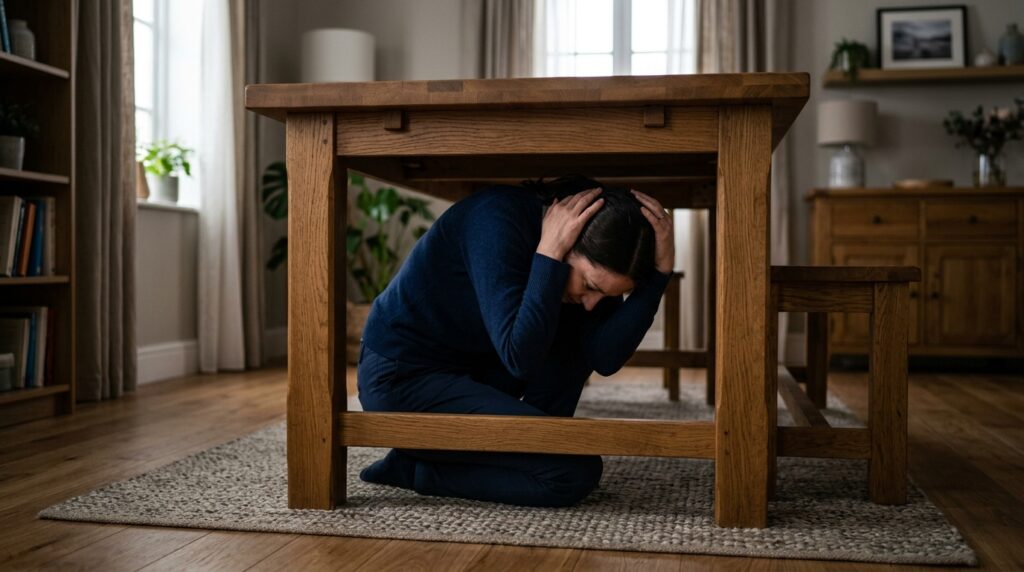
In case of an explosion, you need to lie on the floor and cover your head with your arms
Where You Should Never Hide at Home
Even if you understand the principle of safe zones, there are several places in your apartment that must be avoided at all costs:
- Balcony or loggia. This is the most vulnerable part of the home: thin partitions, lots of glass, risk of falling, and being hit by street debris;
- Kitchen. During strong shaking or a blast wave, the kitchen turns into a room of flying knives, dish fragments, and heavy appliances. Additionally, gas pipes and ventilation run through it;
- Rooms with panoramic windows. Even if it’s the farthest corner of a large living room, the abundance of glass reduces safety to zero;
- Places under heavy objects. Don’t lie down to take cover beneath a spot where there’s a heavy safe, piano, or refrigerator on the floor above or on top of a wardrobe. If the ceiling collapses, they’ll crash right on top of you;
- Elevator. In an emergency situation, it instantly becomes a blocked metal cage;
- Spacious rooms. Large open spaces are worse at withstanding extreme loads on the roof and walls.
Extreme loads change the physical properties of materials. Just as trees can explode during severe frosts due to powerful internal pressure, ordinary glass partitions in an apartment under wind pressure turn into deadly projectiles.
What You Should Keep on Hand in Case of an Emergency
If you live in a region where hurricanes are possible, or the situation requires heightened readiness, assemble an emergency go-bag. It’s best to store it near your shelter — for example, in a storage closet or central hallway.
What should be in your emergency go-bag:
- flashlight and spare batteries;
- charged power bank and phone cable;
- first aid kit with bandages, antiseptics, and a several-day supply of your personal medications;
- clean drinking water and food that doesn’t require cooking;
- copies of important documents in a waterproof bag;
- a small supply of cash;
- a whistle (it can save your life if the exit is blocked by debris and you need to call rescuers);
- heavy-duty gloves and sturdy shoes so you can safely move across broken glass;
- a respirator or at least a dust mask.
The Safest Place to Hide in Your Apartment
So that you don’t waste time thinking in a critical moment, memorize these simple rules:
- The safest place: a small interior room on a lower floor, as far as possible from the building’s facade;
- Best options: storage closet, walk-in closet, hallway, bathroom, or toilet without windows;
- The main threat: any windows, glass doors, and balconies;
- Your actions during wind: go to your shelter, sit as low as possible, cover your head and neck, wait for the official all-clear;
- Your actions during an explosion: instantly lie below windowsill level, take cover behind a solid wall or furniture, never look out the window, and forget about elevators.
Any emergency situation is chaos in which the brain operates on instinct. Understanding how buildings are destroyed and why an ordinary concrete storage closet is more reliable than a beautiful living room helps correct those instincts. Identify a windowless safety zone in your home in advance, because one day this simple action could save your life.