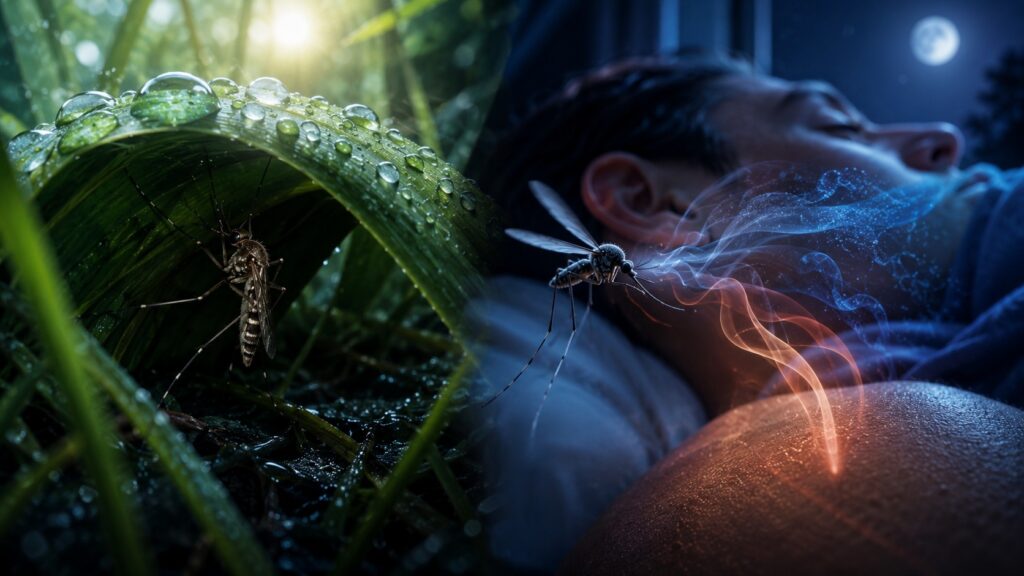
Mosquitoes hide during the day because their lives depend on it
During the day, mosquitoes disappear somewhere, and you can peacefully stroll through parks, work, or relax. But as soon as the sun sets, they appear seemingly out of nowhere and find you even in a closed room. They annoyingly whine near your ear, and some people get bitten more often than others. Where do mosquitoes disappear during the day, and how do they manage to track us down even in complete darkness? Science has answers to these and many other questions.
Where Mosquitoes Hide During the Day
A mosquito’s main enemy during the day is not a person with a slipper, but overheating and dehydration. The insect has a tiny body and a large evaporation surface area, so bright sun and dry air literally dry it out in flight. Because of this, mosquitoes are almost inactive during the peak of the day: a study of the daily rhythms of blood-sucking mosquitoes in the south of Russia’s Tyumen region showed that peak mosquito activity occurs in the morning and evening, while high temperatures and bright light suppress it during the day.
So during the day, mosquitoes don’t fly away anywhere — they simply wait out the dangerous time in places that are darker, cooler, and more humid.
The most common mosquito shelters are:
- Tall grass and bushes — they provide shade, coolness, moisture, and protection from wind;
- The underside of leaves, tree canopies, spaces beneath shrubs — a mosquito doesn’t need a cave; a humid microclimate under foliage is enough;
- Areas near water — puddles, ditches, barrels, ponds, buckets, and even saucers under flower pots, because larvae develop in standing water;
- Building basements — especially in cities.
Basement mosquitoes can live right inside apartment buildings if the basement has standing water due to leaks or plumbing problems. In a heated basement, these mosquitoes breed year-round, and in the evening they fly out into stairwells and get into apartments through entryways, elevators, and ventilation. Inside the apartment itself, a mosquito also chooses dark and quiet places — behind curtains, under furniture, in ceiling corners, in the bathroom, storage room, or near houseplants.

During the day, many mosquitoes hide under leaves
Why Mosquitoes Appear in the Evening
Most common mosquitoes come out to hunt at dusk and at night for the same reason they hide during the day: it’s cooler, more humid, and safer in the evening. The risk of drying out decreases, and at this time a person becomes the ideal target — lying still, breathing steadily, and consistently emitting heat and scent.
Interestingly, mosquitoes are specifically triggered by changes in lighting. According to the same study from Tyumen State University, a rapid transition from day to dusk and from night to dawn stimulates females, and light level is one of the main factors limiting their activity. Simply put, a mosquito responds not to the clock but to light.
But not all mosquitoes are strictly nocturnal. Some mosquito species readily attack during the day as well, especially in shade and outdoors. And when mosquito populations are large, they bite even during daylight hours under the forest canopy, where there’s no direct sun and humidity remains high.
How Mosquitoes Find People in the Dark
At night, a mosquito doesn’t see in the dark in the usual sense — it finds its victim through individual signals, activating them in sequence as it gets closer. It works like a multi-stage guidance system.
The first thing that kicks in is carbon dioxide from our breathing. At a distance, this is the main landmark: the mosquito detects an increase in CO₂ concentration and understands that someone nearby is breathing. Russia’s consumer protection agency directly states that mosquitoes find their victims specifically by the carbon dioxide exhaled by humans. For us, it has no smell, but for a mosquito, it’s a clear signal. The trail of our scent gets broken up by wind, so the mosquito zigzags, loses the trail, picks it up again, and gradually gets closer.
When carbon dioxide alone isn’t enough, the scent of skin and sweat kicks in. The mosquito needs to confirm that what’s ahead is a living body, not just a source of gas. Lactic acid, ammonia, acetone, and substances produced by skin microflora all come into play. This gives a simple explanation for why mosquitoes attack more aggressively after a workout, in the heat, or after a glass of wine. You breathe more actively, sweat more, your skin is warmer, and the scent trail is more noticeable.
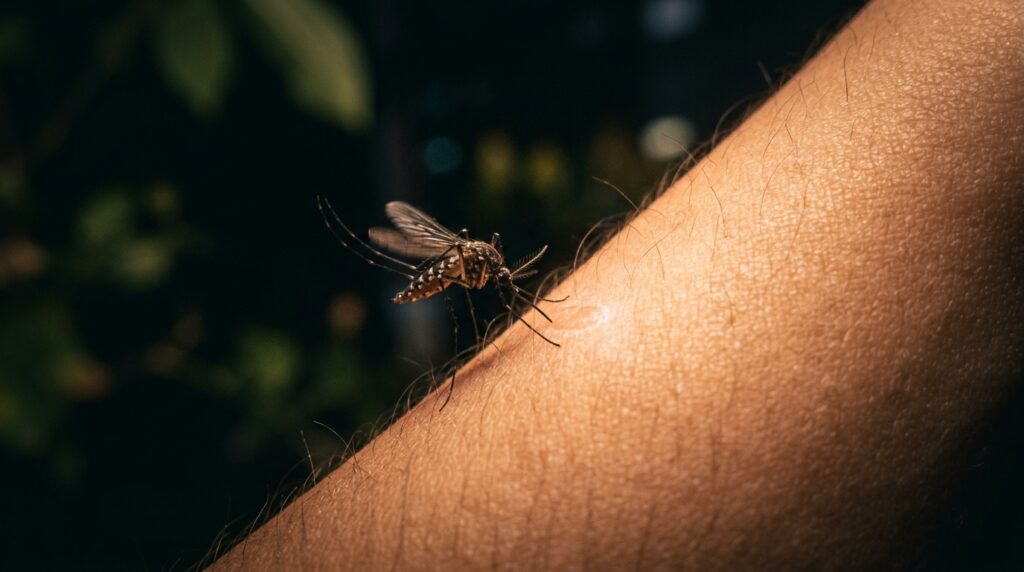
At night, a mosquito finds people not with its eyes but through chemical and thermal signals
Why Mosquitoes Bite Some People More Often
The phrase “I just have sweet blood” sounds naive, but there’s a real basis behind it — though it’s not about the blood itself. Mosquitoes are attracted to the set of scent signals surrounding a person, and it’s different for everyone: the composition of skin oils, sweat, and microbiome is individual, so some people are objectively more attractive to mosquitoes than others.
In a study comparing the influence of temperature, carbon dioxide, and body odors, scientists linked increased attractiveness to carboxylic acids, which are likely produced by microorganisms on the skin. In other words, whether you get bitten more often than your neighbor largely depends on your own skin bacteria.
Why a Mosquito Whines Near Your Ear
The familiar nighttime mosquito whine is simply the sound of its wings working. And the mosquito ends up near your ear not out of spite: the head is a convenient navigation zone. There’s a stream of exhaled carbon dioxide nearby, facial warmth, moisture from breathing, and exposed skin. When you’re lying still, the airflow from your breathing is stable, making it easier for the mosquito to reach your face, neck, and arms.
Another fact that surprises many: only female mosquitoes bite. Males don’t need blood because they feed on plant sugars and nectar. Females need blood for reproduction — from it they obtain the substances needed to form eggs. So the thin whine above your ear at night is always a female.
And why does a mosquito disappear the moment you turn on the light? It’s not because it’s afraid of light like a vampire. It’s simply that conditions change: you start moving, air currents get disrupted, the mosquito loses the stable trail of carbon dioxide and scent, and bright lighting makes landing risky. Often it doesn’t fly away at all — it just lands on a wall or curtain and waits until you lie down again.
How to Get Rid of Mosquitoes Near Your Home
The most effective way to fight mosquitoes is not chasing them with a slipper but eliminating their breeding sites. Larvae develop in standing water, so the main goal is to remove any accumulations of it. Walk around your property and home and check everything where water might stagnate:
- buckets, barrels, watering cans, and old tires;
- saucers under flower pots and pet bowls;
- children’s pools, clogged gutters, and ditches;
- basements with leaks and flooding.
Consumer protection authorities recommend eliminating mosquito breeding sites and covering containers where even a small amount of water can accumulate. In a typical apartment, mosquito screens and closed windows work excellently, while in basements the solution is fixing leaks and treating breeding sites. Authorities specifically emphasize that mosquito prevention includes treating bodies of water and basements of residential buildings, as well as using screens and approved repellents.
So, during the day mosquitoes hide wherever it’s dark, humid, and cool: in grass and bushes, under leaves, near water, in basements, and in dark corners of apartments. This is how they save themselves from overheating and dehydration. At night, conditions become safer, and a person turns into a conspicuous beacon for them: we exhale carbon dioxide, radiate heat, release moisture, and emit a complex skin scent. That’s why a mosquito finds us even in complete darkness — it doesn’t so much see us as it reads our chemical and thermal trail. This means the most reliable protection works not against the mosquito itself but against the conditions in which it appears.