There are places very far from civilization, and people there live quite happily
When we think about the most secluded corner of the planet, the answer depends on whether we’re looking for empty ocean or people. Strictly geographically, the most isolated place on the planet is Point Nemo, where there is nothing but water. The most remote human settlement, however, is hidden on the island of Tristan da Cunha. Let’s figure out where these extreme locations are and what it’s like to find yourself thousands of kilometers from familiar civilization.
Where Is Point Nemo Located
To find absolute emptiness, you’ll need to head to the southern part of the Pacific Ocean. It is there, between South America, New Zealand, and Antarctica, that the famous Point Nemo is located. This is a patch of water whose coordinates cartographer Hrvoje Lukatela calculated in 1992 using a computer model. The location got its name in honor of Captain Nemo from Jules Verne’s novels, since the word means “nobody” in Latin.
The main feature of this zone is that from it to the nearest land you would have to travel almost 2,700 kilometers. Moreover, all the nearest land masses are located at practically the same distance:
- the uninhabited coral Ducie Atoll;
- the rocky islet of Motu Nui near Easter Island;
- Maher Island off the cold coast of Antarctica.
An interesting paradox is that the closest people to Point Nemo are often astronauts. When the International Space Station flies over this area, it is at an altitude of about 400 kilometers, while the nearest uninhabited shore on Earth is almost 2,700 kilometers away.
Why Spacecraft Are Sunk at Point Nemo
Point Nemo is also a biological desert. This area is trapped inside the giant South Pacific Gyre. Such an enormous current system poorly allows nutrient-rich water to pass through. Due to the colossal distance from continents, not even mineral dust, which the wind usually carries, reaches here.
Life here certainly exists, but it is mainly represented by microorganisms: bacteria and archaea that have learned to survive in an extremely nutrient-poor environment. Scientists record one of the lowest concentrations of nutrients in the world here. Large fish, birds, and whales may pass through, but they don’t stay long because there is simply nothing for them to feed on.
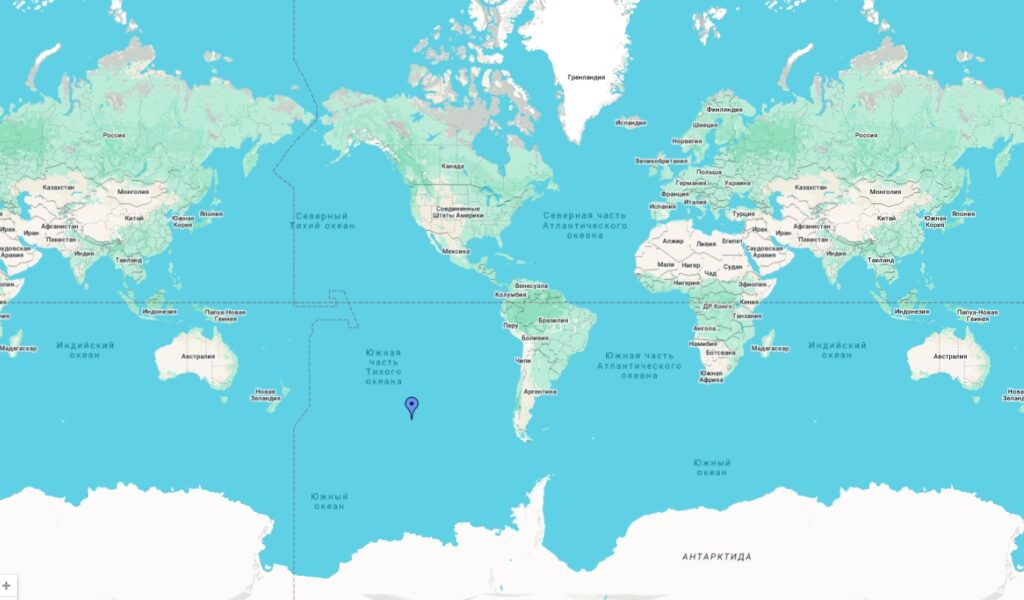
Point Nemo on Google Maps
It is precisely this absolute emptiness and the absence of shipping routes that attracted the attention of world agencies. The surrounding waters are used as a safe graveyard for spacecraft. When large orbital stations or cargo ships complete their service, they are directed into the atmosphere so that unburned debris falls into this lifeless area of the ocean, posing no threat to cities or passing ships. This is where the Mir station found its final resting place. The ISS will also be sunk here in the 2030s.
The Most Remote Inhabited Island
If empty ocean doesn’t appeal to you and you’re looking for the most secluded place in the world with actual residents, the answer is Tristan da Cunha. This volcanic island is located in the southern part of the Atlantic Ocean, between Africa and South America.
There is no airport here, which means you can’t fly in for the weekend. The only way to reach the island is a long sea voyage from Cape Town, South Africa. The distance is more than 2,800 kilometers, and the journey across rough waves takes about six days.
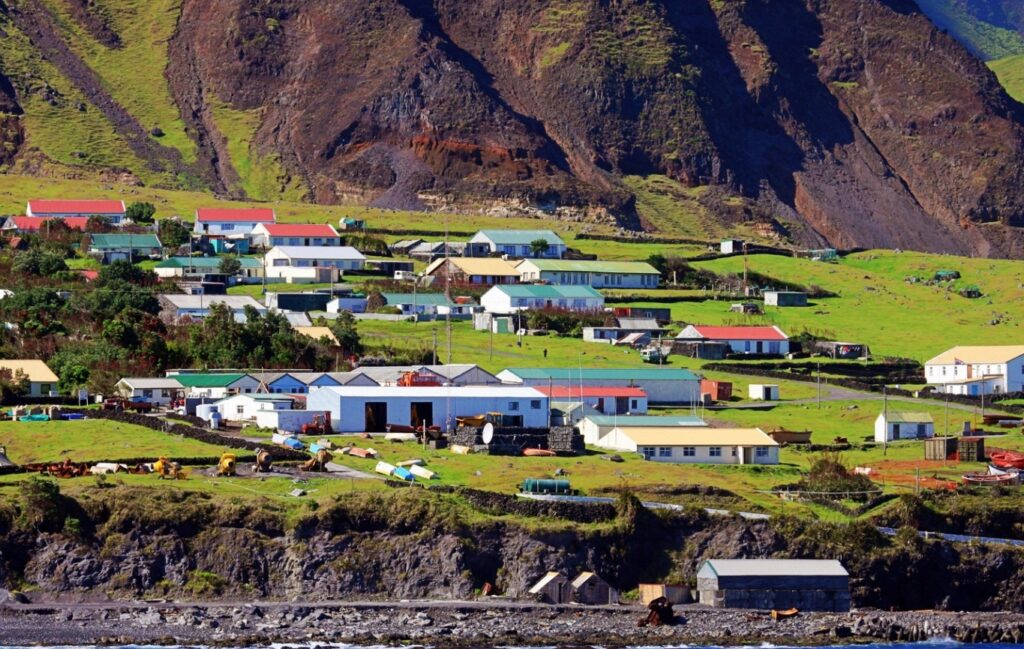
Tristan da Cunha Island. Image source: vokrugsveta.ru
Regular passenger services do not exist, so people have to use fishing and supply vessels. Spots on them are booked many months in advance, and boarding priority is strictly allocated:
- Patients requiring medical evacuation or treatment on the mainland;
- Local residents returning home;
- Government officials and invited specialists;
- Tourists, who must obtain authorization from the authorities in advance.
How People Live Far from Civilization
Today, just over 220 people live on the island. They all reside in the single settlement with the romantic name Edinburgh of the Seven Seas, which the islanders themselves simply call the settlement in everyday life. The modern residents are descendants of a small group of settlers from Europe, America, and Africa who arrived here back in the 19th century.
Despite its remote location, this is a fully functioning, albeit miniature, society. There is a school where children study until the age of sixteen, a medical center with visiting doctors, a police station, a post office, and a couple of churches. The foundation of the island’s economy remains fishing, especially the harvesting of delicacy rock lobster, and subsistence agriculture. Almost every family grows potatoes on designated plots and keeps cows and sheep.

Residents of Tristan da Cunha Island. Image source: vokrugsveta.ru
However, the main problem for the locals lies in their strict dependence on the whims of nature and sea deliveries. If complex equipment breaks down on the island, the necessary part has to be ordered and waited for months. Storms often prevent ships from approaching the shore for unloading, delaying the delivery of flour, tea, and medicine. But despite everyday hardships, the islanders consider their home one of the safest and most peaceful places on the planet, where everyone knows each other and helps their neighbors in everything.
So, are you convinced that the geography of our planet is amazing? For some, the pinnacle of isolation will forever remain the silent Point Nemo, where for thousands of kilometers around there is not a single living soul, except for rare microorganisms. And for the residents of Tristan da Cunha, remoteness from civilization is simply a way of life, proving that humans are capable of building a cozy society even at the very edge of the world.