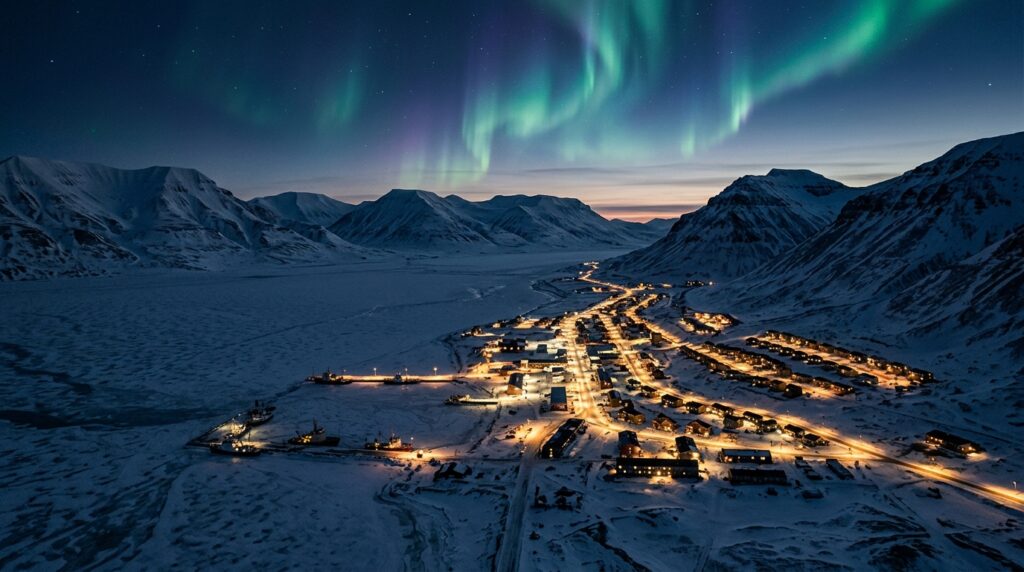
Sun lovers would definitely not enjoy the Norwegian town of Longyearbyen
There is a place on our planet where the sun doesn’t appear above the horizon for several months in a row. Not because of clouds or smog — the Sun simply doesn’t physically rise above the horizon line. Yet people live there, work, go shopping, and raise children. What does their day look like, and how does the body cope with such darkness? After all, sunlight is extremely important for humans because our productivity depends on it!
The City with the Longest Polar Night
The most well-known settlement with such an extreme light regime is Longyearbyen on the Svalbard archipelago. You might think it’s just a tiny polar research station, but it’s not. It’s a fully-fledged town with a population of about 2,500 people, administratively belonging to Norway. It’s located far beyond the Arctic Circle, in the middle of the Arctic, with only about a thousand kilometers remaining to the North Pole.
Longyearbyen sits at approximately the 78th parallel north. For comparison, the conventional Arctic boundary runs along the 66.5th parallel. It is precisely because of this extreme location that the polar night here lasts an incredibly long time. The sun completely hides below the horizon from late October to mid-February.
Why Polar Cities Have a Long Polar Night
The main reason for this natural phenomenon lies in the tilt of Earth’s axis. Our planet orbits the Sun not upright but at an angle of approximately 23.5 degrees. Because of this, the Northern and Southern hemispheres take turns receiving more or less sunlight, which creates Earth’s seasons.
In winter, the Northern Hemisphere tilts significantly away from the star. If you imagine a desk lamp as the Sun and a tilted globe, the top of the Earth will constantly remain in shadow as it rotates. A regular daily rotation of the planet simply isn’t enough for the sun to rise in polar regions. The star continues its movement but does so hidden, passing deep below the horizon.
Is the Polar Night Pitch Black
Many people think that the polar night means absolute blackness 24 hours a day, but reality looks different. In early November and closer to February, the sun approaches the horizon closely, creating beautiful blue, pinkish, and violet twilight. There’s a persistent feeling that dawn is about to break, but after a few hours the sky goes completely dark again.
True dense darkness blankets Longyearbyen closer to the December solstice. The situation is saved by white snow, which excellently reflects moonlight and starlight, as well as powerful artificial lighting. The town’s streets are flooded with light from streetlamps, shop windows, and car headlights. And the prolonged darkness also offers a unique opportunity: only here can you observe bright northern lights right in the middle of the day.
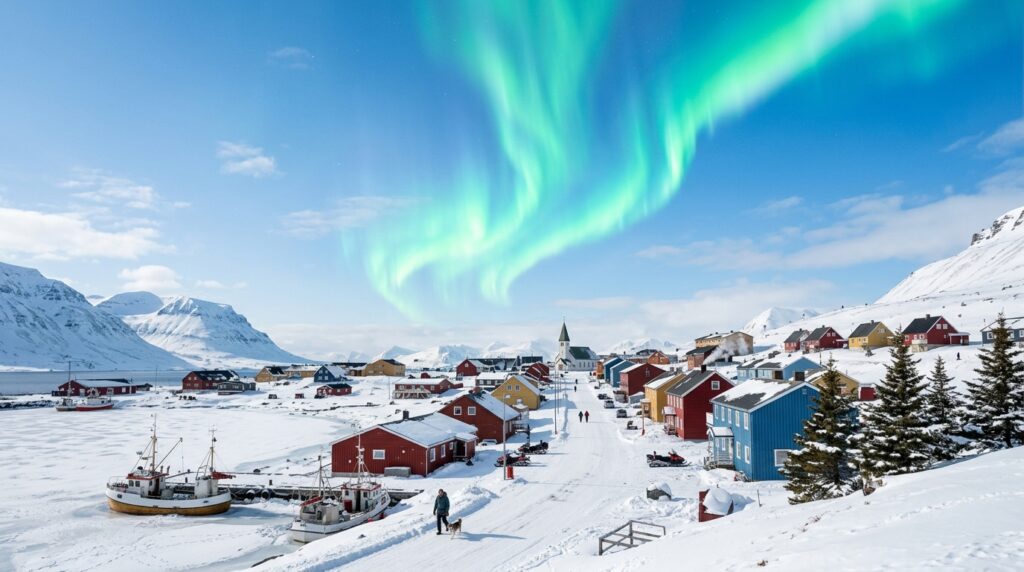
In the middle of winter, the northern lights over Svalbard can be observed even during the day
How Residents of Arctic Cities Live Without Daylight
Longyearbyen boasts quite modern infrastructure. There are kindergartens, schools, a university center, a large library, and even an airport with regular flights. People get around by car and snowmobile, just doing so in twilight or by headlight. However, constant darkness affects the body, as the absence of morning light severely disrupts our internal biological clocks.
Due to the lack of sunlight, residents of the Far North often face the following problems:
- constant drowsiness and chronic fatigue;
- serious sleep schedule disruptions and insomnia;
- noticeable mood deterioration and reduced concentration;
- loss of time perception, when day and night merge into one.
To prevent the brain from getting confused about time, Norwegian doctors recommend maintaining a strict daily routine. Local residents try to wake up and go to bed at the same hours, brightly illuminate their rooms in the morning, and make sure to maintain high physical activity.
Life After the Polar Night
The situation begins to change dramatically in mid-February, when the edge of the solar disk finally appears above the horizon. At first, the sun peeks out for just a few minutes, but in spring the daylight hours begin to increase rapidly.
Starting around April, the polar night gives way to the polar day. The Sun stops setting below the horizon until the end of August, moving in a circle overhead even in the dead of night.
Such climatic phenomena are also well known to residents of Russia. The populations of Murmansk, Norilsk, and Pevek also know what life without sunlight is like, but there the dark period lasts significantly less. For example, in Pevek on the Chukchi Peninsula, the night lasts about 50 days. That is precisely why Norway’s Longyearbyen, with its record three and a half months of darkness, remains the most famous city that has conquered the polar night.
As you may have gathered, the human body is remarkably flexible and can adapt to very harsh conditions. And the town of Longyearbyen proves that with the right approach to health and daily life, people can lead a full life even in the darkest and most extreme corners of our planet.