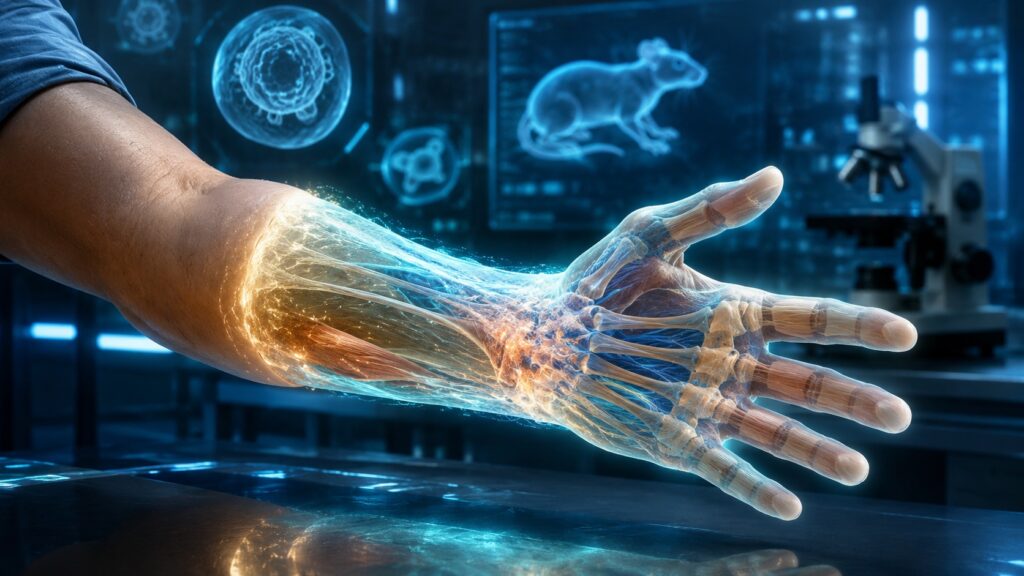
Scientists believe that humans can regrow limbs — they just need to learn how to trigger the process
We are accustomed to thinking that losing an arm or a leg is irreversible. That our body, unlike lizards and starfish, cannot regrow what was lost, and that amputation puts an end to any hope of restoring a limb. But what if that’s not the case? A recent study by American scientists showed that mammals, including humans, have a hidden regeneration mode that we simply don’t know how to activate. Scientists found a way to awaken this mechanism, and it seems the limits of our body’s capabilities are far broader than we thought.
Why Humans Lack Limb Regeneration
When a salamander or starfish loses a body part, a blastema forms at the wound site — a special cluster of cells from which a new limb gradually grows. In humans and other mammals, evolution took the path of speed and safety, sacrificing the ability to regenerate.
Any serious tissue damage triggers an emergency defense protocol. Platelets are released into the blood, white blood cells clear dead cells from the wound, and then fibroblasts arrive at the site. These specialized cells rapidly close the gap, pulling it together with tough strands of collagen and fibronectin.
As a result, the body quickly scars the tissue to avoid deadly infections. Because of this, cells lose their flexibility and miss the opportunity to form a regenerative blastema. Essentially, the body applies a rough but reliable patch instead of regrowing the limb.
How Scientists Triggered Regeneration in Mice
A team of biologists led by Ken Muneoka set out to determine whether fibroblasts already present at the injury site could change their role. The scientists hypothesized that if cells are given the right chemical signals, they would abandon scar formation and switch to building mode. The results of the study were reported by the authors at Refractor.
The experiment on mice with amputated digits consisted of several key stages:
- A protein stimulating cell division (FGF2) was applied to the closed stump;
- Under the influence of the protein, tissues formed a full-fledged blastema, proving that the regeneration process is not permanently blocked;
- Then a microscopic bead containing bone morphogenetic protein 2 (BMP2) was placed in the wound;
- This addition caused cells to grow new bone fragments and tendons.
This proves that with the right biochemical intervention, existing mammalian cells are capable of behaving just like those of regenerating amphibians.
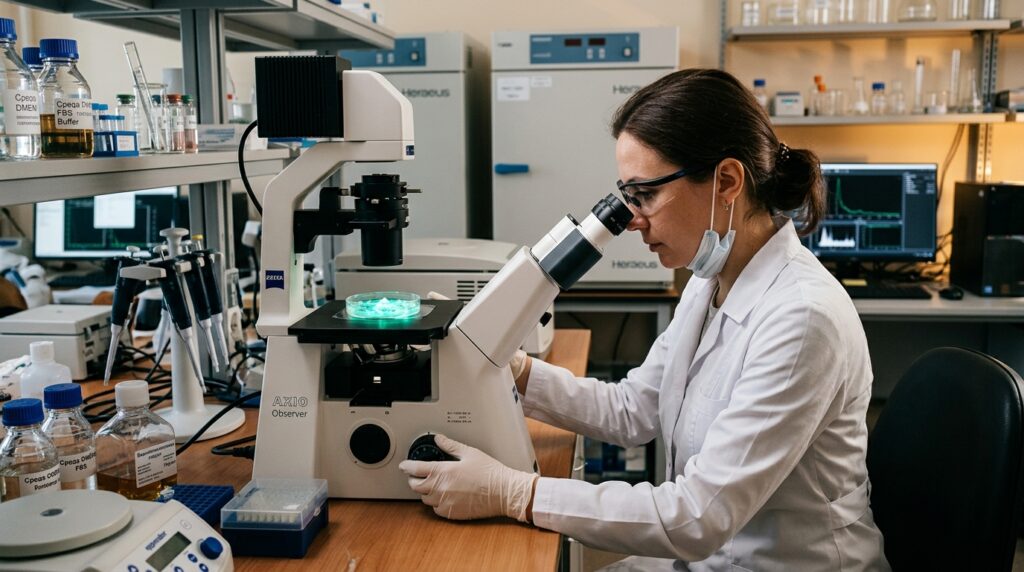
Scientists stimulated mouse tissues with special proteins to trigger the growth of structural elements
Will Doctors Be Able to Regrow Human Arms and Legs
Despite the impressive results, achieving a perfect new digit in mice has not yet been possible. The newly formed structures could not independently cover themselves with new skin, and their shape was far from the original. Assembling a fully functional organ from new bones, ligaments, and blood vessels requires incredibly complex growth coordination.
The question of whether a human can fully restore parts of their body still remains open. Growing new arms or legs is still an unattainable goal for modern science. The current results are merely a basic demonstration that the physiological mechanism exists.
Nevertheless, the discovery has enormous practical significance for surgery. According to the researchers, if doctors learn to even slightly shift the cellular balance from scarring toward regeneration, it would radically improve the healing of severe injuries. Doctors could minimize the formation of rough scars on internal organs and restore joint mobility to patients after serious injuries.
Now it has become clear that the biological tools for regeneration are already built into our bodies, and all that is needed is to find the precise chemical signal to use them. Further research will help determine exactly how fibroblast behavior in human wounds can be safely controlled.