Scientists have four theories about what lies at the edge of the Universe
Many people imagine the edge of the Universe as a giant wall, a dark void, or a boundary beyond which nothing exists. Some think that space itself ends there or that it contains an entrance to another reality. In reality, all these versions are far from the truth. What lies beyond the limits of visibility is structured entirely differently, and it is far more fascinating than any fantasy. Let’s figure out what exactly is out there and why we cannot see it.
What Is the Observable Universe
When we talk about the boundaries of the cosmos, we need to strictly distinguish between two concepts: the observable part and the Universe as a whole. The first is an enormous but finite bubble around Earth. The second may have no boundaries at all.
Imagine standing at night in thick fog, shining a powerful flashlight. You see a clear illuminated circle with a radius of a couple dozen meters. But you know for certain that beyond the edge of that illuminated circle, the forest, road, or field continues. Your flashlight simply isn’t powerful enough to penetrate the fog any further.
The horizon of the observable Universe works exactly the same way. The role of fog here is played by the finite speed of light and the age of the cosmos itself. We are limited by a physical barrier, and we can only see those objects whose radiation has managed to reach us over 13.8 billion years.
What Is the Size of the Universe
If the Universe is about 13.8 billion years old, it seems logical that we can see objects at a maximum distance of 13.8 billion light-years. But astronomers estimate the observable radius of the Universe at approximately 46.5 billion light-years, and the total diameter of the visible region at 93 billion light-years. This is stated in the Encyclopaedia Britannica.
How is this possible? The thing is, space itself has not been standing still. While photons were traveling to our telescopes, the Universe was continuously expanding. Imagine an ant crawling toward you along a stretching rubber band. While it walks, the point from which it started keeps moving farther and farther away.
Therefore, although ancient light traveled for nearly 14 billion years, the objects that emitted it are now at an enormous distance from us.
What Is Cosmic Microwave Background Radiation
If we point our telescopes at any spot in the sky and look at the maximum accessible distance, we won’t hit a physical wall. We will see the ancient cosmic microwave background radiation.
In the first hundreds of thousands of years after the beginning of its existence, the cosmos was filled with scorching, opaque plasma. Light literally got stuck in it, colliding with particles. Only when space expanded and cooled were photons able to break free.
Cosmic microwave background radiation is ancient electromagnetic radiation that uniformly fills the Universe and has survived to the present day.
It turns out that peering into the depths of the cosmos, we are looking far back in time, observing an era when the cosmos was very young. It’s like looking at baby photos of an adult. You look at the picture and understand that you’re seeing the past, not the boundary of the cosmos.
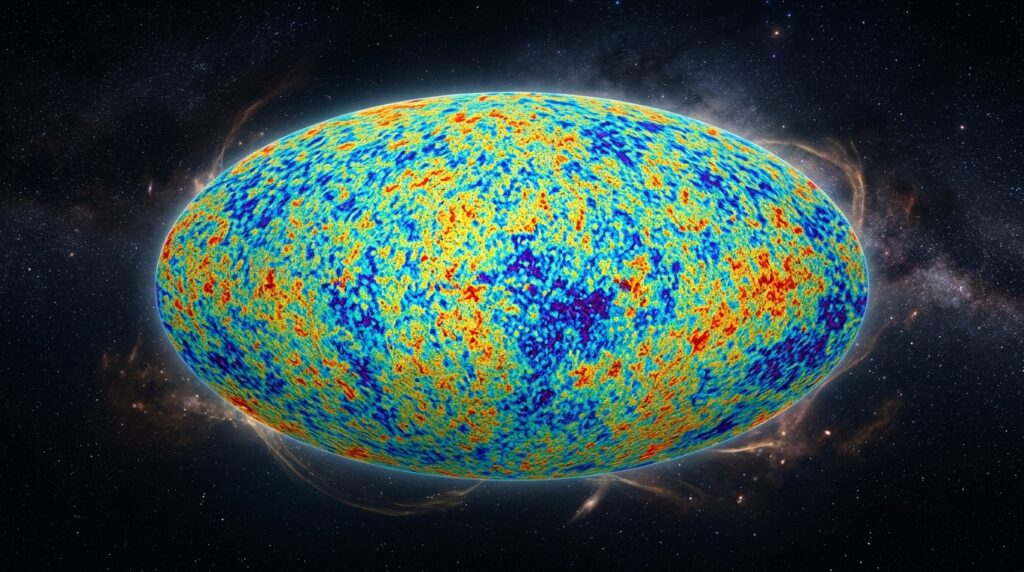
Cosmic microwave background radiation shows us what space looked like at the very beginning of its development
What Lies at the Edge of the Universe
Since we cannot receive light or radio signals from there, science relies on mathematical models. When we wonder whether there is anything beyond the limits of the observable part of our reality, physicists offer several possibilities:
- A continuation of familiar cosmos. This is the most logical and probable answer. Since the observable part of the Universe looks uniform and identical in all directions, most likely beyond the horizon there are exactly the same galaxies, star clusters, and dark matter;
- Infinite space. If the cosmos has no limits, then our visible bubble is just a tiny patch. An observer in a distant galaxy would have their own sphere of visibility, which might not overlap with ours at all. Earth is not the center of the Universe; it is merely the center of our personal field of view;
- A closed sphere without an edge. Space may be finite in volume but have no physical boundary. It’s similar to the surface of the Earth: if you walk strictly straight, you will never fall off the edge but will simply return to the starting point. But if such curvature exists, the scale of the Universe exceeds our zone of visibility many times over, so to us it appears absolutely flat;
- Multiverse. Some computer models allow for the possibility that our region is just one of many bubbles. Beyond unimaginable distances, other Universes with entirely different physical properties may begin, but for now this remains merely a bold theoretical hypothesis.
Why We Can’t Simply Wait for New Light
A reasonable question arises: if light continues to fly toward Earth every second, does that mean the boundary of our observations will constantly grow, and one day we’ll see everything? Only partially.
We have a serious problem in the form of dark energy. Due to its influence, the expansion of the Universe is constantly accelerating, and galaxies are flying apart from each other ever faster. This does not violate the laws of physics, since it is space itself between objects that is expanding, not galaxies flying faster than light.
Because of this acceleration, the most distant regions of the cosmos are receding from us at such an enormous speed that light being emitted there right now will never be able to catch up to Earth. The cosmic horizon cuts us off from information that could come from the future.
In the end, the edge of the observable Universe is not a boundary of reality but merely the limit of our physical capabilities. Beyond it there is no void or concrete wall. There, the magnificent and possibly infinite cosmos continues. Understanding this fact is sobering — we sit inside our informational bubble and try to decipher the structure of an ocean from just a single drop — but thanks to science, even this drop allows us to draw incredibly precise conclusions about the scale of our world.