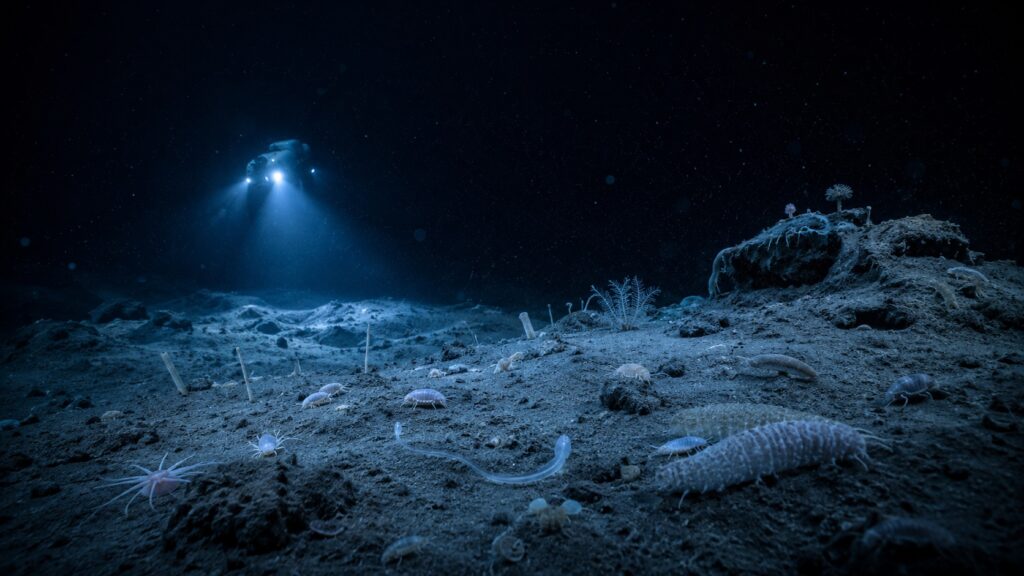
There are no ancient monsters at the bottom of the Mariana Trench, but there are many other creatures
At the bottom of the Mariana Trench, you won’t encounter giant megalodons, bubbling lava rivers, or portals to other worlds. Instead, something far more interesting is hidden there: a cold, dark plain of soft silt where, under a pressure of a thousand atmospheres, unique life thrives. Descending 11 kilometers reveals a world that looks more like a lifeless alien landscape, but in reality it is full of creatures perfectly adapted to extreme conditions.
Where Is the Mariana Trench Located and How Deep Is It
When we talk about the bottom of the Mariana Trench, researchers usually mean the Challenger Deep. Without any exaggeration, it can be said that this is the deepest point of the ocean. According to estimates from the U.S. National Oceanic and Atmospheric Administration (NOAA), the depth there is approximately 10,994 meters.
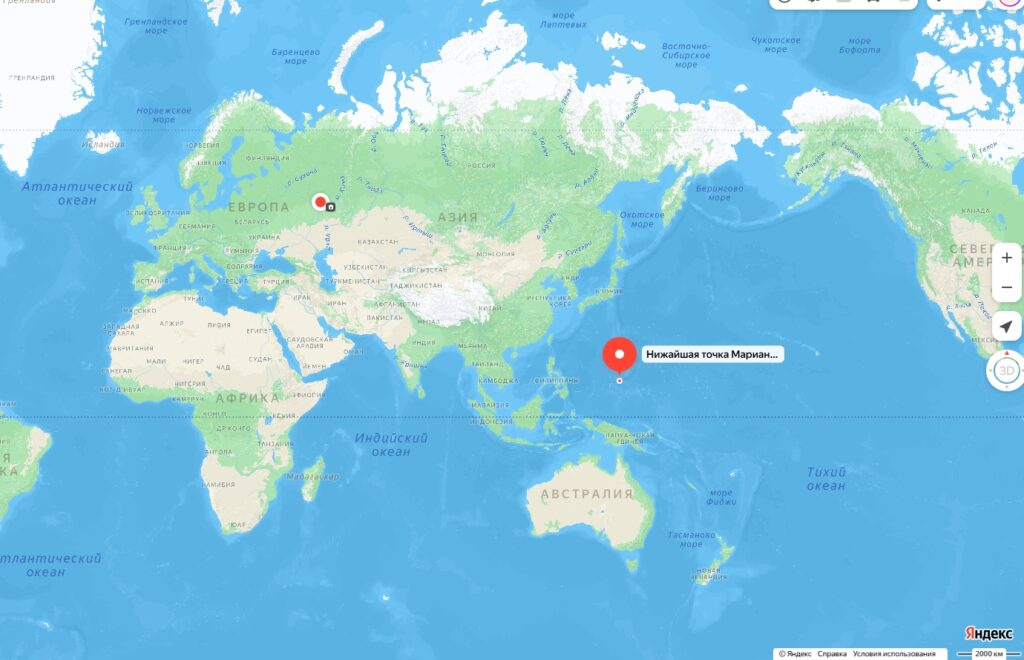
The Mariana Trench on Yandex Maps
However, the Five Deeps expedition in 2019 completed a manned dive to a depth of 10,925 meters. This range in figures is completely normal. Measuring the exact relief at a depth of nearly 11 kilometers is incredibly difficult due to the colossal pressure, temperature variations in the water column, and inevitable inaccuracies of acoustic instruments.
What the Bottom of the Mariana Trench Looks Like
In movies, the deepest places of the ocean are often depicted as gloomy rocks with deep crevices. But in reality, the bottom in the Challenger Deep area is a soft, flat, and dusty surface. Director James Cameron, who made a solo dive in 2012, compared the local sediment to the finest baby powder.
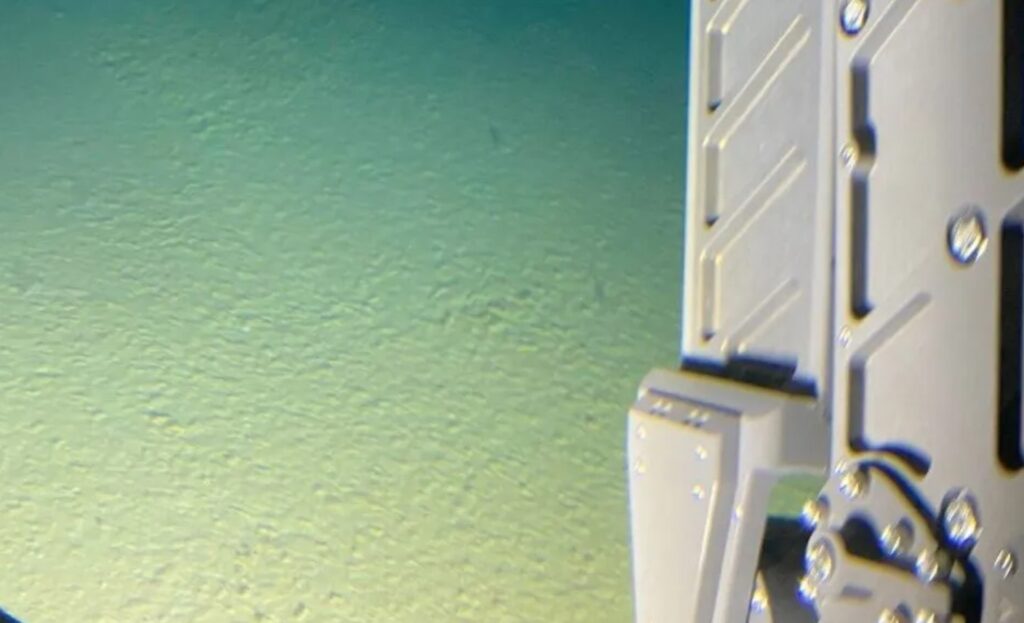
The smooth bottom of the Mariana Trench
This is not ordinary beach sand, but deep-sea silt. It consists of mineral dust, remains of microscopic creatures, and organic matter. The Mariana Trench is located in a subduction zone, where one tectonic plate slides beneath another, so frequent earthquakes stir up the sediment. Later, this dust slowly settles again, like fresh snow, smoothing out irregularities and erasing the tracks of crawling animals.
What Happens at a Depth of 11 Kilometers
Sunlight is physically unable to penetrate through such a column of water, so eternal absolute darkness reigns at the bottom of the Mariana Trench. The temperature stays just a few degrees above zero.
But the main challenge for all living things is water pressure. At the bottom of the trench, it reaches about eight tons per square inch, which is roughly a thousand times greater than normal pressure at the Earth’s surface. For a human without a protective submersible, this is an instantly lethal environment, but evolution has created organisms for which such conditions are the only comfortable ones.
Who Lives at the Bottom of the Mariana Trench
At the very bottom, large active fish are completely absent. Biologists have established that below the 8,400-meter mark, fish survival becomes impossible due to severe limitations — their proteins simply stop functioning properly. At the same time, at somewhat shallower depths, many deep-sea fish of the Mariana Trench look alike due to similar mechanisms of adaptation to the extreme cold environment.
However, at a depth of 11 kilometers, cameras capture amphipods (crustaceans resembling shrimp), holothurians (sea cucumbers), transparent worms, and xenophyophores. The latter are remarkable single-celled organisms that grow to the size of a tea saucer.
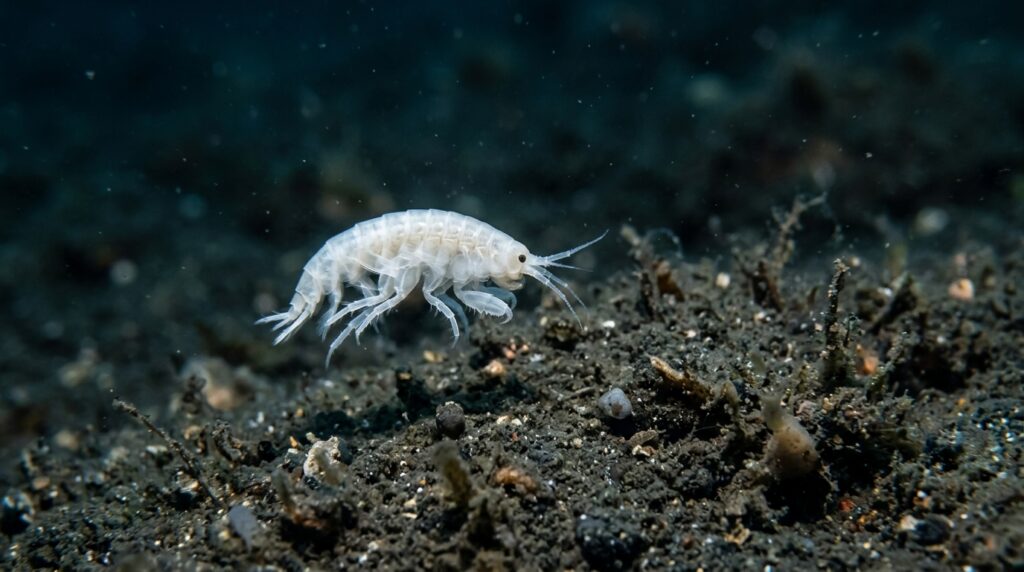
Deep-sea amphipods are among the most frequent visitors to the bottom of the Mariana Trench
What Microbes Live at the Bottom of the Ocean
The true masters of the Challenger Deep are nearly invisible. Studies of bottom sediments show that diverse colonies of unique microbes thrive in the silt. Many of their genetic lineages turned out to be completely new to science.
The bottom of the Mariana Trench is best described as a slowly operating microbial factory. These bacteria process carbon, participate in the nitrogen cycle, and even in the arsenic cycle. They literally break down everything that accumulates on the bottom into basic chemical components.
Where Does Food Come From at the Bottom of the Ocean
Since there is no sunlight, there are no photosynthesizing algae. Almost the entire nutritional base comes here from above. From the upper layers of the ocean, microscopic flakes of dead plankton, waste products, and bits of organic slime constantly fall downward.
The deeper you go, the less food reaches the bottom, as it gets consumed along the way. But the steep slopes of the Mariana Trench work like a giant funnel trap. Organic material rolls down the walls and accumulates at the very bottom, providing a modest but stable ration for local inhabitants.
Volcanoes, Lava, and Hot Springs Deep Underwater
The Mariana system is a zone of high geological activity. However, the Challenger Deep itself is not an open cauldron of boiling magma, as artists sometimes depict.
At the same time, in other sections of the trench, scientists find hydrothermal vents and signs of serpentinization. During this process, reactions between rocks and water occur. As a result, hydrogen and methane are released, which become food for bacteria, allowing them to survive without relying on organic matter falling from above.
Trash at the Bottom of the Mariana Trench
The saddest fact about the Mariana Trench is that trash reached it before mass research expeditions did. In 2019, explorer Victor Vescovo during his dive discovered a plastic bag and candy wrappers on the bottom.
But visible plastic is just the tip of the problem. In the bodies of deep-sea amphipods, biologists find persistent chemical pollutants such as polychlorinated biphenyls (PCBs). These toxic substances persist in the environment for decades and accumulate in the food chain even in the most isolated places on our planet.
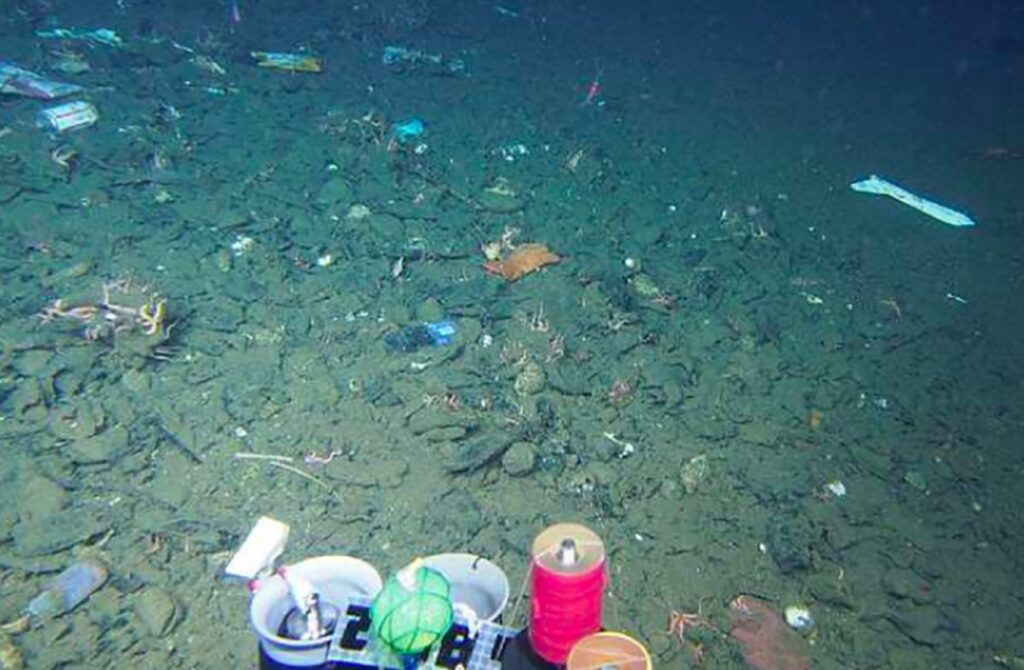
Trash at the bottom of the Mariana Trench. Image source: orbitinside.com
What Is Definitely Not at the Deepest Point on Earth
Numerous dives have definitively debunked myths about ancient monsters. The real picture of the Mariana Trench floor lacks fantastic grandeur, but that doesn’t make it any less astonishing.
Instead of sunken cities and megalodons, scientists find there:
- the thinnest layer of deep-sea silt;
- bacteria that feed on sulfur and arsenic;
- tiny crustaceans and translucent sea cucumbers;
- microplastic particles and chemicals.
Life in the Challenger Deep exists not in spite of extreme conditions, but precisely because it has adapted over millions of years to the colossal pressure and total darkness. By studying the microbes of the Mariana Trench, scientists gain clues about how life could survive on other objects in the Solar System.