Some people demonize microwaves, and often do so for no reason
Some people still believe that microwaves destroy vitamins, break apart molecules, and make food carcinogenic. This myth has been circulating from one social network to another for over a decade. In reality, a properly functioning microwave oven does not make food radioactive or turn it into poison. But the real danger of microwaves does exist, and it has nothing to do with radiation. What exactly can harm your health, and how can you avoid it?
How a Microwave Heats Food from the Inside
To understand why food in a microwave doesn’t get ruined, you need to look inside the device. The heart of any microwave oven is the magnetron, which generates electromagnetic waves at super-high frequencies, usually around 2450 MHz.
These waves act like an invisible magnet that constantly switches its polarity. Polar molecules — primarily water molecules inside the food — try to keep up with these changes and begin to rotate very rapidly. Molecular friction occurs, and the energy of the electromagnetic field is converted into heat. It’s not the air in the chamber or the plate that heats up, but the liquid inside the product itself.
The popular horror story that radiation tears apart water molecules, violating the laws of nature, is completely wrong. Water does not break down into hydrogen and oxygen.
Heating food in a microwave works quite simply:
- Microwaves penetrate the outer layers of the product to a depth of several centimeters;
- Their energy is absorbed by water and dissolved salts;
- The outer areas heat up quickly;
- Heat naturally spreads deeper into the dish.
The Difference Between Microwaves and Radiation
The word “radiation” often scares people because it is associated with radioactivity. But visible light from a light bulb, the Wi-Fi signal from a router, heat from a radiator, and an X-ray image are all different types of electromagnetic radiation. The difference is only in the amount of energy.
Household microwaves belong to non-ionizing radiation. This means they physically lack the power to knock an electron out of an atom, damage DNA, or make a cutlet radioactive. Ionizing matter is something gamma rays or X-rays can do, but they simply don’t exist in a kitchen appliance. When the microwave timer beeps and the device turns off, the waves disappear instantly. The food doesn’t start emitting radiation, just as a person doesn’t emit radio signals after putting a smartphone in their pocket.
How a Microwave Affects Vitamins and Proteins
People often complain that a microwave changes the structure of food. And that’s absolutely true. However, any thermal processing changes the structure of products.
When you fry an egg in a pan, the transparent egg white denatures and becomes white and firm. When you boil potatoes, their starch absorbs water and becomes soft. In a microwave, exactly the same chemical processes occur — heat is simply delivered in a different way.
As for vitamins, they do indeed break down at high temperatures. Vitamin C, B1, and folic acid are especially vulnerable. But the main enemy of vitamins is not the type of stove, but the cooking time and the amount of water.
When boiling broccoli in a pot for a long time, a huge portion of vitamin C simply leaches into the water, which is then poured down the drain. In a microwave, vegetables cook in just a couple of minutes with almost no water. Thanks to this, the preservation of vitamins in food turns out to be even higher than with traditional long boiling on a stove. Of course, if you dry food at maximum power for half an hour, there won’t be any benefit left — but that applies to any cooking method.
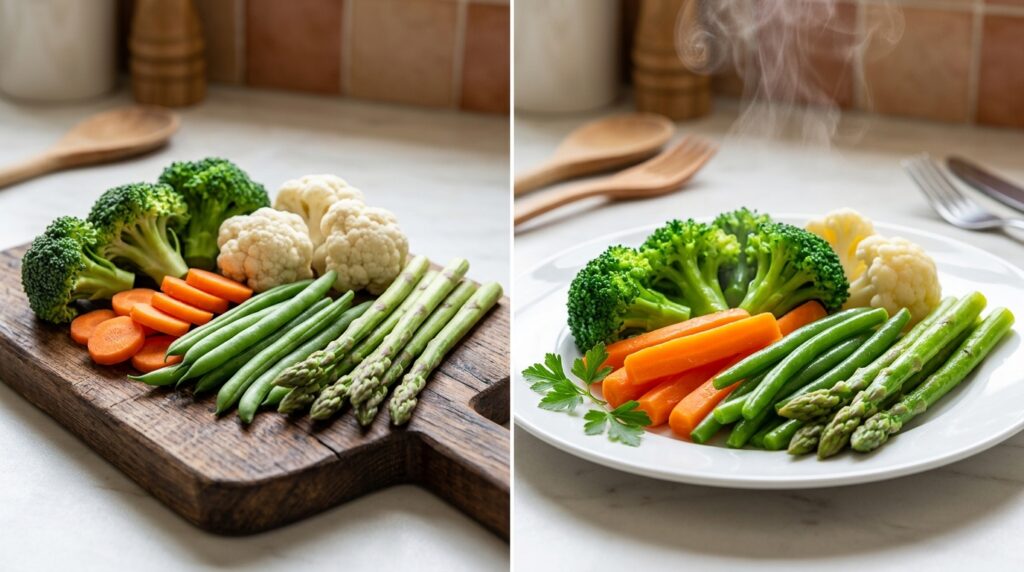
Vegetables from the microwave often retain their bright color and nutritional value
Why Microwave-Safe Dishes Matter
The most real and underestimated danger when reheating food is related to what the food is placed in. Many people habitually put delivery containers, sour cream cups, or cheap disposable dishes into the microwave.
Food-grade plastic comes in different types, and not all of it is designed for high temperatures. When heated — especially if the food is fatty or acidic — plastic components can migrate into the food. This doesn’t mean you’ll get poisoned immediately, but regular consumption of such chemicals is harmful to health.
To avoid problems, follow these basic rules:
- Use only containers labeled as microwave-safe;
- Never heat food in disposable trays from the supermarket;
- The safest choice is heat-resistant glass or regular ceramics without metallic patterns;
Hidden Dangers of Uneven Heating in a Microwave
Because microwaves don’t always distribute evenly inside the chamber, food can heat up in patches. On one side, the soup is boiling; on the other, it remains ice cold. This is not just unpleasant to taste but also poses a risk of stomach upset.
Microwaves themselves don’t kill bacteria. Microbes in food die only from high temperatures. If a cold spot remains inside a large portion, bacteria in that area can easily survive. To avoid this, thick food should always be stirred halfway through the reheating cycle.
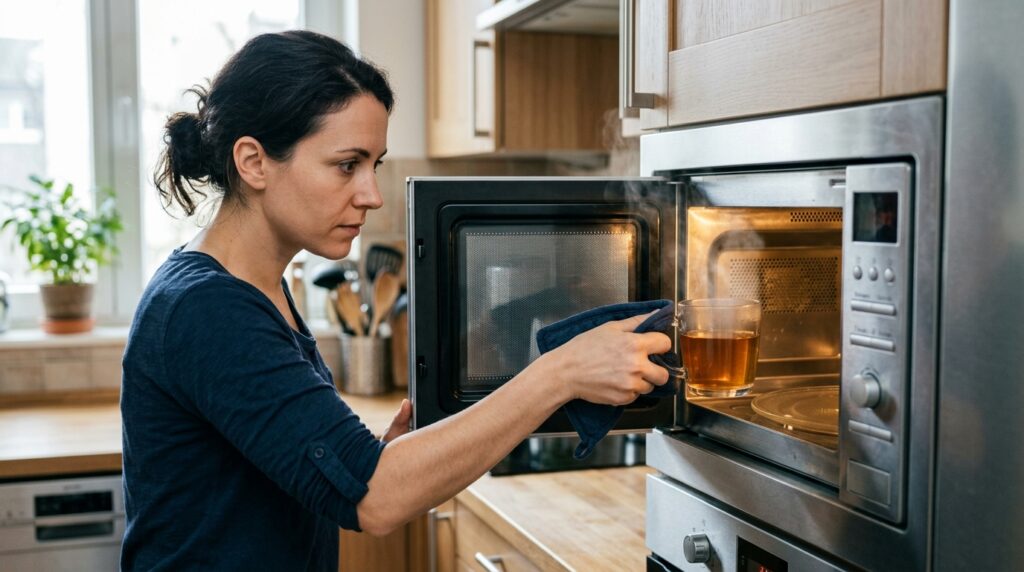
It’s better to heat water in a smooth mug in short intervals
Another non-obvious problem is superheated water. In a microwave, pure water in a smooth glass can heat above 100 degrees Celsius but appear not to boil, because it lacks nucleation sites for bubble formation. As soon as you take the glass out or drop a tea bag into it, the water can explosively burst into boiling spray right in your face.
For the same reason, you should never heat raw eggs in their shell. The moisture inside turns to steam, the pressure has nowhere to go, and the egg explodes all over the kitchen. Products with a tight outer layer, like sausages or potatoes, should always be pierced with a fork.