
Scientists were surprised when they scanned people’s brains as they fell asleep
Every evening we go to bed confident that we’ll fall asleep first and only then start dreaming. But French researchers discovered that the brain works differently before sleep, and dreams can begin before you physically stop being awake. This discovery changes our understanding of the boundary between reality and fantasy.
What Happens to the Brain Before Sleep
Scientists call the transitional state between reality and dreaming hypnagogia. During these brief minutes, a fragment of an ordinary thought can suddenly turn into a vivid image, and a sound from the street can become part of a bizarre storyline. It was previously believed that we start dreaming only after entering deep or REM sleep. New data shows that our mind doesn’t switch off like a light switch. There is an entire gray zone where wakefulness and sleep intertwine in a complex pattern.
As sleep researcher Delphine Oudiette notes, being conscious doesn’t mean thinking rationally. During moments of so-called mind wandering, some parts of our brain can be fully active while others have already drifted into drowsiness. All of this was reported by the authors at ZME Science.
The Falling Bottle Experiment
To catch this elusive boundary between reality and sleep, French neuroscientists invited 103 volunteers who can fall asleep quickly to their laboratory. After filtering out some data, 92 people made it into the final analysis. Participants wore caps with 64 EEG sensors for precise tracking of electrical activity and were seated in a dark, quiet room.
The essence of the experiment was simple:
- The person held a small plastic bottle in their hand;
- As soon as muscles relaxed due to oncoming sleep, the object would fall and wake the volunteer with a sharp noise;
- Immediately after waking, scientists asked what had been going on in the person’s head in the last ten seconds before the drop.
This method is not entirely new. Historians claim that Thomas Edison and Salvador Dalí used a similar trick with metal objects to catch fresh, unconventional ideas at the boundary of sleep and reality. But this time, scientists recorded the electrical rhythms of the brain for the first time at the very moment such images were born, ultimately collecting 375 detailed reports of mental experiences.
Four States Between Sleep and Wakefulness
To avoid subjectivity, the researchers didn’t decide themselves what counts as a dream and what counts as a thought. They fed all collected reports to a machine learning algorithm. The artificial intelligence sorted the responses into four distinct groups.
It turned out that before falling asleep, we can experience completely different scenarios:
- Fleeting fragments: short, fragmented flashes of memory (for example, “I suddenly remembered my father’s face”);
- Connection with reality: focus on the surroundings (“I was listening to cars driving past the window”);
- Bizarre dreams: strange, illogical storylines (“I saw little aliens”);
- Planning: clear rational thoughts (“I was thinking through my list of work tasks for tomorrow”).
The real surprise came when the team compared participants’ words with the EEG medical readings. It would be logical to assume that planning tasks happens during wakefulness and aliens only appear during sleep. But the actual data completely shattered this familiar pattern.
Why Strange Images Appear Before Sleep
Experiment participants described completely wild scenes. For example, one woman distinctly felt ants crawling over her body against a backdrop of giant crossword puzzles, while the instruments registered 100% wakefulness. Conversely, some people were matter-of-factly planning their next day, even though their brain, according to the sensors, was already in a light sleep phase.
To understand the mechanics of this phenomenon, the authors studied how different brain regions communicate with each other. It turned out that waking dreams arise from desynchronization between the frontal lobes, which are responsible for logic and control, and the occipital lobes, which process visual information.
Simply put, our inner “strict boss” momentarily loses focus, and the visual center begins generating random vivid images. In such moments, lucid dreams and strange associations become possible even before consciousness officially shuts down. Logical thinking simply drowns in a whirlpool of vivid sensory experiences.
Why We Think We Didn’t Sleep All Night
This discovery has enormous practical significance for people suffering from paradoxical insomnia. Patients often complain to their doctors that they suffered all night and didn’t close their eyes for a single second. Meanwhile, sensors in the clinic show that the person slept normally for several hours.
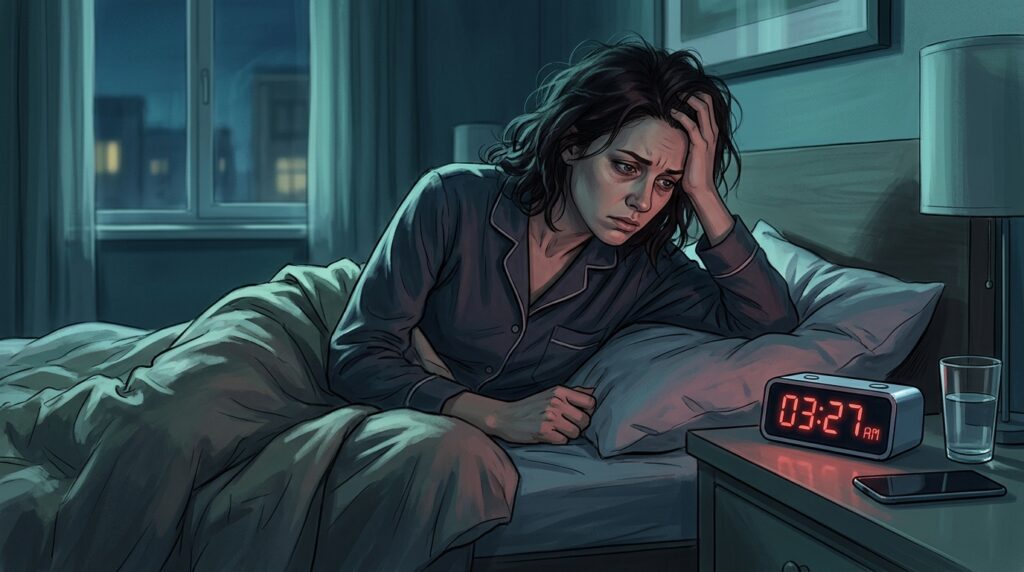
In paradoxical insomnia, instruments register sleep, although the person themselves feels fully awake
Previously, clinicians would shrug or consider patients overly anxious. But now science has a logical explanation. Medical instruments evaluate only general electrical waves, ignoring what is actually happening in consciousness. If the brain has entered a sleep phase but the person’s mind is stuck in a state of intense planning and monitoring reality, subjectively they will feel strong fatigue from a sleepless night.
For now, this is only a preliminary hypothesis, as only healthy people participated in the experiment. But the study clearly shows that dreaming is not a movie that only starts playing after you’ve finally fallen asleep. It can begin long before the closing credits of wakefulness, imperceptibly replacing reality with our fantasies.