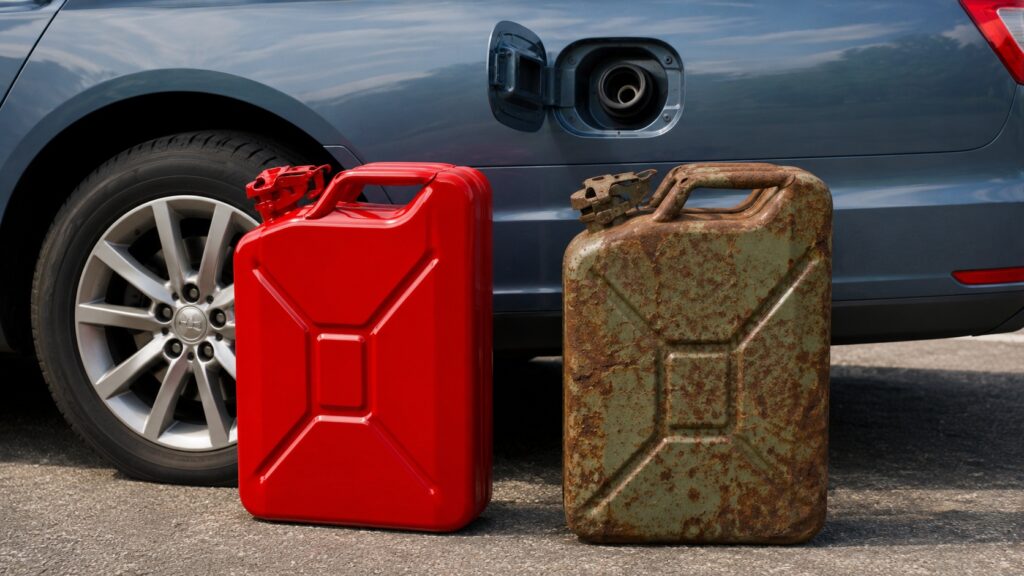
You can mix gasoline from different producers, but only if you know the nuances
There’s still fuel from one gas station in the tank, but only a different chain is nearby? Many drivers are afraid to mix because they believe that additives from different producers may react with each other. Producers, however, claim that all gasolines meet standards and are compatible with each other. Nevertheless, engineers name several conditions when mixing gasoline is better avoided.
How Gasoline from Different Producers Mixes
Gasoline only seems like a uniform liquid with a single parameter — the number 92, 95, or 98 on the pump. In reality, it’s a mixture of numerous hydrocarbons and additives. Its composition is selected at the oil refinery so that the fuel meets requirements for octane rating, volatility, sulfur content, and other characteristics.
That’s why gasoline from different producers doesn’t separate into layers or turn into sediment simply because of different logos at the gas stations. Two batches can be compared to the same drink prepared using slightly different recipes: the composition isn’t completely identical, but the main properties are preserved.
Even if the density of two batches differs slightly, gasoline mixes during refueling and driving. Accelerations, braking, and turns constantly shake the contents of the tank. The octane rating doesn’t determine which gasoline will necessarily end up on top and which on the bottom.
What Happens to Additives from Different Gas Stations
Regular AI-95 and branded fuel with the same octane rating may differ in their additive packages. Producers add cleaning components, anti-corrosion agents, and other permitted substances. It is precisely these additives that often explain the higher price of premium gasoline.
If you top up regular AI-95 with branded AI-95, there’s no need to expect a dangerous reaction between additives. Most likely, only the concentration of the branded package will decrease. The claimed cleaning or protective effect may become weaker because the expensive fuel has been diluted with regular fuel.
Similarly, two premium gasolines of different brands usually don’t start a chemical war inside the tank. The GOST 32513-2023 standard in effect in Russia permits the use of various additives provided that the finished fuel meets established requirements. At the same time, metal-containing additives with iron, manganese, and lead are prohibited.
The gas station brand itself doesn’t determine compatibility. What matters much more is that the fuel is of good quality, corresponds to the declared class, and is suitable for the specific engine.
Mixing AI-92, AI-95, and AI-98
Gasoline with different octane ratings also mixes without forming sediment or causing a sudden chemical reaction. However, the properties of the resulting fuel change. If you combine AI-92 and AI-95, the mixture will have an intermediate detonation resistance — the fuel’s ability to withstand compression without excessively rapid, almost explosive combustion.
You can’t call an equal mixture a guaranteed AI-93.5. The exact octane rating of gasoline is determined during testing because the actual characteristics of batches may slightly differ from the minimum requirements.
If the manufacturer allows AI-92, adding AI-95 usually doesn’t create a problem. If the car requires fuel no lower than AI-95, a significant amount of AI-92 is already undesirable. Particularly sensitive may be:
- turbocharged engines;
- engines with a high compression ratio;
- cars with modified ECU tuning;
- vehicles operating in hot weather or under heavy load.
Modern electronics can detect the onset of detonation and adjust ignition timing. The car may lose some power, accelerate more slowly, and consume more fuel. But you can’t constantly rely on this protection because prolonged severe detonation can damage engine components.
According to Za Rulem, topping up AI-95 with AI-98 or AI-100 is usually fine. The detonation resistance of the mixture will increase, but a power gain is not guaranteed. If the engine is designed for AI-95 and doesn’t utilize the advantages of a higher octane rating, its behavior will barely change.
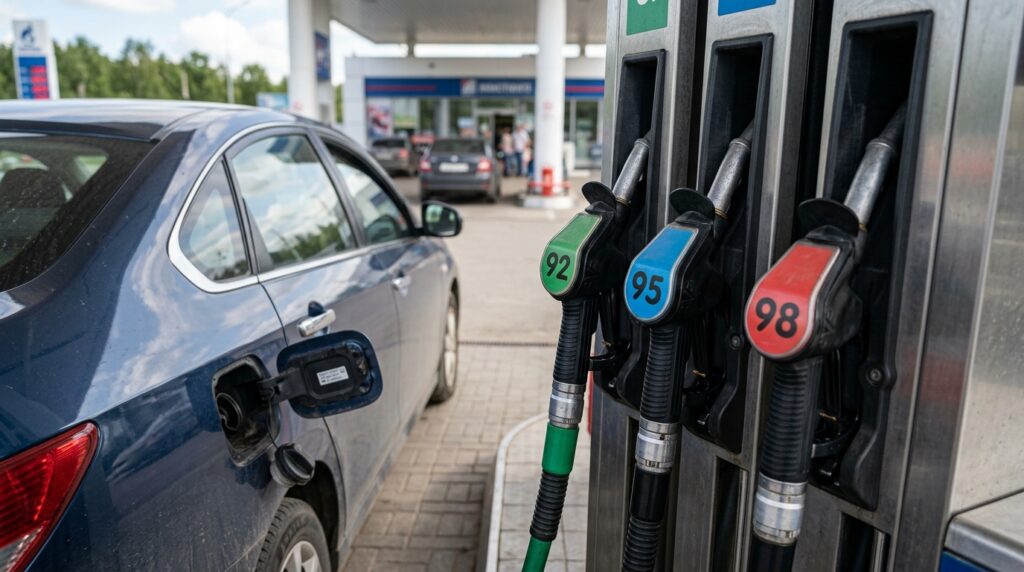
When mixing gasolines, the numbers on the pump and the car’s requirements matter
The Main Danger of Mixing Gasoline
A serious risk arises not when two brands meet, but when one of the gasolines turns out to be bad. Quality fuel can dilute questionable fuel but cannot completely remove water, dirt, or harmful impurities.
Bad gasoline can ruin the entire tank, even if most of the mixture was filled at a trusted gas station. Problems can be caused by:
- water, dirt, or rust from the storage tank;
- an excessive amount of resins;
- prohibited additives;
- octane rating lower than stated;
- elevated sulfur or benzene content.
After a problematic fill-up, the engine may start poorly, idle unevenly, or jerk during acceleration. Other signs include loss of power, metallic pinging under load, unusual smoke, a sharp smell, and a lit Check Engine light.
A single such symptom doesn’t yet prove the gas station is at fault. Similar malfunctions can occur due to spark plugs, coils, injectors, and sensors. But if several signs appeared shortly after visiting a gas station, the fuel quality is worth checking. According to another article by Za Rulem, the main enemy of an engine is fuel of unknown origin.
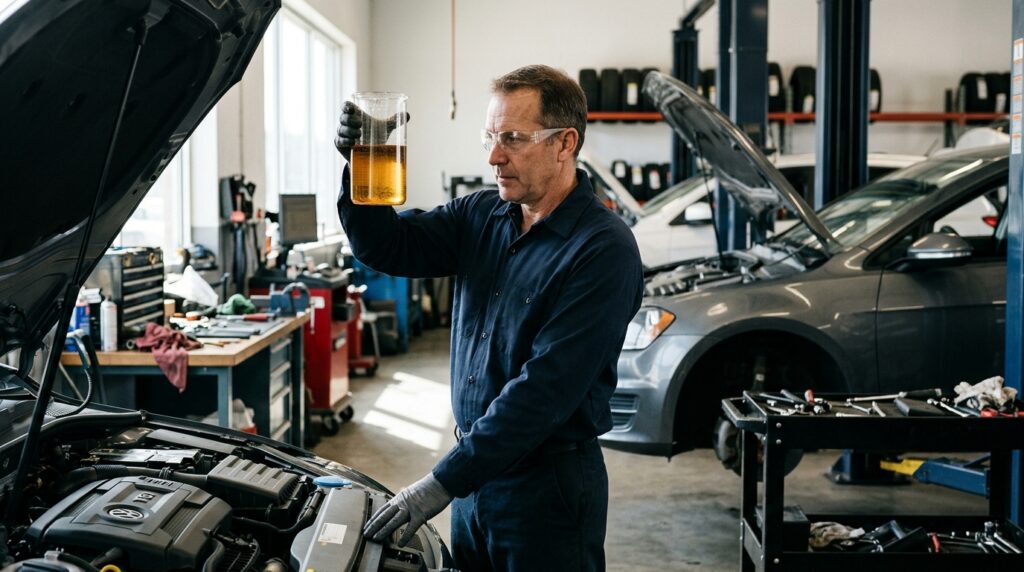
Contaminated fuel can be detected by examining a sample at a service center
What to Do After Mixing Gasoline
If the engine runs smoothly, there’s no need to drain the tank, flush the injectors, or urgently buy an additional additive. You can continue driving, and at the next fill-up, choose the fuel indicated on the fuel door or in the car’s owner’s manual.
If a car that requires AI-95 accidentally received some AI-92, it’s better to avoid high RPMs, hard accelerations, towing a heavy trailer, and other heavy loads until the next fill-up. With a significant amount of AI-92, you can top up with quality AI-98 or AI-100, but this is only a one-time correction, not a way to constantly blend fuel yourself.
If the engine misfires badly, stalls, pings, or the Check Engine light is flashing, the course of action according to Rospotrebnadzor is as follows:
- Stop driving to avoid increasing the risk of damage to the engine or catalytic converter;
- Keep the receipt and note the gas station address, pump number, date, time, fuel grade, and volume;
- Have the car delivered to a service center — in case of serious symptoms, use a tow truck;
- Obtain a written report on the cause of the malfunction and, if necessary, file a claim with the gas station owner.
The main guideline in all of this is the automaker’s requirements, not the name of the gas station chain. Normal AI-95 from one brand mixes perfectly fine with normal AI-95 from another. The real danger is fuel of unknown origin or a mixture whose octane rating turned out to be lower than what the engine requires.