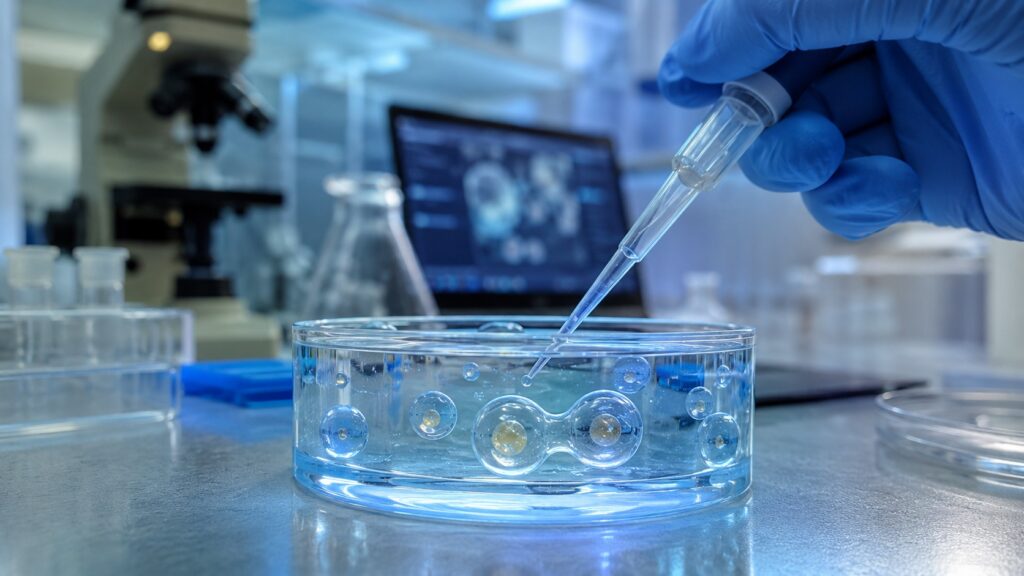
The artificial cell can do a lot, but it’s hard to call it alive just yet
For many years, humanity has been asking the question: at what point does an ordinary set of chemicals turn into a living being? For a long time, biologists could at most modify certain features of existing organisms, but recently American researchers managed to demonstrate what life from scratch looks like under laboratory conditions. Their creation, called SpudCell, is capable of feeding, growing, copying its DNA, and even competing for resources. This artificial cell was created entirely from non-living components.
How the SpudCell Artificial Cell Works
For decades, attempts to create synthetic life came down to modifying already existing organisms. For example, when scientists created a new species of bacteria that digests plastic, they took a living base and edited its genome. The same approach was used in 2010, when researchers first launched a chemically synthesized genome inside a living bacterial shell.
The approach with SpudCell is radically different because it’s a “bottom-up” assembly. The basic artificial cell works like a tiny bubble made of fat molecules. Inside this minuscule sphere float synthetic DNA and a protein production system.
The genome of such a system is extremely small — only about 90,000 base pairs. For comparison, that’s tens of times smaller than an ordinary bacterium, not to mention a human. The genetic instructions are distributed across separate DNA fragments, which makes the design convenient for customization but rather fragile.
How the Artificial Cell Grows and Divides on Its Own
One of the main challenges in bioengineering has always been getting a non-living system to divide. In nature, microorganisms use a complex internal scaffold for this purpose. However, artificial life divides differently — through purely mechanical stress.
For SpudCell to grow, auxiliary feeder cells are added to the nutrient medium. They fuse with the main cell, supplying it with the necessary lipids, enzymes, and building materials.
When the cell accumulates a sufficient quantity of surface proteins, they begin to crowd on the membrane. This creates strong mechanical pressure that literally forces the liposome to split in two, forming a new generation. During experiments, the systems that produced more of these proteins divided more efficiently and ultimately outcompeted their rivals.
Key Differences Between the Artificial Cell and a Real One
Despite the impressive results, the researchers avoid calling their creation truly alive. The laboratory cell critically depends on external assistance and cannot exist outside laboratory conditions.
Here’s why the artificial cell still falls short of a real one:
- It cannot independently create ribosomes — the molecular machines for assembling proteins. These have to be supplied externally;
- The reproduction process is very slow. While E. coli under good conditions divides in half an hour, SpudCell takes about 12 hours;
- The system accumulates genetic errors. During division, daughter cells don’t always receive a complete set of DNA, causing the population to die off completely after several generations;
- The bubble cannot independently clean itself of waste or manage its own metabolism.
Why Scientists Needed Artificial Life from Scratch
It might seem that if natural microorganisms work faster and more reliably, why bother assembling complex systems from reagents? The answer lies in control. Real biological objects are the result of billions of years of evolution and carry an enormous amount of unnecessary genetic baggage.
According to the project’s authors, when you assemble a system yourself, you know the exact composition of every component. All molecules and their concentrations are known. This transforms biology into a precise engineering discipline.
In the future, such fully controlled micro-factories could change the world. The medicine of the future will be able to use similar programmable platforms for targeted drug delivery directly to tumors. They could be used to safely produce new materials, fuel, or food proteins without the fear that the cell might mutate and start behaving unpredictably.
Safety and the Future of Synthetic Cells
Any news about creating organisms in a test tube raises concerns, but biosafety experts remain calm. The current version of the development is absolutely defenseless against the external environment and poses no threat to humans.
The next step for scientists is creating version 2.0. The main goal is to teach the system to independently build ribosomes and better pass on genetic material to offspring.
If this succeeds, science will gain an ideal engineering platform. And although for now this creation is neither ordinary chemistry nor a fully living being, it forces us to look at how the laws of biology work in an entirely new way.