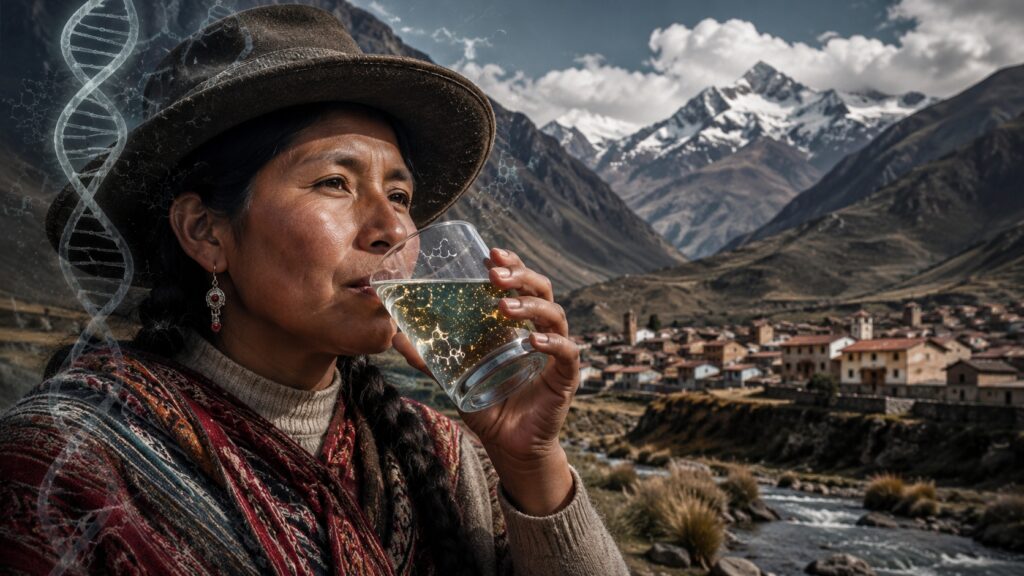
Residents of the Andes can drink water with arsenic, and it doesn’t harm them
For thousands of years, residents of the Argentine Andes have been drinking water that would kill most people due to its high concentration of toxic substances. But researchers discovered they possess a unique genetic ability to safely metabolize arsenic. This discovery became the first proven case of human evolution in response to a toxic environment.
Why the Water in the Andes Is Poisoned with Arsenic
The high-altitude city of San Antonio de los Cobres in Argentina is situated at an elevation of nearly 3,800 meters. Here, volcanic rocks have been leaching natural arsenic into groundwater for centuries. Before modern purification systems were installed in 2012, the arsenic content in drinking water exceeded the World Health Organization’s safe limit by approximately 20 times.
Arsenic is extremely toxic, and its accumulation in the body causes skin lesions, severe cancers, and early mortality. However, people have been living continuously on this dangerous plateau for 7,000 to 11,000 years. How they managed to survive under such harsh conditions is a mystery that has puzzled biologists for decades.
Why Andes Residents Don’t Die from Arsenic
When a toxin enters an ordinary person’s body, special enzymes attempt to break it down. This process can be compared to the operation of a chemical plant, where hazardous waste is sequentially converted into neutral refuse for safe disposal.
The breakdown of arsenic in the body consists of several stages:
- First, enzymes convert arsenic into an intermediate form, monomethylated arsenic, which is the most poisonous;
- Then the body continues its work and converts this type into dimethylated arsenic. This final form of arsenic is the least harmful and is relatively easily eliminated from the body naturally through urine.
As early as 1995, researchers noticed that local women processed the poison in a completely different way. The bodies of Andes residents efficiently skip the dangerous stage, producing a minimum of the toxic intermediate substance and a maximum of the safe final form. The body literally learned to accelerate the removal of the poison, preventing it from accumulating in internal organs.
Mutation for Protection Against Heavy Metals
To understand the cause of this anomaly, a team of evolutionary biologists from Uppsala University in 2015 collected DNA samples from 124 local women. The scientists analyzed millions of genetic markers and compared them with genomes of people from Peru and Colombia.
The key to the mystery was found in the AS3MT gene, which is responsible for producing the enzyme that breaks down arsenic. It turned out that mutations near the AS3MT gene occur significantly more frequently in residents of San Antonio de los Cobres than in their continental neighbors. It is precisely these gene variants that make the enzymes work faster and more safely.
Can Humans Adapt to Chemicals
Usually we observe human adaptation to altitude, oxygen deprivation, or extreme cold. Long-term exposure to heavy metals rarely leads to the emergence of beneficial mutations, and more often an unprepared population simply faces disease.
In this case, people gained a strong evolutionary advantage precisely thanks to thousands of years of living near poisoned water sources. Natural selection favored those whose livers coped better with the poison: they lived longer, got sick less often, and left more healthy offspring.
According to the study’s authors, this data provided the first evidence of adaptation to a toxic chemical in humans. Moreover, recent observations hint that similar genetic shields may have also developed in other Andean peoples sharing similar natural conditions.
We tend to think that human evolution is a thing of the distant past. But the story of the inhabitants of South American mountains proves that our bodies continue to adapt to the most aggressive environmental conditions, literally restructuring their chemical processes at the genetic level.