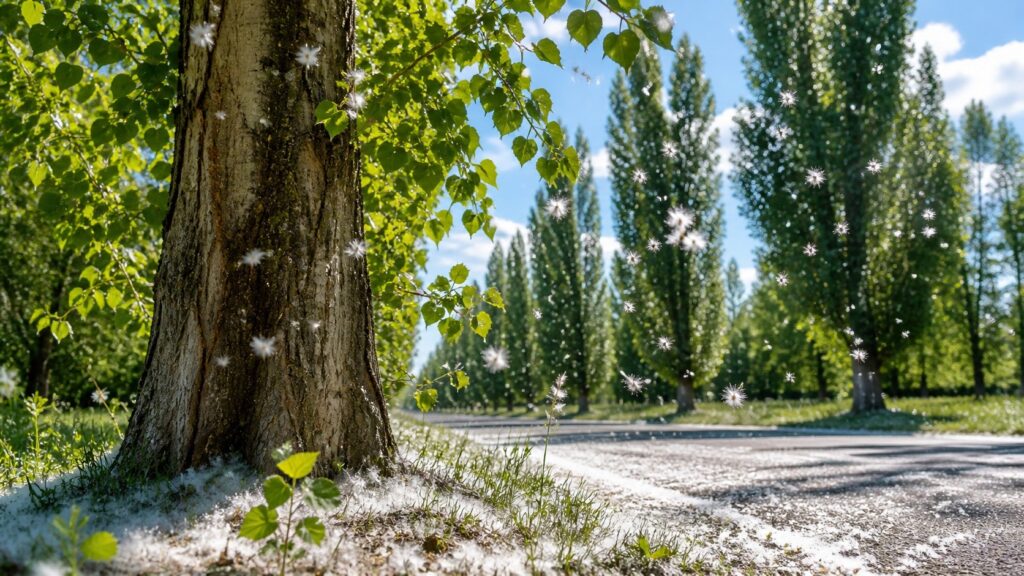
Surprisingly, poplar fluff is not an allergen
Do you also remember how there used to be noticeably more poplar trees in cities? Those tree-lined avenues along the roads, courtyards in the shade, and that summer fluff you couldn’t escape. This was no coincidence — the poplar became the main tree of Soviet urban greening not by accident, but because of its advantages over other trees. But decades later, it turned out that poplars cause allergies, which can sometimes be serious enough to require an ambulance.
Stalin’s Plan for the Transformation of Nature
After World War II, destroyed cities needed to be quickly restored. Poplars began to be used in urban greening starting in 1946 — after the war, it was necessary to restore Moscow’s appearance as quickly as possible and replace lost trees. Scientists proposed the balsam poplar — it was distinguished by rapid growth, a dense crown, ease of propagation, and resistance to urban conditions. The greening program was approved by Stalin, and poplars began their “triumphant march” across the country.
It didn’t stop with cities alone. Lombardy poplars began to be planted en masse along highways. They were planted because they grow well and quickly — nearly two meters per year — and the goal was to get the largest possible trees for beautification and greening.
Why poplars were chosen over birch or spruce
The poplar is a record-holder among trees for oxygen production. A single poplar produces as much oxygen as seven spruces, four aspens, or three lindens. The oxygen released by one mature tree in a day is enough for three people to breathe.
But it’s not just about oxygen. A mature tree collects up to 53 kg of dust per season — a colossal volume for a single plant. From May to September, one poplar absorbs more than 40 kilograms of carbon dioxide, while an oak absorbs 28 kg, a linden — 16 kg, a pine — only 10, and a spruce — just 6 kg.
The poplar also has another important quality — incredible resilience in aggressive urban environments. Poplars can survive the harshest conditions — along busy highways or on industrial grounds. Birch, spruce, or pine couldn’t withstand this: a birch planted directly beside a road would most likely die quickly.
There was also a practical calculation for agriculture. During the growing season, a 15-year-old poplar evaporates 82 m³ of water, making it useful in agroforestry — moisturizing and improving soils along fields.
Why poplars were planted along roads
A separate reason why poplars specifically were planted along highways has to do with the characteristics of their crown. Lombardy poplars have branches that grow upward, pressing close to the trunk. During storms and thunderstorms, broken branches fall downward along the trunk rather than toward the road. This reduced the risk of traffic accidents caused by fallen branches — an important factor on rural highways where vehicle speeds are high.
The pyramidal shape of poplars significantly saves urban space, as the crown grows upward rather than outward. This allowed trees to be planted fairly densely without blocking the roadway.
Along with protection from exhaust fumes and dust, such plantings functioned as a living barrier: the trees provided shade, humidified the air, and served as windbreaks for fields located beyond the roadside.
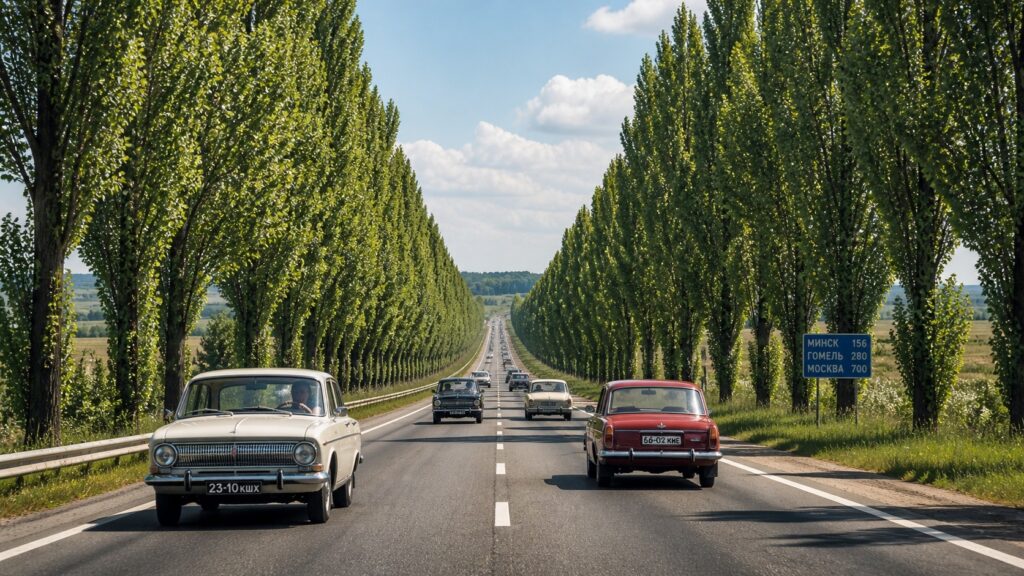
Poplars also provided protection from exhaust gases
Why poplars cause allergies
Every year in early summer, Russian city streets are blanketed by a white blizzard — poplar fluff. It’s commonly believed that the fluff itself causes allergies. But reality is more cunning, and the cause of the allergy isn’t as unique as people think.
Contrary to popular belief, an allergy to poplar fluff does not exist. The seed fibers of the poplar are too large to act as an irritant and trigger an immune system response. However, the fluff works as a perfect carrier.
So what actually makes people sneeze and rub their eyes? Poplar fluff itself is not an allergen — it merely adsorbs pollen allergens (pollen from meadow and cereal grasses) on its surface and helps spread them. In simple terms, the fluff works as an invisible taxi for pollen: poplar fluff is very light in structure and therefore quickly travels long distances, collecting enormous amounts of pollen allergens along the way.
At the same time as poplar fluff appears, many other plants are blooming: wheat, barley, dandelion, timothy grass, nettle, and couch grass. It is their pollen that sticks to the fluff and causes allergic reactions. A person sees white flakes, starts sneezing, and logically blames the fluff. But the real culprit is the invisible pollen traveling on it.
There’s another problem too: poplar fluff clogs car engine and air conditioning radiators, and it’s also a fire hazard — dry fluff ignites easily.
What is being done with poplars today
The problems with poplar fluff were recognized as early as the 2000s, and concrete actions began in the 2010s. Starting in 2014, Moscow authorities began replacing poplars with other trees, including “non-fluffy” poplars. Every year, specialists replace between five and ten thousand such trees.
However, completely cutting down old poplars and replacing them is a gigantic task. Considering that in Tyumen alone there are 500,000–600,000 poplars, the budget can’t handle it, so only dead or leaning trees are removed.
Modern solutions look like this:
- Old “fluffy” poplars are being replaced with non-shedding varieties — for example, the Berlin poplar has proven itself well on Moscow streets;
- Poplars are also being replaced with other trees that don’t produce fluff: ash, elm, and linden;
- Specialists prune poplars older than 40 years whose height exceeds 15 meters — after pruning, the trees don’t produce fluff for about four years;
- Since 2000, some cities have been planting only Lombardy poplars, which don’t produce fluff — these are specially grown in nurseries.
However, there’s a catch: when branches are damaged or trimmed, a poplar can change sex — a male specimen transforms into a female and starts producing fluff. That’s why botanists aren’t confident that fluff won’t appear on the new trees in 35–40 years.
The Soviet idea of greening cities with poplars was brilliant in its own way: a fast-growing, hardy, record-breaking air-purifying tree solved several problems at once in a devastated country. The side effect of fluff wasn’t considered a serious problem — allergology was in its infancy at the time. Today, cities are gradually transitioning to new varieties, but the process takes years. And those very poplars planted under Stalin and Khrushchev are living out their final years in Russian cities, still remaining some of the best natural filters of urban air.